
The $5,000 Text: How to Spot a “Package Delivery” Scam Before You Click.

2,534 words, 13 minutes read time.

The Anatomy of a $5,000 Digital Shakedown

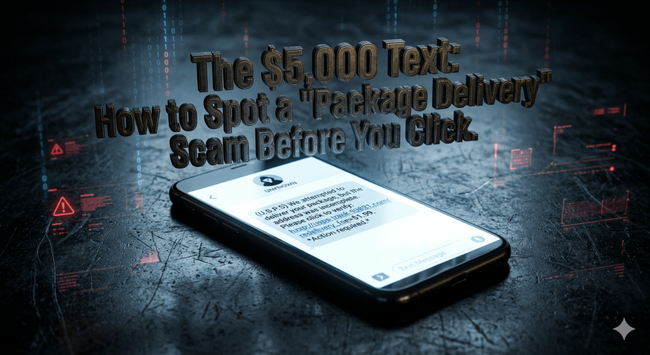
The notification vibrates against your thigh with the same rhythmic insistence as a legitimate update from a tech giant, and in that split second, the trap is set. We live in an era of instant gratification and logistical transparency where the expectation of a cardboard box arriving at our doorstep has become a baseline psychological state. Scammers understand this better than you do, and they have weaponized the supply chain to turn your smartphone into a liability. A “Package Delivery” scam is not some low-effort prank executed by a bored teenager in a basement; it is a high-consequence, precision-engineered social engineering operation designed to exploit the cognitive friction between your digital life and your physical reality. When you receive a text claiming your “shipment is on hold due to an incomplete address,” you aren’t just looking at a message; you are looking at the entry point of a sophisticated redirect chain that aims to liquidate your checking account before the screen even times out.

Analyzing the mechanics of these attacks reveals a terrifyingly efficient conversion funnel that begins with the “Failed Delivery” hook. This specific lure is chosen because it creates immediate, low-level anxiety that demands a resolution, bypassing the logical filters we usually apply to suspicious emails. Unlike a random “you won a lottery” text which triggers immediate skepticism, the package delivery notification feels plausible because, in 2026, everyone is always waiting for something. This sense of urgency is the fuel for the fire, pushing the target to act before they think. The goal is to move the user from the secure environment of their encrypted messaging app to a controlled, malicious web environment where the predator dictates the rules of engagement. By the time you realize the URL looks slightly “off,” the site has already fingerprinting your browser, logged your IP address, and presented you with a pixel-perfect imitation of a major carrier’s tracking portal.

The Velocity of Vulnerability: Why Smishing is More Lethal than Email Phishing

The hard reality that most men fail to grasp until their identity is compromised is that the mobile device is a far more dangerous environment than the desktop. We have been trained for decades to look for red flags in emails—checking the sender’s full address, hovering over links, and noting poor grammar—but that defensive muscle memory disappears when we are holding a five-inch piece of glass. There is a documented “Mobile Trust Gap” where users are statistically much more likely to click a link sent via SMS (smishing) than one sent via email. This is partly due to the intimacy of the medium; text messaging is traditionally reserved for family, friends, and trusted services, leading to a lowered guard. Furthermore, the UI of mobile browsers often hides the very indicators we need to stay safe, such as the full URL path, making it nearly impossible to distinguish a legitimate domain from a “typosquatted” imitation at a glance.

Beyond the psychological comfort of the medium, the sheer velocity of a smishing attack makes it a superior weapon for the modern criminal. In a traditional phishing campaign, an email might sit in a spam folder or be filtered out by enterprise-grade gateways before it ever reaches the human eye. In contrast, an SMS bypasses most traditional security stacks and lands directly in the user’s pocket, often accompanied by a haptic buzz that triggers a compulsive “check” response. Industry data from the Verizon Data Breach Investigations Report suggests that the click-through rate on mobile-based social engineering is significantly higher than its desktop counterparts. This is not because the targets are unintelligent; it is because the environment is optimized for rapid, impulsive interaction. When you are walking through a parking lot or sitting in a meeting, you aren’t performing a forensic analysis of a link—you are trying to clear a notification, and that split-second lapse is all a threat actor needs to initiate a $5,000 drawdown.

Deconstructing the Payload: From a 160-Character Text to a Drained Bank Account

The journey from a simple SMS notification to a catastrophic financial loss is a masterclass in psychological manipulation and technical misdirection. Once a target clicks that “Update Address” or “Pay Redelivery Fee” link, they are rarely sent directly to a data-harvesting form; instead, they are bounced through a series of rapid redirects designed to bypass automated security scanners and “sandboxes” used by mobile OS providers. These intermediate hops serve as a filtering mechanism to ensure the visitor is a live human on a mobile device rather than a security bot trying to index the site for a blacklist. Once the environment is confirmed as “clean” for the attacker, the victim lands on a high-fidelity clone of a USPS, FedEx, or DHL tracking page. This isn’t a low-budget imitation; these sites use stolen CSS and JavaScript directly from the official sources to ensure every button, font, and logo looks authentic. The trap begins with a request for a “nominal” redelivery fee, usually between $1.50 and $3.00, a move calculated to lower your defensive threshold.

The brilliance of asking for a two-dollar fee is that it feels too small to be a “scam” to the uninitiated, yet it is the primary vector for the entire theft. By entering your credit card information to pay this pittance, you aren’t just losing two dollars; you are handing over a full profile of your financial identity. The malicious form is scripted to capture your Name, Address, Phone Number, Card Number, Expiration Date, and—most critically—the CVV code in real-time. In many advanced “Package Delivery” kits, this data is exfiltrated via a Telegram bot or an API call to a Command and Control (C2) server the moment you hit “Submit.” While you are waiting for a fake loading circle to finish “processing” your payment, the attacker is already using your credentials to make high-value purchases or, worse, attempting to add your card to a digital wallet like Apple Pay or Google Pay. This transition from a “shipping issue” to a full-scale takeover of your financial rails happens in seconds, often before you’ve even locked your phone screen.

The Infrastructure of Deceit: Bulletproof Hosting and SMS Gateways

To understand why your phone is being bombarded with these messages, you have to look at the industrial-scale infrastructure supporting the modern cybercriminal. These campaigns are no longer manual; they are powered by “Scam-as-a-Service” platforms available on the dark web for a monthly subscription. A threat actor doesn’t need to know how to code a fake website or manage a database; they simply buy a “kit” that includes the pre-designed landing pages, the redirect logic, and the automated exfiltration scripts. To deliver the “payload”—the initial text message—they utilize SMS gateways and “SIM farms” located in jurisdictions with lax telecommunications oversight. These gateways allow a single attacker to blast out tens of thousands of messages per hour using “spoofed” or rotating sender IDs, making it nearly impossible for carriers to block the source of the attack in real-time. By the time a carrier identifies a malicious number, the attacker has already cycled through five more.

The technical backbone of these operations is further reinforced by the use of “bulletproof” hosting providers—services that explicitly ignore DMCA takedown notices and law enforcement inquiries. These hosts allow the phishing pages to stay online just long enough to harvest a few hundred victims before the domain is burned and the operation moves to a new URL. This “fast-flux” approach to infrastructure means that by the time you report a link as a scam, it has likely already been decommissioned and replaced by another nearly identical site. This cat-and-mouse game is a core component of the business model. The attackers leverage automation to scale their reach while minimizing their operational costs, ensuring that even a 0.1% “success rate” on a million sent texts results in a massive payday. Analyzing the traffic patterns of these gateways reveals a relentless, 24/7 bombardment aimed at the global supply chain, turning the simple act of receiving a package into a high-stakes defensive operation for every smartphone user.

Hardening the Human Firewall: Tactical Indicators of a Delivery Scam

Recognizing a package delivery scam requires more than just a gut feeling; it requires a disciplined, analytical approach to every notification that hits your lock screen. The first and most glaring indicator is the “Urgency Engine,” a psychological trigger designed to make you bypass your logical filters by claiming a package will be “returned to sender” or “destroyed” if action isn’t taken within a few hours. Legitimate logistics giants like UPS or FedEx do not operate with this level of theatrical desperation; they leave door tags or update your tracking portal with a “Delivery Exception” that stays valid for days. Furthermore, you must scrutinize the source of the message with extreme prejudice, looking specifically for “Long Codes”—standard ten-digit phone numbers—rather than the five- or six-digit “Short Codes” typically used by major corporations for automated alerts. If a random 10-digit number from a different area code is texting you about a “package issue,” the probability of it being a malicious actor is effectively 100%.

The second layer of defense involves a forensic look at the URL itself, which is where most men fail the test because they don’t look past the first few characters. Scammers frequently use URL shorteners like Bitly or TinyURL to mask the true destination of the link, or they employ “Typosquatting” where the domain looks nearly identical to the real thing—think “https://www.google.com/search?q=fedx-delivery.com” or “https://www.google.com/search?q=usps-update-parcel.com.” A legitimate tracking link will always be hosted on the primary corporate domain of the carrier, and any deviation from that structure is a definitive red flag that should result in an immediate block and delete. You should also be hyper-aware of the “Redelivery Fee” trap; no major carrier will ever text you out of the blue demanding a credit card payment of two dollars to complete a delivery that has already been shipped. These organizations handle billing through the sender or through established, logged-in customer accounts, never through an unauthenticated SMS link that asks for your CVV code on a whim.

The Technical Counter-Strike: How to Kill the Attack Surface

Stopping these attacks requires moving beyond the passive advice of “don’t click” and adopting a proactive, technical posture that hardens your mobile environment against intrusion. The most effective move you can make is to implement DNS-level filtering on your device, using services like NextDNS or Cloudflare’s 1.1.1.1 (with Warp) to block known malicious domains before your browser even attempts to resolve them. By layering a protective DNS over your cellular and Wi-Fi connections, you create a digital “tripwire” that can automatically kill the redirect chain of a smishing link, rendering the attacker’s payload useless even if you accidentally tap the screen. Additionally, you should dive into your mobile OS settings—whether iOS or Android—and enable “Filter Unknown Senders,” which shunts messages from non-contacts into a separate folder, effectively de-prioritizing the “Urgency Engine” and giving you the mental space to evaluate the message without the pressure of a notification badge.

Furthermore, we need to address the systemic weakness of SMS-based Multi-Factor Authentication (MFA), which is often the ultimate goal of the “Package Delivery” scammer. If a threat actor manages to harvest your PII and card details, their next step is often a “SIM Swap” or an attempt to intercept the one-time password (OTP) sent to your phone to authorize a large transaction. To kill this attack vector, you must migrate every sensitive account—banking, email, and logistics—away from SMS MFA and onto hardware security keys like a YubiKey or, at the very least, an authenticator app like Aegis or Raivo. By removing your phone number as a “trusted” factor for identity verification, you neuter the effectiveness of the entire smishing ecosystem. When your security doesn’t rely on a 160-character plain-text message, the $5,000 text becomes nothing more than a minor annoyance that you can delete with the clinical indifference of a man who has already won the battle.

Conclusion: Vigilance as a Lifestyle

The digital landscape is not a playground; it is a persistent conflict zone where your personal data is the primary currency and your momentary distraction is the enemy’s greatest asset. The “$5,000 Text” is merely a symptom of a much larger, more aggressive shift in how organized crime operates in the twenty-first century. These attackers are betting on your fatigue, your busyness, and your inherent trust in the logistical systems that keep your life running. By deconstructing the “Package Delivery” scam, we see that it relies entirely on a sequence of exploited trust: trust in the SMS medium, trust in the brand of the carrier, and trust in the urgency of the notification. Breaking that chain requires a fundamental shift in your digital posture, moving from a “trust but verify” mindset to a hard “Zero Trust” model where every unsolicited communication is treated as a hostile probe until proven otherwise.

Maintaining this level of defensive depth isn’t about living in fear; it’s about operating with the clinical precision of someone who understands the stakes. You now have the technical blueprint to identify the redirect chains, the infrastructure of deceit, and the tactical indicators that separate a legitimate service alert from a sophisticated financial shakedown. The most powerful tool in your arsenal isn’t a piece of software—it is the disciplined refusal to be hurried into a mistake. When that next “failed delivery” text vibrates in your pocket, you won’t react with the frantic impulse of a victim. You will look at the long-code sender, the obfuscated URL, and the absurd demand for a two-dollar fee, and you will recognize it for exactly what it is: a desperate, automated attempt to breach your perimeter. You delete the message, you block the sender, and you move on with your day, having successfully defended your sovereignty in a world that is constantly trying to subvert it.

Call to Action

Don’t wait for the next buzz in your pocket to start caring about your digital perimeter. The reality is that these threat actors are evolving faster than your mobile carrier’s spam filters, and the only thing standing between your bank account and a total liquidation is your own disciplined response. Take five minutes right now to audit your most sensitive accounts: kill the SMS-based multi-factor authentication, move your security to a dedicated hardware key or an authenticator app, and stop clicking links that you didn’t explicitly go looking for. If you found this breakdown useful, share it with someone who might be one “Package Pending” text away from a financial disaster, and subscribe to stay updated on the latest technical deep dives into the modern threat landscape. Your security is your responsibility—own it.

SUPPORTSUBSCRIBECONTACT ME

D. Bryan King

Sources

Disclaimer:

The views and opinions expressed in this post are solely those of the author. The information provided is based on personal research, experience, and understanding of the subject matter at the time of writing. Readers should consult relevant experts or authorities for specific guidance related to their unique situations.

#automatedPhishing #bankAccountProtection #bulletproofHosting #clickThroughRates #Cloudflare1111 #credentialHarvesting #CVVHarvesting #cyberAttackerInfrastructure #cyberDefense #cybercrimeTactics #cybersecurityForMen #cybersecurityStrategy #deliveryFailureText #digitalIdentityTheft #DigitalPerimeter #DNSFiltering #fakeTrackingLink #FedExPhishing #financialFraud #hardwareSecurityKeys #humanFirewall #identityProtection #maliciousURL #MFASecurity #mobileForensics #mobileOSHardening #mobileSecurity #mobileThreatLandscape #mobileTrustGap #multiFactorAuthentication #NextDNS #onlineSafety #PackageDeliveryScam #parcelScam #phishingIndicators #phishingKits #phishingLink #PIITheft #redeliveryFeeScam #redirectChain #riskMitigation #scamAsAService #shippingFraud #SIMSwapping #smishingAttacks #smishingDefense #smishingProtection #SMSGateways #SMSPhishing #SMSSecurity #socialEngineering #textMessageScam #threatActorTactics #typosquatting #UPSDeliveryScam #urlShorteners #USPSScamText #YubiKey #zeroTrustMobile
The CEO Ransom: How Hackers Target High-Net-Worth Individuals, Not Just Companies.

2,946 words, 16 minutes read time.

The Shift from Corporate Databases to Individual Fortunes: Why the Executive is the New Perimeter

The landscape of modern cyber warfare has shifted its primary focus from the broad, indiscriminate harvesting of corporate data to the surgical, high-stakes targeting of individuals who command significant financial and social capital. While large-scale ransomware attacks against multinational corporations continue to dominate the headlines, a more insidious and sophisticated trend is emerging: the “CEO Ransom.” This evolution in cyber-criminal strategy recognizes that a single high-net-worth individual (HNWI) often possesses a digital attack surface that is significantly less defended than a Fortune 500 network, yet offers a comparable, if not more accessible, financial payout. Analyzing the trajectory of recent breaches reveals that adversaries are no longer content with the “spray and pray” methodology of traditional phishing; instead, they are engaging in what is known as “Big Game Hunting,” where the target is not just a database, but the personal assets, reputation, and decision-making power of an elite executive.

This transition toward the individual as the primary attack vector is driven by the realization that personal digital ecosystems are frequently the “soft underbelly” of corporate security. An executive may operate within a multi-million dollar cybersecurity framework at the office, but their home network, personal mobile devices, and family communications often lack even a fraction of that oversight. Consequently, threat actors are leveraging public data, social engineering, and sophisticated technical exploits to bridge the gap between an individual’s private life and their professional responsibilities. By compromising a personal account or an unsecured home IoT device, an attacker gains a foothold that can lead to direct financial theft, identity takeover, or the leverage required for high-stakes extortion. This methodology bypasses traditional perimeter defenses entirely, moving the frontline of cybersecurity from the server room to the living room.

The Anatomy of a High-Net-Worth Target: Digital Footprints and Lifestyle Vulnerabilities

Mapping the attack surface of a high-net-worth individual requires an understanding of how lifestyle transparency creates digital vulnerability. In an era of constant connectivity, the “life-logging” habits of the elite—whether through public appearances, social media updates, or high-profile philanthropic endeavors—provide a wealth of open-source intelligence (OSINT) for potential adversaries. An attacker can meticulously reconstruct an individual’s daily routine, travel schedule, and professional associations simply by aggregating fragmented data points from public records and social platforms. This data is then utilized to craft highly personalized and convincing social engineering campaigns that are far more effective than generic lures. For example, knowing the specific charitable foundation an executive supports or the boutique investment firm they frequent allows an attacker to masquerade as a trusted entity with terrifying precision.

Furthermore, the vulnerability of family offices and private digital infrastructure presents a unique challenge that traditional IT departments are often ill-equipped to handle. Family offices, which manage the private wealth and personal affairs of HNWIs, frequently operate with lean staffs that may prioritize convenience and “white-glove” service over rigorous security protocols. This creates an environment where sensitive financial documents, travel itineraries, and private communications are stored on systems that lack enterprise-grade monitoring or incident response capabilities. Analyzing the digital footprint of a modern executive reveals an interconnected web of personal and professional nodes, including high-end smart home systems, private jet management portals, and luxury concierge services, all of which represent potential entry points. When these systems are linked via a single, inadequately secured personal email address or a shared password, the entire architecture becomes a house of cards waiting for a single, targeted exploit to bring it down.

Why Legacy Security Models Fail the Modern Executive: The “Castle and Moat” Fallacy

The fundamental failure in modern executive protection lies in the continued reliance on the “Castle and Moat” security philosophy, a model that assumes a clear boundary between a “trusted” internal network and an “untrusted” external world. For the high-net-worth individual, this boundary has not only blurred but has effectively ceased to exist. An executive’s life is characterized by high mobility, involving constant transitions between corporate headquarters, private residences, international hotels, and transit hubs. Each of these environments introduces a different set of variables and potential compromises that a static, office-based firewall cannot address. When an individual relies on the perceived security of a luxury hotel’s Wi-Fi or the convenience of a shared family iPad, they are inadvertently bypassing the millions of dollars invested in corporate-grade endpoint detection and response (EDR) systems. The legacy model fails because it is designed to protect a location, whereas the modern threat landscape is designed to target the person, regardless of their coordinates.

Analyzing the social engineering tactics used in the 2020 Twitter high-profile account breach serves as a stark case study in this systemic failure. In that instance, attackers did not breach a hardened server through a zero-day exploit; instead, they targeted the human element—employees with administrative access—using sophisticated vishing (voice phishing) techniques. For a high-net-worth individual, the “administrative access” to their life is often held by a small circle of assistants, household staff, or family office personnel. These individuals often lack formal security training, making them the ideal bypass for an executive’s personal security. If a threat actor can convince a personal assistant to “verify” a password or click a “shipping notification” link, the most expensive residential security system in the world becomes irrelevant. This highlights the reality that legacy security is too rigid for the fluid nature of an executive’s lifestyle, failing to account for the decentralized and highly social nature of their digital interactions.

Furthermore, the “Castle and Moat” fallacy ignores the proliferation of interconnected devices that form the modern executive’s “Personal Area Network” (PAN). From high-end wearables and biometric health trackers to smart home automation systems that control everything from climate to physical entry points, the number of potential backdoors is staggering. Most of these consumer-grade devices prioritize user experience and aesthetic over cryptographic integrity. They frequently ship with hardcoded credentials, lack a standardized patching mechanism, and communicate over unencrypted protocols. A compromise of a single smart thermostat in a private home can provide the lateral movement necessary for an attacker to reach a laptop used for sensitive business negotiations. In this context, the “moat” is dry, and the “castle” walls are porous, leaving the individual at the center of a fragmented and highly vulnerable ecosystem that requires a complete shift toward a Zero Trust architecture for personal life.

The Weaponization of Information: From Spear-Phishing to Deepfake Extortion

The weaponization of information has evolved from crude, mass-market email scams into a highly refined discipline of digital psychological warfare. For the high-net-worth individual, the threat is no longer a generic “Nigerian Prince” lure but a surgically crafted spear-phishing campaign that leverages specific, verified details about their business dealings, philanthropic interests, or social circle. Attackers engage in weeks or months of “pre-texting,” where they monitor an executive’s public statements and corporate filings to build a narrative so compelling that the target’s natural skepticism is neutralized. This is particularly evident in the rise of Business Email Compromise (BEC) at the personal level. In these scenarios, an attacker might intercept a legitimate conversation between an executive and their wealth manager, eventually injecting a fraudulent wire transfer request that mirrors the tone, formatting, and timing of previous, authentic interactions. Because the request fits the established pattern of the executive’s life, it often bypasses the standard scrutiny applied to corporate transactions.

Beyond traditional text-based deception, we are entering the era of the “Deepfake Extortion” economy, where generative AI is used to create hyper-realistic voice and video clones of trusted individuals. This represents a paradigm shift in the threat landscape. Imagine a scenario where a family office comptroller receives a video call from the CEO, appearing in their usual office setting, requesting an urgent, off-book transfer for a confidential acquisition. The voice is perfect, the mannerisms are identical, and the urgency is palpable. This is not a hypothetical threat; the technology to execute such an attack is currently available and increasingly accessible. For a high-net-worth individual, whose voice and likeness are often widely available in public interviews and media appearances, the data required to train these AI models is plentiful. The ability to fabricate “proof of life” or “proof of authorization” undermines the foundational trust of all digital communication, turning an executive’s own identity into a weapon used against their interests.

The psychological impact of this information weaponization cannot be overstated, as it often extends into the realm of “doxing” and the threat of reputational destruction. Extortionists no longer just lock up files; they exfiltrate sensitive personal data—private photos, legal documents, or confidential health records—and threaten to leak them unless a ransom is paid. For an individual whose career and social standing are built on a specific public image, the threat of a data leak is often more motivating than the threat of data loss. This “double extortion” tactic is particularly effective against high-profile targets because it creates a sense of powerlessness and urgency. The attacker is not just hitting the bank account; they are hitting the target’s legacy. As AI tools continue to lower the barrier for creating convincing fake evidence, the potential for “synthetic extortion”—where the leaked information is entirely fabricated but indistinguishable from the truth—becomes a terrifyingly viable tool for professional cyber-criminals.

Continuing with the deep-dive into the technical and structural vulnerabilities that define the high-net-worth threat landscape.

Technical Root Causes: The Interconnectedness of Personal and Professional Tech

The crisis of executive cybersecurity is rooted in the “collision of worlds,” where the boundary between enterprise-grade security and consumer-grade convenience dissolves. Most high-net-worth individuals operate under a “Shadow IT” umbrella in their personal lives, utilizing applications and hardware that have never been audited by a security professional. This manifests most dangerously in the use of legacy personal email accounts—often established decades ago—as the primary recovery mechanism for high-value financial and professional portals. Because these personal accounts frequently lack the rigorous conditional access policies found in a corporate environment, they become the “master key” for an attacker. Once an adversary gains access to a Gmail or iCloud account, they can systematically reset passwords across the target’s entire digital life, bypassing multi-factor authentication (MFA) by intercepting recovery codes or leveraging the “trusted device” status of a compromised smartphone.

Furthermore, the proliferation of “smart” luxury is a primary technical driver of risk. Modern estates are managed by Integrated Building Management Systems (IBMS) that control everything from biometric wine cellars to surveillance arrays. These systems are often installed by third-party contractors who prioritize functionality over security, frequently leaving remote access ports (such as RDP or VNC) open to the public internet with default or weak credentials. For a sophisticated threat actor, these systems are not just targets; they are pivot points. A vulnerability in a smart lighting controller can allow an attacker to move laterally into the home office network, where they can deploy keyloggers or screen-capture malware on a device used for sensitive board-level communications. This interconnectedness creates a “cascading failure” scenario, where a single weak link in a non-critical system can compromise the integrity of the individual’s most sensitive professional and financial assets.

Credential stuffing and the persistent habit of password reuse remain the most exploited “low-tech” vulnerabilities in the high-net-worth bracket. Despite the availability of password managers, many individuals rely on a handful of complex but reused variations for their most important logins. When a third-party service—such as a niche luxury travel site or a private members’ club database—is breached, those credentials are immediately tested against major banks, email providers, and social media platforms. For an executive, the cost of a credential leak is amplified by the speed at which an attacker can move. In the time it takes for a breach notification to be sent, an automated script can have already drained a brokerage account or locked an executive out of their primary communication channels. This technical negligence is often a byproduct of “security friction,” where the more successful an individual becomes, the less they are willing to tolerate the procedural hurdles required to stay secure, ultimately trading long-term safety for short-term convenience.

Actionable Fixes: Building a Personal Security Operations Center (PSOC)

Defending a high-net-worth individual requires moving beyond “best practices” and toward the implementation of a Personal Security Operations Center (PSOC) framework. The first and most non-negotiable step in this process is the elimination of “soft” MFA. Standard SMS-based or push-notification authentication is no longer sufficient for high-value targets, as it is susceptible to SIM swapping and MFA fatigue attacks. A robust PSOC mandate requires the transition to hardware-based security keys, such as Yubico or Google Titan, for all critical accounts. By requiring a physical token that must be present to authorize a login, the individual effectively nullifies the threat of remote credential theft. This physical “handshake” introduces a layer of friction that is proportional to the value of the assets being protected, ensuring that even if an attacker possesses a password, they lack the physical “key” to the vault.

In addition to hardware-based identity management, the adoption of specialized, encrypted communication channels is vital for maintaining the confidentiality of family and financial data. Relying on standard cellular calls or unencrypted messaging apps for discussing sensitive maneuvers is a significant operational security (OPSEC) failure. A PSOC approach utilizes end-to-end encrypted (E2EE) platforms like Signal or Threema, coupled with the “disappearing messages” feature to ensure that no permanent digital trail exists for an attacker to harvest. Furthermore, the use of a dedicated, “hardened” device for financial transactions—one that is never used for general web browsing or social media—greatly reduces the risk of malware infection. This “air-gapping” strategy, while demanding, ensures that the individual’s most sensitive actions are performed in a clean-room environment, isolated from the noise and danger of the broader internet.

Finally, the technical architecture of the private residence must be overhauled to reflect an enterprise-security mindset. This involves the segmentation of home networks using VLANs (Virtual Local Area Networks) to ensure that untrusted IoT devices—like smart TVs and kitchen appliances—are physically and logically isolated from the “secure” network used for work and banking. Coupled with the use of a high-performance, open-source firewall like pfSense or a managed security appliance, the individual gains granular visibility into the traffic entering and leaving their home. This allows for the implementation of “geofencing,” where traffic from high-risk jurisdictions can be blocked at the network level, and the setup of automated alerts for any unusual data exfiltration patterns. By treating the home as a micro-enterprise, the high-net-worth individual transforms their private life from a soft target into a hardened fortress, making the “CEO Ransom” a prohibitively difficult and expensive operation for any adversary to pursue.

Conclusion: Resilience as a Competitive Advantage

The “CEO Ransom” is more than a technical threat; it is a strategic challenge that requires a fundamental shift in how high-net-worth individuals perceive their digital existence. In an era where personal data is weaponized and individual reputations are traded as commodities on the dark web, the traditional boundary between “personal” and “professional” has been permanently erased. For the modern executive, cybersecurity is no longer a department to be delegated to a remote IT team; it is a core component of personal leadership and risk management. Resilience in this landscape is not defined by the absence of attacks—as the targeting of high-value individuals is now an inevitability—but by the robustness of the systems put in place to neutralize those attacks before they can escalate into a crisis. By treating digital hygiene with the same rigor as financial auditing or physical security, an individual transforms their digital footprint from a liability into a hardened asset.

Ultimately, the goal of a Personal Security Operations Center (PSOC) and the adoption of an uncompromising defensive posture is to move the individual out of the “Big Game Hunting” sights of global adversaries. Privacy, in its truest sense, has become the ultimate luxury—and the ultimate defense. When an executive can operate with the confidence that their communications are encrypted, their identities are anchored by hardware, and their home networks are segmented and monitored, they gain a competitive advantage. They are free to focus on their professional mandates without the looming shadow of digital extortion or financial sabotage. The “CEO Ransom” only succeeds when the target is unprepared, unmonitored, and over-leveraged on convenience. By reclaiming control over the digital perimeter, the high-net-worth individual ensures that their legacy remains their own, protected by a fortress of their own making.

Call to Action

If this breakdown helped you think a little clearer about the threats out there, don’t just click away. Subscribe for more no-nonsense security insights, drop a comment with your thoughts or questions, or reach out if there’s a topic you want me to tackle next. Stay sharp out there.

D. Bryan King

Sources

CISA: Targeted Attacks Against High-Profile Individuals
FBI IC3: 2023 Business Email Compromise Report
Verizon 2024 Data Breach Investigations Report (DBIR)
NIST Special Publication 800-63: Digital Identity Guidelines
INTERPOL: The Rise of Global Financial Cybercrime
Krebs on Security: Investigating Individual Extortion Trends
Mandiant: Advanced Persistent Threats (APT) Targeting Executives
CrowdStrike: Defining ‘Big Game Hunting’ in Modern Ransomware
MITRE: Deepfakes as a New Frontier for Cyber Attacks
Proofpoint: State of the Phish 2024 Executive Analysis
PwC Global Digital Trust Insights: The Individual Risk Factor
Black Hat USA 2023: Social Engineering High-Value Targets

Disclaimer:

The views and opinions expressed in this post are solely those of the author. The information provided is based on personal research, experience, and understanding of the subject matter at the time of writing. Readers should consult relevant experts or authorities for specific guidance related to their unique situations.

#antiPhishing #AssetFortification #BECScams #BespokeExtortion #BigGameHunting #businessEmailCompromise #CEORansom #credentialStuffing #CyberAssetProtection #cyberDefense #cyberResilience #cyberRiskManagement #cyberWarfare #CybersecurityForHNWIs #dataBreach #dataPrivacy #deepfakeFraud #DigitalExtortion #DigitalFootprintOSINT #digitalHygiene #DigitalPerimeter #EliteSecurity #EncryptedMessaging #ExecutivePrivacy #ExecutiveProtection #FamilyOfficeSecurity #HardwareMFA #HighNetWorthSecurity #HomeNetworkSegmentation #IBMSSecurity #identityTheft #InformationWeaponization #IoTVulnerabilities #mobileSecurity #NetworkHardening #passwordManagement #personalCybersecurity #PersonalSOC #pfSense #PrivacyAsLuxury #PrivateWealthSecurity #ransomwareEvolution #ReputationalProtection #ResidentialFirewalls #secureCommunications #secureRemoteAccess #SignalPrivateMessenger #SIMSwapping #smartHomeSecurity #socialEngineering #SpearPhishing #TacticalPrivacy #TargetedAttacks #threatHunting #VIPSecurity #VLANSecurity #YubiKey #zeroTrust