 Walk News
https://www.walknews.com/1284008/ フランスが危険な報告規則を撤廃、年金基金がMSTRを買収、その他――今週の振り返り – Bitcoin News #Chainalysis #France #Tether #フランス



Interesting research indicates interactions of cryptocurrency in support of human trafficking operations increased 85% year-over-year.
Further, this increase in cryptocurrency activity related to human trafficking is aligned with the growth of Southeast Asia based scam compounds, online casinos and gambling sites, and money laundering networks. https://www.chainalysis.com/blog/crypto-human-trafficking-2026/ #Crypto #CryptoCrime #CryptoCurrencies #HumanTrafficing #CSAM #SoutheastAsia #BlockChain #OnlineGambling #OnlineScams #MoneyLaundering #Crime #OnlineCrime #ChainAlysis

1,5 QUADRILHÃO em stablecoins até 2035? 😱
Imagina só: 1,5 QUADRILHÃO em stablecoins até 2035 — isso é real ou exagero? 😳
• O que o vídeo diz:
- Segundo o relatório citado (Chainalysis mencionado no vídeo), o volume de stablecoins pode chegar a 1,5 quadrilhões de dólares até 2035. 📈
• Por que isso importa:
- Adoção massiva de stablecoins pode mexer com os bancos tradicionais e o sistema financeiro. 🏦🔥
- Maior...
#stablecoins #cripto #blockchain #criptomoedas #Chainalysis #MorningCrypto

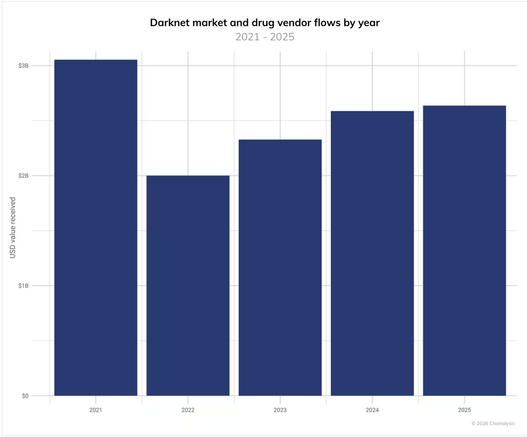
Illicit cryptocurrency activity surged to a record $154 billion in 2025, driven largely by a sharp increase in sanctions evasion by nation-states using blockchain networks, according to a new report from blockchain analytics firm Chainalysis.

The Dark Web Exposed: Cybercrime’s Hidden Marketplace
1,918 words, 10 minutes read time.
When people hear “dark web,” they often imagine a digital underworld where hackers trade stolen identities, malware, and secrets under layers of unbreakable encryption. While that image contains kernels of truth, it’s heavily distorted by media dramatization and technical misunderstanding. In reality, the dark web is neither a monolithic criminal empire nor an impenetrable fortress—it’s a technically specific segment of the internet designed for anonymity, used by journalists, activists, and privacy advocates as much as by cybercriminals. Yet its role in enabling large-scale cybercrime is undeniable. Stolen credentials, ransomware tools, and corporate data routinely surface in hidden marketplaces long before breaches make headlines. For defenders, ignoring this space means missing early warnings of compromise. The goal isn’t to chase every rumor in obscure forums but to understand how adversaries operate so we can build more resilient systems. This isn’t about fear—it’s about foresight.
Demystifying the Dark Web: Separating Fact from Fiction
To engage with the dark web intelligently, we must first clarify what it actually is. The internet consists of three conceptual layers: the surface web, the deep web, and the dark web. The surface web includes everything indexed by search engines—news sites, public blogs, e-commerce stores. The deep web encompasses all non-indexed content: private databases, medical records, internal company portals, and subscription-based academic journals. Neither of these is inherently illicit; in fact, the deep web constitutes the vast majority of online data. The dark web, by contrast, refers specifically to websites hosted on anonymizing networks like Tor or I2P, accessible only through specialized software and identifiable by unique domains such as .onion. These sites prioritize user and host anonymity through multi-layered encryption and randomized routing, making traffic analysis extremely difficult.
This technical foundation has been wildly misrepresented in popular culture. Movies and TV shows depict the dark web as a neon-lit bazaar where anyone can instantly buy passports or hire assassins with a few clicks. In truth, navigation is cumbersome, services are unstable, and trust is scarce. There’s no Google for the dark web; users rely on curated link directories, forum posts, or word-of-mouth referrals to find active sites. Many marketplaces vanish overnight due to law enforcement action or exit scams, forcing users to constantly rebuild their networks. Moreover, while anonymity tools like Tor provide strong protections, they’re not foolproof. Operational security failures—such as reusing usernames across platforms, leaking metadata, or connecting without proper firewall rules—have repeatedly led to arrests. The myth of invincibility serves cybercriminals by discouraging scrutiny, but the reality is far more fragile. Recognizing this helps shift focus from sensationalism to signal: instead of fixating on the “mystery” of the dark web, defenders should monitor for concrete indicators, like employee email addresses appearing in credential dumps or proprietary documents listed for sale.
How Cybercrime Actually Works Underground
Beneath the myths lies a highly structured, almost bureaucratic ecosystem of cybercrime. Modern dark web operations function less like chaotic black markets and more like legitimate SaaS businesses—complete with customer support, service-level agreements, and reputation systems. The infrastructure relies on three pillars: anonymizing networks, cryptocurrency, and modular marketplace design. Tor remains the dominant access layer, though some actors are migrating to alternatives like I2P or private Telegram channels to evade increasing scrutiny. On top of this, cybercriminal marketplaces replicate the user experience of Amazon or eBay: vendors list products with descriptions, pricing, and reviews; buyers rate sellers; and disputes are mediated by platform administrators. This mimicry isn’t accidental—it builds trust in an environment where betrayal is common.
Cryptocurrency is the lifeblood of these transactions. While Bitcoin was once the default, its traceability has pushed many toward privacy-focused coins like Monero, which obfuscate sender, receiver, and transaction amounts. Payments typically flow through escrow systems: the buyer sends funds to a wallet controlled by the marketplace, and the seller receives payment only after delivery is confirmed or a dispute window closes. This reduces fraud and encourages repeat business—a critical factor in sustaining underground economies. Beyond marketplaces, private forums serve as collaboration hubs where threat actors share tactics, dissect new defensive technologies, and even auction access to compromised corporate networks. Some of these forums operate on subscription models, charging monthly fees for real-time breach data or custom exploit development. This professionalization reflects a broader shift: cybercrime is now industrialized. Roles are specialized—coders develop ransomware, affiliates conduct phishing campaigns, money mules launder proceeds—and profits are shared via affiliate programs. The result is a scalable, resilient threat model that doesn’t rely on lone geniuses but on distributed, redundant networks. Understanding this reveals why perimeter defenses alone fail: the adversary isn’t just bypassing firewalls—they’re leveraging economic incentives and user behavior at scale.
Real Breaches, Real Consequences: Case Studies from the Front Lines
The abstract mechanics of dark web markets become starkly real when examined through actual breaches that originated or escalated within these hidden channels. Take the Colonial Pipeline ransomware attack in May 2021—a single compromised password, allegedly purchased on a dark web marketplace, enabled the REvil-affiliated group to cripple fuel distribution across the U.S. East Coast. Investigators later confirmed that the initial access credential belonged to a legacy VPN account with no multi-factor authentication, and that the password had been circulating in underground forums for months after earlier data breaches. Colonial’s systems weren’t breached by a zero-day exploit or a nation-state actor; they were unlocked with a reused credential sold for less than $50 in Monero. This incident underscores a brutal truth: many catastrophic breaches begin not with sophisticated intrusion techniques, but with the commodification of negligence—poor password hygiene, unpatched remote access tools, and lack of identity monitoring.
Similarly, the 2023 MGM Resorts cyberattack, which disrupted hotel operations, casino floors, and booking systems for over ten days, traces back to social engineering tactics refined in dark web communities. The attackers, linked to the Scattered Spider group, impersonated an employee to trick an IT help desk into resetting credentials—a technique openly discussed and even scripted in underground forums. Once inside, they moved laterally using legitimate administrative tools, exfiltrated data, and deployed destructive ransomware. Within hours of the breach, internal documents and customer records began appearing on dark web leak sites, used as leverage to pressure the company into paying a ransom. Notably, threat intelligence firms had already flagged Scattered Spider’s growing activity in private Telegram channels and invite-only forums weeks before the attack, yet without proactive monitoring, MGM had no early warning. These cases demonstrate that the dark web isn’t just a passive repository of stolen data—it’s an active planning ground where tactics are stress-tested, tools are refined, and targets are selected based on perceived weaknesses. The lag between intelligence availability and organizational response remains one of the most exploitable gaps in modern cybersecurity.
What Organizations Can Do: Practical Defense Strategies
Given this reality, what can defenders actually do? The answer lies not in attempting to “shut down” the dark web—that’s a law enforcement mission—but in integrating dark web awareness into existing security programs in a pragmatic, risk-based way. First and foremost, organizations should implement continuous dark web monitoring for their digital footprint. This doesn’t mean scanning every .onion site; rather, it involves subscribing to reputable threat intelligence feeds that track known marketplaces, paste sites, and forums for mentions of corporate domains, executive names, or employee email addresses. Services like those offered by Recorded Future, Flashpoint, or even CISA’s Automated Indicator Sharing (AIS) program can provide timely alerts when credentials associated with your organization surface. When such data appears, it’s not just evidence of a past breach—it’s a flashing red indicator that those credentials may still be active and usable.
Second, credential hygiene must be elevated from a best practice to a core security control. Enforce strict password policies, eliminate shared accounts, and mandate multi-factor authentication (MFA) everywhere—especially on remote access systems like VPNs, RDP, and cloud admin portals. More importantly, integrate identity threat detection and response (ITDR) capabilities that can flag anomalous login behavior, such as logins from unusual geolocations or at odd hours, even if valid credentials are used. Assume that some credentials are already compromised; your goal is to render them useless through layered verification and rapid rotation. Third, treat employee awareness as a technical control, not just a compliance checkbox. Train staff to recognize social engineering attempts—particularly vishing (voice phishing) and help desk impersonation—which are increasingly orchestrated using scripts and playbooks traded on the dark web. Simulated attacks based on real-world TTPs (tactics, techniques, and procedures) observed in underground forums can harden human defenses more effectively than generic phishing quizzes.
Finally, avoid overpromising on dark web monitoring ROI. It won’t prevent all breaches, nor should it replace foundational hygiene like patching and network segmentation. But when integrated thoughtfully, it provides context that transforms reactive incident response into proactive risk mitigation. Seeing your company’s name in a ransomware leak post isn’t just alarming—it’s actionable intelligence that can trigger immediate credential resets, enhanced logging, and executive briefings. In an era where adversaries operate with the efficiency of startups and the patience of predators, visibility into their planning grounds isn’t optional. It’s part of the new baseline for resilience.
Conclusion: Seeing Clearly in the Shadows
The dark web will never be fully eradicated. As long as there is demand for anonymity—whether for whistleblowing or weaponized data theft—the infrastructure will adapt, migrate, and reemerge under new protocols. Law enforcement takedowns, while symbolically powerful, often produce only temporary disruption; markets fragment, actors regroup, and new platforms rise within weeks. This isn’t a reason for despair, but for recalibration. Instead of viewing the dark web as an unknowable abyss, we should treat it as another layer of the threat landscape—one that reveals adversary intent, capability, and timing with remarkable clarity if we know where to look. The criminals don’t want you to understand this. They rely on mystique to obscure their methods and on organizational inertia to delay defensive action. By demystifying the dark web, grounding our understanding in verified incidents, and embedding practical monitoring into our security posture, we strip away that advantage. In cybersecurity, visibility is power. And in the shadows, even a little light goes a long way.
Call to Action
If this breakdown helped you think a little clearer about the threats out there, don’t just click away. Subscribe for more no-nonsense security insights, drop a comment with your thoughts or questions, or reach out if there’s a topic you want me to tackle next. Stay sharp out there.
D. Bryan King
Sources
Disclaimer:
The views and opinions expressed in this post are solely those of the author. The information provided is based on personal research, experience, and understanding of the subject matter at the time of writing. Readers should consult relevant experts or authorities for specific guidance related to their unique situations.
#OnionSites #AlphaBay #anonymizingNetworks #Bitcoin #breachPrevention #CaaS #Chainalysis #CISA #ColonialPipelineHack #credentialStuffing #cryptocurrency #cyberAttribution #cyberDefense #cyberResilience #cyberThreatLandscape #cybercrime #cybercrimeAsAService #cybercriminalForums #cybersecurity #DarkWeb #darkWebEconomics #darkWebMonitoring #darknetMarkets #dataBreach #digitalFootprintMonitoring #escrowSystems #Europol #FBICybercrime #identityTheft #identityThreatDetection #INTERPOL #ITDR #KrebsOnSecurity #lawEnforcementTakedowns #leakedData #MFA #MGMResortsBreach #MITREATTCK #Monero #multiFactorAuthentication #NCSC #operationalSecurity #passwordHygiene #pasteSites #phishingKits #privateForums #proactiveSecurity #ransomware #SilkRoad #socialEngineering #stolenCredentials #TelegramCybercrime #threatIntelligence #TorNetwork #undergroundMarketplaces #vendorRatings #VerizonDBIR #vishing
 Japan Pop News
 Life Japan
 BGDon 🇨🇦 🇺🇸 👨💻
 eddieoz
 Iwpost
 crypto news 🧠 eicker.crypto
 WhisprNews
 Bryan King