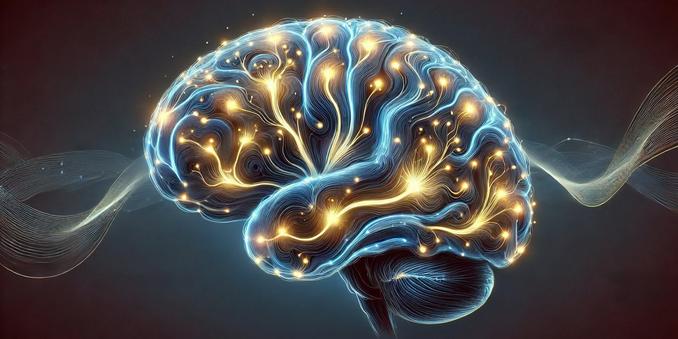
From a mental health professional perspective, the report that remembering facts and recalling life events activate nearly identical brain networks underscores the close integration of memory systems, challenging decades of memory theory. This overlap holds significance for understanding memory-related presentations across clients and may inform research directions related to aging and neurodegenerative conditions such as Alzheimer’s and dementia.

Article Title: This brain discovery is forcing scientists to rethink how memory works

Link to Science Daily Mind-Brain News: https://ift dot tt/rYMmKPw

#MemoryResearch #Neuroscience #BrainImaging #Alzheimers #Dementia

Copy and paste broken link above into your browser and replace "dot" with "." for link to work.

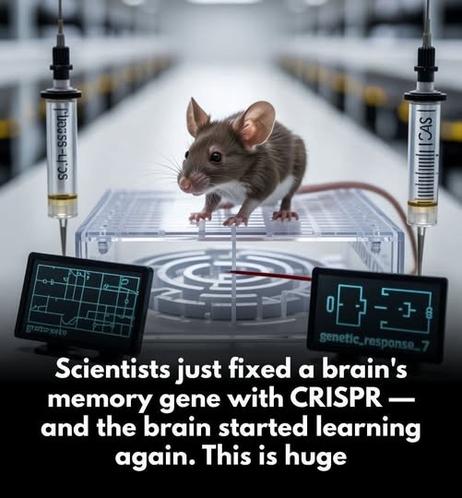
Scientists just fixed a brain’s memory gene with CRISPR — and the brain started learning again.

In a breakthrough experiment on mice, researchers identified a single faulty gene linked to memory loss and cognitive decline. By using CRISPR gene-editing, they precisely repaired the defect inside live brain cells. To their surprise, the animals began regaining learning ability within weeks.

The gene in question controls how neurons form connections, which are essential for memory storage. When it malfunctions, brain circuits weaken, leading to memory impairment similar to conditions like Alzheimer’s disease. Correcting it allowed neurons to re-establish stronger connections, restoring lost brain function.

This experiment marks one of the first times gene editing has directly improved higher brain functions rather than just fixing physical traits. The edited mice performed better in mazes, recognition tests, and pattern recall, showing a measurable recovery in cognitive performance.

If such results can one day be translated to humans, it could open the door to powerful new treatments for neurodegenerative diseases. Instead of drugs that only slow symptoms, doctors may be able to reverse the genetic roots of memory decline.

Of course, challenges remain: editing genes in the human brain is risky, requiring precision delivery systems that won’t harm surrounding tissue. Long-term safety and ethical questions will also be central before any clinical use.

Still, this is a powerful glimpse into what medicine could become — not just treating memory loss, but restoring the brain’s ability to learn itself.

Neuroscience & Memory
#Neuroscience #MemoryResearch #BrainHealth #CognitiveScience #MemoryRestoration #Neuroplasticity #BrainFunction #CognitiveRecovery #LearningScience

Gene Editing & CRISPR
#CRISPR #GeneEditing #GeneticTherapy #GenomeEditing #MolecularMedicine #GeneTherapy #Genomics #PrecisionMedicine #Neurogenetics

Neuroscientists share how to 'revive' memories that you thought you had forgotten forever

https://fed.brid.gy/r/https://www.upworthy.com/how-to-remember-things

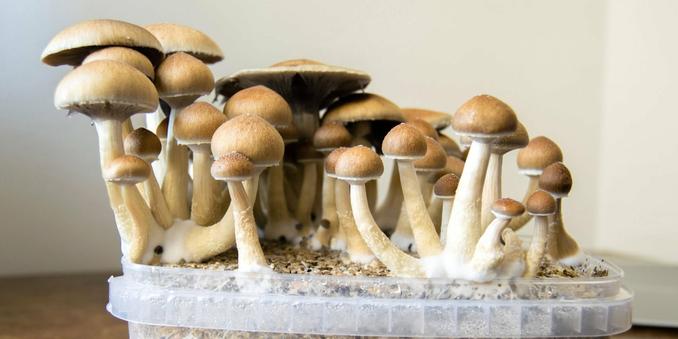
Magic mushrooms may help reverse stress-induced memory deficits, new study suggests

Recent research found that Psilocybe cubensis extract improved memory and increased brain plasticity-related protein levels in stressed rats, but timing was key, as benefits were observed only when given 24-48 hours before memory training.

PsyPost
Scientists sheds light on how our brains create mental “chapters” with new event segmentation study

The brain actively segments experiences into events based on internal priorities, not just external changes, influencing memory and perception. This reveals how attention and goals shape our understanding and recall of life's continuous narrative.

PsyPost

🚨 New research alert! 🧠 Our study shows that task-irrelevant vibrotactile stimuli can disrupt short-term memory for visually-presented verbal items. The interference is produced by conflicting amodal serial-ordering processes.

https://www.tandfonline.com/doi/full/10.1080/20445911.2023.2198065

#MemoryResearch #CognitiveScience 🧐 #Neuroscience 🧬 #Psychology 🧑‍🔬 #ExperimentalPsychology 🔬

Irrelevant changing-state vibrotactile stimuli disrupt verbal serial recall: implications for theories of interference in short-term memory

What causes interference in short-term memory? We report the novel finding that immediate memory for visually-presented verbal items is sensitive to disruption from task-irrelevant vibrotactile sti...

Taylor & Francis

False memories are recollections of events that did not happen or happened differently from how they are remembered. False memories can have serious consequences, such as affecting eyewitness testimony, creating false accusations, or altering personal identity. A new study has found that false memories can be formed in as little as 8 seconds, depending on the type of memory and the context.

#FalseMemory #MemoryResearch #Psychology

https://www.sciencealert.com/your-brain-can-create-a-false-memory-quicker-than-you-think

Your Brain Can Create a False Memory Quicker Than You Think

Research suggests people can generate false memories within the blink of an eye.

ScienceAlert

@s_michelmann @ptoncompmemlab

Oh yes and this should get tags.

#Memory
#MemoryResearch
#ContinuousMemories
#PsychScience
#PtonCompMemLab (I guess?)

Sorry, I'm interested because I'm hoping such research will lead to better information about the treatment of PTSD and cPTSD but I'm more of an end user than someone knowledgeable on the subject so I'm probably missing loads.