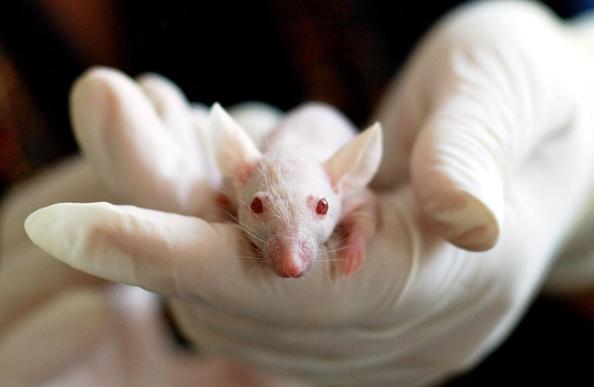
Can ‘mini brains’ replace lab animals? Organoids are changing how scientists study disease | The-14
Lab-grown organoids offer a humane alternative to animal testing, helping scientists study diseases more accurately and advance personalized medicine research.

Mice with human cells developed using ‘game-changing’ technique
Human cells injected into amniotic fluid find their way into fetal mouse organs.

The Human Cell Atlas is mapping 37 trillion human cells for disease insights.
Efforts to generate a complete atlas of all human cells have made tremendous progress. Researchers from the Human Cell Atlas (HCA), a glob...

Researchers show that introduced tardigrade proteins can slow metabolism in human cells
University of Wyoming researchers have gained further insight into how tardigrades survive extreme conditions and have shown that proteins from the microscopic creatures expressed in human cells can slow down molecular processes.
"Your body renews itself every seven years”: An idea that’s been around at least since John Dos Passos’s novel “Manhattan Transfer” (1925).
#111Words #JohnDosPassos #HumanCells #Biology https://andrewjshields.blogspot.com/2024/03/your-body-renews-itself-every-seven.html"Your body renews itself every seven years”: An idea that’s been around at least since John Dos Passos’s novel “Manhattan Transfer” (1925)
I'd have assumed that the idea that the cells in human bodies are completely replaced in a seven-year cycle arose during my lifetime, so I w...

'Ice printing' tiny sculptures could help scientists engineer blood vessels
A technique for printing 3D structures from ice could be used to help make artificial veins and arteries.

“Vaccine” shedding in schools | Drs Amerling Thorp & Trozzi
Doctors Amerling, Thorp and Trozzi discuss "vaccine" shedding, a fast-approaching return to school, and strategies for our children's survival and well-being.
Green Synthesis of CdTe Quantum Dots and Their Effect on Human and Animal Cells
https://link.springer.com/article/10.3103/S0095452723030040#greensynthesis #quantumdots #CdTe #toxicity #humancells #animalcells #cancercellcultureAbstract
Since the nanoscale in combination with luminescent properties and prospective applications in different fields of optoelectronics and biomedicine is stimulating a growing interest towards research ..
Keywords:
green synthesis
quantum dots
CdTe
toxicity
human cells
animal cells
cancer cell culture

Green Synthesis of CdTe Quantum Dots and Their Effect on Human and Animal Cells - Cytology and Genetics
Abstract Since the nanoscale in combination with luminescent properties and prospective applications in different fields of optoelectronics and biomedicine is stimulating a growing interest towards research in the area of cadmium telluride (CdTe) quantum dots (QDs), the method of “green” synthesis of CdTe QDs with the use of the Pleurotus ostreatus mycelium culture as a biological matrix has been developed. The study of their physical and chemical characteristics has shown that the synthesized CdTe QDs are characterized by a crystalline structure and a predominantly spherical morphology and are 3–8 nm in size with the luminescence maximum within the 340–370 nm range. The study of their effects on different types of mammalian cells has shown that CdTe QDs have dose-dependent effects on mouse endothelial cells and human and rat erythrocytes, T- and B-lymphocytes, colorectal cancer cells (Colo 205), and human breast cancer cells (MCF-7). In particular, suppression of proliferative indices of endotheliocytes and an increase in the count of dead cells were observed, which indicates the cytotoxic action of nanocrystalline CdTe and its antiproliferative effect on endothelial cells. At the 5 µM concentration, CdTe QDs exhibited hemolytic activity, due to their action on erythrocytes, and affected adhesive contacts and cancer cell survivability. At the same time, human breast cancer cells (MCF-7) were more sensitive to their action. The data obtained are exclusively important for the understanding of mechanisms underlying the toxicity of CdTe QDs and for their future application in biological and biomedical research.
‘Astonishing’
#molecular syringe ferries
#proteins into
#humancellshttps://www.nature.com/articles/d41586-023-00922-4 Technique borrowed from nature, and honed using
#artificialintelligence, could spur the development of better drug-delivery systems

‘Astonishing’ molecular syringe ferries proteins into human cells
Technique borrowed from nature, and honed using artificial intelligence, could spur the development of better drug-delivery systems.
Bacterial injection system delivers proteins in mice and human cells
Researchers at the Broad Institute of MIT and Harvard and the McGovern Institute for Brain Research at MIT have harnessed a natural bacterial system to develop a new protein delivery approach that works in human cells and animals. The technology, described today in Nature, can be programmed to deliver a variety of proteins, including ones for gene editing, to different cell types. The system could potentially be a safe and efficient way to deliver gene therapies and cancer therapies.
 The-14
 Steve Dustcircle 🌹
 NewsTainmentOra
 Andrew Shields
 Matt Willemsen
 Cabeceo_Queen
 Cytology and Genetics
 Phys.org