The Beauty and Brutality of the Desert
The first time I ran out of water in the desert was the last time.
In my fourth year of medical school, I arranged a month-long rotation on the Navajo Nation to explore the idea of working in very remote locations. With awe and wonder, I experienced the wide horizons of the American Southwest for the first time. I’d made good time on the cross-country road trip of over 2,000 miles from Virginia to New Mexico, so I took a break to stretch my legs in Kasha-Katuwe Tent Rocks National Monument.
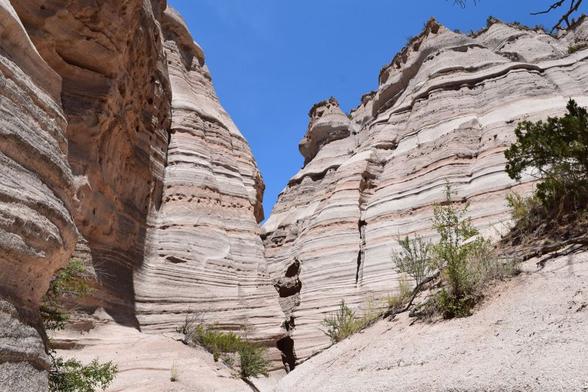
The Canyon Trail is not particularly long (about 3.5 miles) and only a moderately strenuous climb, but desert hiking was new me. Having spent the last four years in hot and humid Norfolk, Virginia, I wasn’t aware of how stealthily moisture leaves the body when your sweat evaporates almost instantaneously. Though I’d brought several water bottles with me, I obliviously slurped through them while lost in astonishment at the remarkable geology of the park. After squeezing through tight canyon walls and clambering up the slope, I reached the top of the mesa and gulped my water, gazing out past the pointed rock pyramids, no signs of human civilization in sight. After some time, a thunderstorm developing to the north jostled me out of my daydreaming, and I turned to head back down.
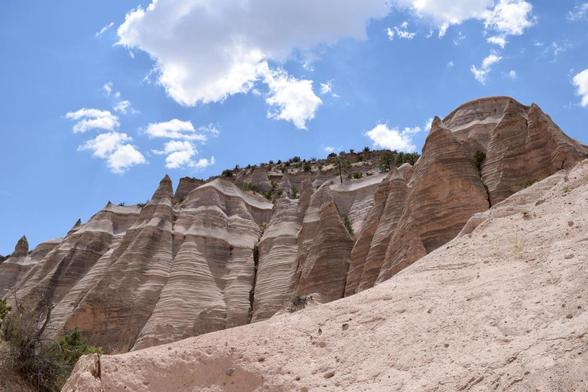
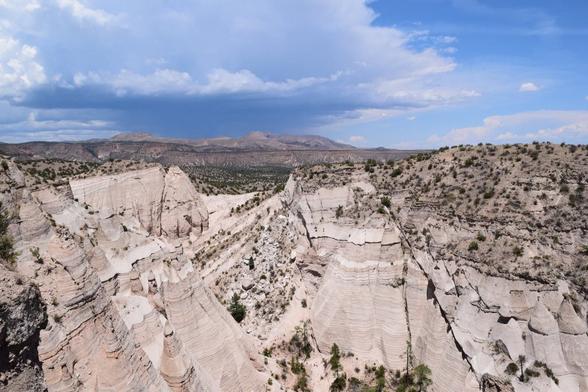
Views from the Canyon Trail at Kasha-Katuwe National Monument. Photos are mine from 2016.
When I lifted my bottle for a swig, I had the alarming realization that it was gone.
“No worries,” I told myself. “It’s all downhill from here. It’ll be fine.”
But the temperature was in the high-90s, and heat radiated from the slot canyon walls. My mouth turned to cotton, and it became hard to swallow. By the time I shuffled back to my car, I was lightheaded and desperate. I had no water stashed in the vehicle, and there were no other people around. I had no cell phone service in this remote place, and I wasn’t sure where the closest store was, but the only option I had was to get in the car and drive.
After about 20 minutes, I came upon a gas station. I walked straight to the cooler section, paid for a gallon of water and, slumped against the car, I gulped the cold liquid straight from the jug. I almost cried with relief.
Though the high desert of New Mexico looks a bit different than the Sonoran Desert where I live now, that formative ordeal intensely influenced how I came to approach the human need for water in the desert wilderness. I always, always, bring more water than I think I’ll need. I always carry some method of purifying water I might find in pools or cattle tanks. I obsessively research water sources when I’m researching a backpacking trip, grading them on their reliability, and neurotically calculating how much I’ll need to carry between them. I carry a gallon of water in my car at all times. I have sworn to myself that, if it is within my power, I will never again be caught in a situation like I was at Tent Rocks.
And yet, anyone who has spent more than 15 minutes with me in the past six years has probably been subjected to my yapping about how much I adore the desert. Last week’s post was a (very) short introduction. The reality is, however, that for all of its rugged and unique and symbolic beauty, the desert is not a gentle place. The animals, plants, aridity, and heat can all feel like they’re conspiring to hurt you (if not kill you). There are many ways to prepare — to reduce the risk of your explorations — but the danger is never completely eliminated. In the last couple years volunteering for the Southern Arizona Rescue Association, I have seen both novice and experienced outdoorspeople find themselves in predicaments because the Sonoran Desert leaves little room for mistakes.
The desert is wild, and it demands respect from all to venture into it.
The United States makes use of this beautiful and brutal desert terrain in a border enforcement strategy known as “prevention through deterrence.” Better-resourced, urban areas are militarized not only with walls and fences, but with helicopters, drones, and increasingly advanced technologies like autonomous surveillance towers and artificial intelligence — technology far beyond my knowledge and expertise.
To avoid detection, migrants (and those they rely on to move them across the border) are funneled into steadily more dangerous terrain through the mountains and desert. Migrants keep to this deep desert not only to bypass the border wall, but also to avoid checkpoints on what are often the only roads through a region. These areas are remote, empty, and typically sparsely populated. Water, if present is usually in cattle tanks or seasonal springs and pools. If something bad happens — like heat-related illness, a snakebite, a broken ankle, getting sick from the water you drink, or just plain running out of water or food — there is nowhere to go for help.
Some of the places I’ve gratefully used as drinking water while backpacking in southern Arizona. Yes, those are cattle troughs and a bathtub.
I think back to my own experience of running out of water ten years ago. I was incredibly scared, but wildly privileged. I had a car. I had identification. I had no fear of being imprisoned or deported if I were discovered, of being sent back to the dangerous home I fled. The 20 minute drive to the convenience store felt like an eternity, but the likelihood that I would actually have died or experienced lasting bodily harm was probably relatively low. Still, I will never forget the fear and desperation that consumed me for several hours. I can only imagine the final thoughts of those less fortunate than I.
As I get ready to walk the Migrant Trail at the end of May, I’m reflecting on why this pilgrimage exists. This particular post is about the desert and why the United States decided it was a useful weapon. Over the next couple weeks, I will write more about US-Mexico border enforcement strategy and how policy changes are correlated with an increase in migrant deaths over the past 30 years. I’ll also touch on how some groups of smart people approach complicated border politics in a way that acknowledges human movement as an adaptive strategy while also recognizing the equally human desire for safety.
Bear in mind that I am a family doctor by training. While I find the politics of people on the move around the world intensely interesting and important at this time in history, these posts are not meant to a doctoral thesis. My aim, rather, is to try to humanize the border conversation between normal, non-academic people around us, like our friends and family. I hope to remind readers (and be forever reminded myself) that when we talk about border patrol “encounters” or “human remains,” these are people with names, lives, families, dreams.
And ultimately, my deepest hope is we can shift the whole conversation into one that focuses on how to meet all of our collective needs as humans, both for those on the move and those in the communities that may receive them.
This is the first article in a short series about the US-Mexico border. Check back later as I continue to reflect on this complicated topic! I know this is a politically charged subject, but let’s strive to keep any comments kind, helpful, and true.
Of note, I recently started publishing on Substack for several reasons, but primarily, the interface makes it easier to comment and engage with commenters. I’ll keep posting on both platforms for a little while longer, but I will likely let the paid ad-free version lapse when the renewal comes around. If you like the streamlined version without “YOU’LL NEVER BELIEVE THIS SIMPLE TRICK TO REMOVE BELLY FAT” ads, consider moving over to Substack. In the meantime, enjoy on the platform of your choice.
#Borders #Hope #Humanity Sally The Flame
 D4rk$ign$
 サファイア・ネオ
 ポイズン雷花
 CBC Sports
 pasjrwoctx👽
 A Sense of Impending Bloom
 Lisa J. Warner / Lisa Luv