"
Ein internationales Forschungsteam entdeckte die größten jemals beobachteten Plasmastrahlen eines Schwarzen Lochs. Diese sogenannten „Jets“ haben eine Gesamtlänge von 23 Lichtjahren und reichen damit erheblich weiter durch das Universum als bisher bekannt. Eine Pressemitteilung des Deutschen Zentrums für Luft- und Raumfahrt (DLR).
"
https://www.raumfahrer.net/dlr-gigantische-plasmastrahlen-eines-schwarzen-lochs-ueberraschen-fachwelt/

18.9.2024

#Astronomie #Astrophysik #DESI #DLR #Galaxien #GMRT #Jet #KeckObservartorium #LOFAR #Porphyrion #SchwarzesLoch

DLR: Gigantische Plasmastrahlen eines schwarzen Lochs überraschen Fachwelt – Raumfahrer.net

Coming next, Yashwant Gupta will talk about the GMRT activities.

(We’ve been going quickly, so we’re killing time to get the program aligned for people hopping across sections.)

#ATRASC2024 #URSI #GMRT

Eine unerklärliche Plasmastruktur im Hydra-Galaxienhaufen | astropage.eu

Hochempfindliche Radiobeobachtungen haben eine Wolke aus magnetisiertem Plasma im Hydra-Galaxienhaufen entdeckt. Der seltsame Ort und die eigenartige Form dieses Plasmas stimmen mit keinem konventionellen Erklärungsmodell überein. Basierend auf ihrer Silhouette wird die Plasmastruktur als Flying Fox (engl. "Flughund") bezeichnet und so lange ein Rätsel bleiben, bis weitere Beobachtungen genauere Einblicke geben können. Ein Team unter

astropage.eu
Today on astro-ph: Off-axis collision in a young galaxy cluster. G. Di Gennaro
find peculiar radio emission in a high-z galaxy cluster. Paper includes #LOFAR, #VLA, #GMRT and @ChandraScience data. https://arxiv.org/abs/2304.05893
The diffuse radio emission in the high-redshift cluster PSZ2 G091.83+26.11: total intensity and polarisation analysis with Very Large Array 1-4 GHz observations

We present the peculiar case of PSZ2G091.83+26.11 at z=0.822. This cluster hosts a Mpc-scale radio halo and an elongated radio source, whose location with the respect to the intracluster medium (ICM) distribution and to the cluster centre is not consistent with a simple merger scenario. We use VLA data at 1-4 GHz to investigate the spectral and polarisation properties of the diffuse radio emission. We combine them with previously published data from LOFAR n the 120-168 MHz band, and from the uGMRT at 250-500 and 550-900 MHz. We also complement the radio data with Chandra X-ray observations to compare the thermal and non-thermal emission of the cluster. The elongated radio emission is visible up to 3.0 GHz and has an integrated spectral index of $-1.24\pm0.03$, with a steepening from $-0.89\pm0.03$ to $-1.39\pm0.03$. These values correspond to Mach numbers $\mathcal{M}_{\rm radio,int}=3.0\pm0.19$ and $\mathcal{M}_{\rm radio,inj}=2.48\pm0.15$. Chandra data reveals a surface brightness discontinuity at the location of the radio source, with a compression factor of $\mathcal{C}=2.22^{+0.39}_{-0.30}$ (i.e. $\mathcal{M}_{\rm Xray}=1.93^{+0.42}_{-0.32}$). We also find that the source is polarised at GHz frequencies. We estimate an intrinsic polarisation fraction of $\sim0.2$, a Rotation Measure of $\sim50~{\rm rad~m^{-2}}$ (including the Galactic contribution) and an external depolarisation of $\sim60~{\rm rad~m^{-2}}$. The $B$-vectors are aligned with the major axis of the source, suggesting magnetic field compression. Hence, we classify this source as a radio relic. We also find a linear/super-linear correlation between the non-thermal and thermal emission. We propose an off-axis merger and/or multiple merger events to explain the position and orientation of the relic. Given the properties of the radio relic, we speculate that PSZ2G091.83+26.11 is in a fairly young merger state.

arXiv.org
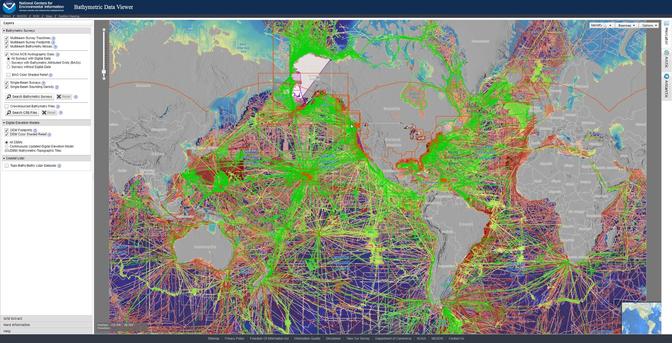
Bathymetric Data Viewer [global, NOAA]
--
https://www.ncei.noaa.gov/maps/bathymetry/ <-- spatial open data web portal
--
“NCEI and the IHO Data Center for Digital Bathymetry (DCDB) archive and share depth data acquired by hydrographic, oceanographic, and industry vessels and platforms during surveys or while on passage. These data, which are used in several national and international mapping bathymetry projects, are free to the public with no restrictions…”
#GIS #spatial #mapping #remotesensing #bathmetry #global #opendata #openaccess #download #NCEI #DCBD #NOAA #elevation #sonar #water #hydrography #hydrospatial #webportal #science #spatialanalysis #DEM #data #digital #multibeam #survey #visualisation #BAG #raster #GEBCO #GMRT #IBSCO #GSHHG
@NOAA @NCEI @GEBCO
Bathymetric Data Viewer

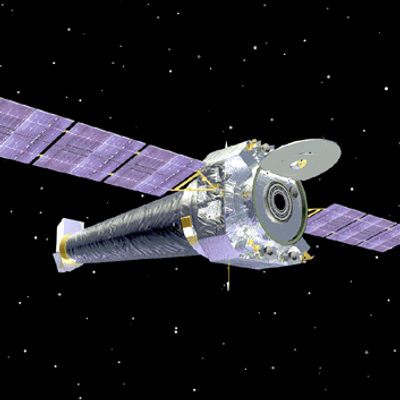
Did you catch our recent #ChandraScience image of Abell 2256, a spectacular merger of at least three galaxy clusters? The hot gas components of these clusters is traced with X-rays -- shown here in blue, using data from us (#Chandra) and our ESA-led friends at #XMM-Newton. This cosmic collision is also a source of radio emission, shown in red from #LOFAR, #GMRT, and the #VLA, produced via particle acceleration. For more details, see
https://chandra.si.edu/photo/2023/a2256/
#Astronomy #Astrodon #Astrophysics
Chandra :: Photo Album :: Abell 2256 :: January 30, 2023

GMRT 2020 and lots of&nbsp;stories

Experiences in the community
Celebrating Science Day at GMRT and&nbsp;WSF

Experiences in the community