 Mark Stothard
Where am I off to on My Next Photography Trip? - https://youtube.com/shorts/KY5GD--RZME?feature=share

Where am I off to on My Next Photography Trip? - https://youtube.com/shorts/KY5GD--RZME?feature=share

The Conditions Were Not the Ones I Would Have Chosen
The cultural and political conditions under which my new book RelationShaping: Field Studies has been published are not the conditions I would have chosen for it. The book is an argument for sustained attention, long apprenticeship, and the slow acquisition of perceptual capacities that operate below the level of declarative description. It enters a culture where the dominant economic logic rewards short attention, fast turnover, and the substitution of automated outputs for the trained reading those outputs are supposed to approximate. I make the case anyway, because the case needs making, and because the people who recognize what the book is describing will recognize it whether the cultural moment is favorable or not.
The book’s central claim is that relational seeing is a competence: a real, trainable capacity to attend to the relations among elements rather than to elements considered separately, acquired the way reading is acquired, operating faster than conscious analysis, producing results the practitioner cannot fully describe in declarative terms. I develop the claim across ten case studies that range from Giorgio Morandi’s still-life shelves to Michael Faraday’s iron-filing diagrams of magnetic field lines, from phyllotactic spirals in plant growth to Renaissance counterpoint, from the human microbiome to Anni Albers’s woven textiles, from mycorrhizal networks beneath forest floors to Charles Sanders Peirce’s three-cornered theory of signs and the classifier predicates of American Sign Language. The case studies share a structure: a trained perceiver attends to relations among elements as the constitutive features of the structure the elements together produce.
The book is the companion volume to The Scientific Aesthetic: An Operating Theory. The Scientific Aesthetic developed the theoretical framework for what I called the originating-act test, distinguishing acts of art and science from the craft activities that follow them. RelationShaping takes the relational dimension of that earlier argument and develops it into a sustained examination of one specific perceptual capacity across a wider range of human practice than the first book could cover. The two volumes can be read independently. They make a single argument together, and the order of publication is the order of the argument’s development.
The argument is not a recent one for me. I started a blog called RelationShaping in the BolesBlogs network in 2007. The blog has been working on the questions this book gathers for almost twenty years, and many of the book’s arguments began as blog posts whose claims I refined, tested against new examples, and pushed further across that span. The new book is the culmination of long work, the gathering of two decades of writing into a single sustained argument that the blog form, by its nature, could not quite hold.
The closing chapters of RelationShaping extend the framework into harder territory. Chapter Eight examines the trained-perception competence in domains where it has not been institutionally named, including the recovery of the Antikythera Mechanism, the decipherment of Linear B, the Hubble Deep Field, and the contested Sappho papyri. The next chapter addresses the methodological problem of attending to relations that have not yet been discovered, drawing on microbiome and connectome research, the Vera C. Rubin Observatory’s Legacy Survey of Space and Time, and the substantial scholarly traditions of Indigenous knowledge integration. The book closes with Chapter Ten, titled “The Severed Field,” which addresses the contemporary cultural and political conditions under which the discipline of attending to the between has come under pressure.
Chapter Ten is the chapter that made the book hard to write, and the chapter that makes the book necessary right now. The trained eye depends on conditions that are political, not merely epistemic. The classroom where a student learns to read counterpoint exists because public funding for music education exists. A museum where a young painter can spend weeks in front of a Morandi exists because the public funding that maintains museum collections exists. The graduate seminar where a future scholar of Indigenous ecological knowledge learns the methodology for ethical engagement exists because public funding for humanities research exists. Forests where botanists learn to read mycorrhizal networks exist because public funding for forest conservation exists. None of those institutional preconditions is independent of the political settlement that funds and protects them. The settlement turns against the institutions; the institutions thin; the conditions for the acquisition of trained perception thin with them; and the next generation of trained perceivers does not appear.
This is what Chapter Ten attempts to articulate. The substantive argument about relational seeing as a trainable competence would have been correct in any historical period. The urgency of articulating it right now belongs specifically to this moment, when the institutional preconditions for the competence are under organized political pressure to dissolve.
The book makes no claim that political pressure is the only force at work, or that institutional contraction has only one cause. The contraction has many causes, including economic restructuring, demographic change, the erosion of forms of community that once supported sustained attention, and the substitution of cheaper automated processes for human practitioners. Political pressure is one cause among several, and it is the cause most directly susceptible to political response.
What the book hopes to offer the reader is a vocabulary. With the vocabulary in hand, a reader may notice the trained eye in the people who still have it, may understand what those people are doing differently, may in some specific case ask to become an apprentice. In other cases, the reader may recognize that the political pressure on the institutions that train such perceivers is not pressure those perceivers can resist alone. They will need allies. The book is one attempt to make the case for being one of those allies.
I want to be honest about the limits of what the book undertakes. The book undertakes a specific task: it names the competence, documents it across a wider range of domains than is usually recognized, and articulates what is being lost when the conditions for its acquisition stop holding. The book makes no proposal for restoring the institutions whose contraction it documents, and no claim that naming the loss is sufficient to reverse it. Naming is the first step the book attempts, on the conviction that a loss without a name cannot be addressed in any organized way. The book gives the loss a name. What follows from the naming is for the reader to decide.
RelationShaping: Field Studies is available now in print, in ebook, and as a free PDF download from BolesBooks.com, along with its companion volume The Scientific Aesthetic: An Operating Theory. The book was difficult to write under the present conditions; it would be dishonest to claim otherwise, and equally dishonest to claim that the difficulty makes the book unnecessary. The argument exists, the case needs making, and the book makes the case.
#amazon #bolesBlogs #book #davidBoles #faraday #fieldStudies #kdp #morandi #philosophy #phyllotactic #politics #relation #relationshaping #scientificAesthetic
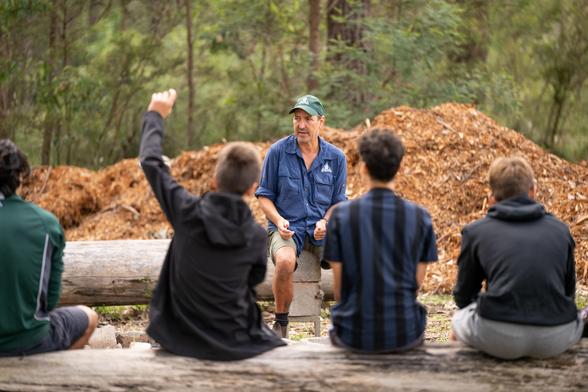
Trinity Grammar School field studies
#landscape #recreational #naturescenery #leisure #outdoorrecreation #study #school #fieldstudies #trinitygrammarschool
https://1001species.substack.com/p/a-little-annoyed
It’s a wonderful thing to watch a bird fly but to know that bird we also need to know how flight is achieved. Field and laboratory biological science are complementary - this cartoon sends a skewed message.
Tales of the seashore - plus raccoons and filberts and some other stuff. Go for a walk.
#Scotland #Arran #Raccoons #Transects #Biology #Nature #FieldStudies #Biodiversity #Seashore #Beaches
https://1001species.substack.com/p/quadrats-transects-and-sparrows

My newsletter is enjoying an encouragingly growing circulation. Nothing earth shattering, but a slow accretion. It began as a way to introduce readers to the too often overlooked wildlife in our towns and villages and gardens, plus some useful information about wildlife gardening based on our own, small scale efforts in suburbia. As Mr. Gradgrind famously said, “What we need is facts, boy. Facts.” But just facts alone can be a bit dry and dusty, so from now on, I will endeavour to occasionally add some colour as I wander down a few related rabbit holes.
Though a goldmine for the curious botanist, Harewood Plains is also an area under threat — from damage caused by off-road dirt bikes, ATVs and tree poaching — in part because so little is still known about it.
https://thediscourse.ca/nanaimo/local-environmentalists-unite-to-protect-harewood-plains
#Nanaimo #vanisle #VancouverIsland #conservation #environmental #ecosystems #biodiversity #StopEcocide #ecology #ProtectBiodiversity #PNW #PacificNorthwest #BritishColumbia #Canada #NorthCowichan #botany #PlantStudies #FieldStudies
I like this name 😋
I spent almost all day outdoor - a lot of yard work, a youth soccer game, fly fishing - especially fishing is like a field study 😉
So, finishing the day with this beer sounds appropriate 😊

 Albums Albums Albums
 David Boles
 Wild Sown
  alexkess
 Greenbirder
 NIOO-KNAW
 PhoenixSerenity
 Eishi Noguchi