The human cost of harvesting emotion: AI firms court performers for training data

Tech firms are hiring improvisational performers to generate unscripted training data that teaches AI systems to understand human emotion. But who benefits?

The Daily Perspective

Essential Reading ->

"One could argue that by repurposing creative works, AI has expanded the art multiplier: each dollar spent on the arts now yields its usual social return, as well as additional value derived from its incorporation into AI systems.

Yet, despite the value of their contributions, public funding for artists and creators has steadily declined. In the United Kingdom, for example, direct support from the Department for Culture, Media and Sport to national arts bodies fell by 18% per person in real terms between 2009-10 and 2022-23. Over the same period, core funding for arts councils dropped by 18% in England, 22% in Scotland, 25% in Wales, and 66% in Northern Ireland. As generative AI continues to churn out synthetic content and displace human labor, that support must increase to reflect the realities of a changing creative economy.

Admittedly, with public finances under pressure and debt on the rise, this is hardly the time for unchecked government spending. Any additional funding would need to be financed responsibly. While a detailed policy blueprint is beyond the scope of this article, it’s worth noting that the enormous profits generated by major tech firms could be partially redirected to support the creative communities that power their models.

One way to achieve this would be to impose a levy on the gross revenues of the largest AI providers, collected by a national or multilateral agency. As the technology becomes increasingly embedded in daily life and production processes, the revenue flowing to AI firms is bound to grow – and so, too, will contributions to the fund. These resources could then be distributed by independent grant councils on multiyear cycles, ensuring that support reaches a wide range of disciplines and regions."

https://www.project-syndicate.org/onpoint/how-ai-profits-can-help-fund-cultural-production-by-mariana-mazzucato-and-fausto-gernone-2025-07

#AI #GenerativeAI #BigTech #Copyright #IP #AITraining #Commons #DigitalCommons #CreativeLabour #PublicGoods

AI Should Help Fund Creative Labor

Mariana Mazzucato & Fausto Gernone show how today’s innovation economy exploits the very people it relies on and propose a fairer system.

Project Syndicate

OnlineFirst - "The mobilities of visual artists: The case of South Africa" by Brian J Hracs, Irma Booyens, Roberta Comunian, and Taylor Brydges:

#mobilities #locationalchoice #visualartists #creativelabour #SouthAfrica

https://journals.sagepub.com/doi/full/10.1177/0308518X251347429

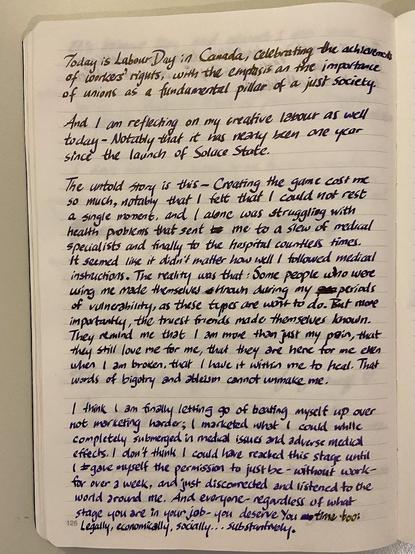
My handwritten letter about my struggles throughout and before the launch year for my first creative title Solace State, and how I am finally finding myself healing and able to come out of my shell more.

"The untold story is this - Creating the game cost me so much...

I think I am finally letting go of beating myself up over not marketing harder... I don't think I could have reached this stage until I gave myself the permission to just be - without work - for over a week, and just disconnected and listened to the world around me. And everyone - regardless of what stage you are in your job - you deserve You time too: Legally, economically, socially... substantively."

#worklifebalance #health #healing #creative #creativelabour #gamedev #gamemarketing #hope

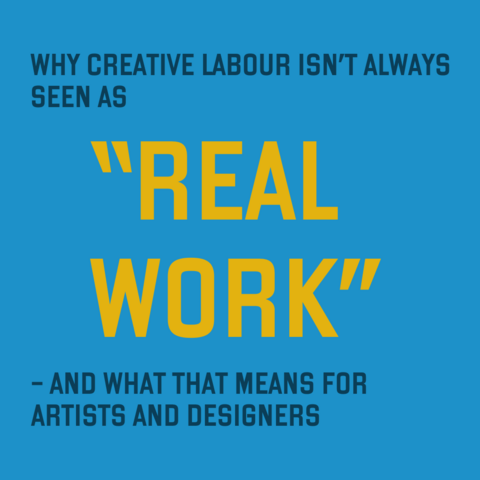
🔵🟡 Why creative labour isn’t always seen as “real work” – and what that means for artists and designers
by @JulienPosture at @itsnicethat
#CreativeIndustry #CreativeLabour #Artist #Designer

https://www.itsnicethat.com/features/arts-and-labour-creative-industry-290424

Why creative labour isn’t always seen as “real work” – and what that means for artists and designers

Throughout history, artistic production has been framed in opposition to productive labour. Today, creatives are still feeling the aftereffects of this. Here, anthropologist and illustrator Julien Posture unpacks why this might be and offers some potential solutions.

Just published in 𝘈𝘐 & 𝘚𝘰𝘤𝘪𝘦𝘵𝘺! 📣 Our article critiques fundamental assumptions that underlie our perceptions of generative AI and this thing called "creativity". We argue for a relational and materialist perspective to the assemblage of actors and forces involved in creative labour using AI tools.

#OpenAccess #AI #Creativity #CreativeLabour #Mediation

https://link.springer.com/article/10.1007/s00146-024-01921-3

Not “what”, but “where is creativity?”: towards a relational-materialist approach to generative AI - AI & SOCIETY

The recent emergence of generative AI software as viable tools for use in the cultural and creative industries has sparked debates about the potential for “creativity” to be automated and “augmented” by algorithmic machines. Such discussions, however, begin from an ontological position, attempting to define creativity by either falling prey to universalism (i.e. “creativity is X”) or reductionism (i.e. “only humans can be truly creative” or “human creativity will be fully replaced by creative machines”). Furthermore, such an approach evades addressing the real and material impacts of AI on creative labour in these industries. This article thus offers more expansive methodological and conceptual approaches to the recent hype on generative AI. By combining (Csikszentmihalyi, The systems model of creativity, Springer, Dordrecht, 2014) systems view of creativity, in which we emphasise the shift from “what” to “where” is creativity, with (Lievrouw, Media technologies, The MIT Press, 2014) relational-materialist theory of “mediation”, we argue that the study of “creativity” in the context of generative AI must be attentive to the interactions between technologies, practices, and social arrangements. When exploring the relational space between these elements, three core concepts become pertinent: creative labour, automation, and distributed agency. Critiquing “creativity” through these conceptual lenses allows us to re-situate the use of generative AI within discourses of labour in post-industrial capitalism and brings us to a conceptualisation of creativity that privileges neither the human user nor machine algorithm but instead emphasises a relational and distributed form of agency.

SpringerLink

What’s the difference between “fine” art and “commercial” art?
Growing up with an illustrator as a father, I always perceived some kind of difference there - fine art is for galleries and commercial art is for cereal boxes.

🎨📦🖼️📰

Now I’m not so sure.

https://www.robotfan.club/p/trying-to-resolve-the-two-kinds-of

#art #commercialart #graphicdesign #fineart #CreativeIndustry #creativelabour

Trying to Resolve the "Two Kinds of Art"

What's supposed to happen to all of the commercial artists?

Robot Fan Club 🤖

#AI #GenerativeAI #CreativeLabour #CollectiveAction: "Perhaps the most important lesson to be learnt from the digital revolution is how important it continues to be for knowledge producers and the creative industries to stand together and act collaboratively and collectively to establish a fair deal for creativity. Technology companies can wield extraordinary resources of money and power to assure the best outcomes for their business models, and are unlikely to be defeated by a single courageous campaign or campaigner. A united front is needed to ensure protections now and in the future; as the capabilities of artificial intelligence improve, new challenges will emerge, but ensuring copyright works will help put in place foundational protections for writers and help establish some boundaries for big tech companies and the technologies they bring to market.

No technology is inevitable. Artificial intelligence won’t replace humanity, but it is likely to change the nature of some jobs and many business models; these are not godlike entities, but human structures and processes. As such, the immediate challenge is not to be overcome by fear of AI or its mythical capabilities, but to deliver collective action that ensures human intelligence and creative labour is not subsumed by short-term commercial concerns."

https://rachelcoldicutt.medium.com/can-machines-read-ceec966fec42

Good morning #Fediverse ! Hope you've all had a great weekend. In this morning's #ConnectionList #Introduction #Connections post, in which I help to more richly connect us together, I'd like you to meet:

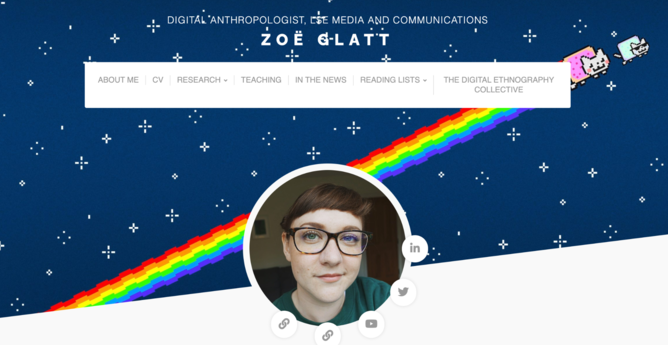
@ZoeGlatt is a #PhD candidate and #DigitalEthnography #researcher, and founder of @DigitalEthnographyCollective. They (not assuming pronouns) are submitting in March and are interested in jobs researching #SocialMedia culture, #CreativeLabour and #CreativeIndustries

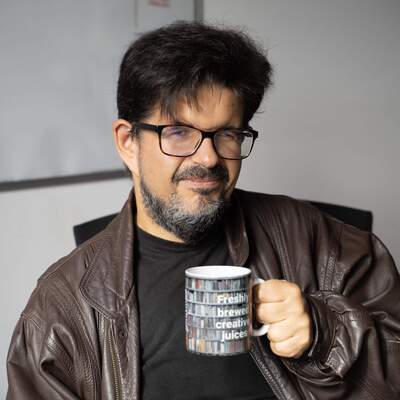
@ndporter is into #SocialScience, #Data and #DataEquity and works with the #Carpentries. The #Carpentries is a volunteer-driven movement to provide #researchers with foundational computational skills in technologies like #Python 🐍, #Git ⌨️ and #HPC #programming 💻

@pip works in #design for #AI at #CSIRO #ProductManagement

@safiyanoble is the author of "Algorithms of Oppression", which if you haven't read it, should be on your reading list, especially if you're into #AIethics or #FairML. It sits in a similar space to @VirginiaEubanks "Automating Inequality" and shows how algorithms serve to reinforce existing structures of oppression, particularly of POC.

@fionatribe is a #CulturalAnthropology person who is interested in #MaterialCulture, #Architecture and #Anthropology

@metasecsol works as an #InfoSec researcher at the #W3 and as a #Lecturer in #InformationSecurity #DevSecOps

Time for an an #introduction! I'm Zoë Glatt, a feminist researcher with interests in #InternetCulture, #CreativeLabour and #DigitalEthnography. I'm currently finishing my PhD at LSE Media & Communications, an ethnographic study of content creator labour in the London influencer industry (2017-2023), addressing how platformisation has escalated precarity and inequality. I also co-founded the The Digital Ethnography Collective <http://mastodon.lol/@DigitalEthnographyCollective> ✌️

MORE HERE: https://zoeglatt.com/

Digital Ethnography Collective (@[email protected])

0 Posts, 0 Following, 0 Followers · The Digital Ethnography Collective is a global community of scholars exploring the intersections of digital culture and ethnographic methods. #DigitalEthnography #InternetResearchers #DigitalCulture 📚 Collective Reading List: http://tinyurl.com/22jax742 🖥 Website: http://tinyurl.com/7x3udujp 👋 Co-Founders, Zoë Glatt & Branwen Spector: http://mastodon.social/@ZoeGlatt 🎥 Livestreams: http://tinyurl.com/bdhf63e7 🐦 http://twitter.com/DigECollective ✍️ Join our mailing list! http://tinyurl.com/yvr84pw7

Mastodon.lol