Cigarette Breaks on the Isle of Tumbledown
Ft Myers Beach, FLA
26.4520° N, 81.9481° W
The instinct to summon a cigarette is a learned behavior. I don’t smoke, but the impulse is there. To draw forth from a crumpled packet. Flick at a lighter. Shield the fickle flame against the tradewinds. But I’ve no cigarettes. No lighter. It is a learned behavior from watching my father in times like these. Times when there are no words and no action seems suitable. When there is fuck-all to be done. Have a smoke.
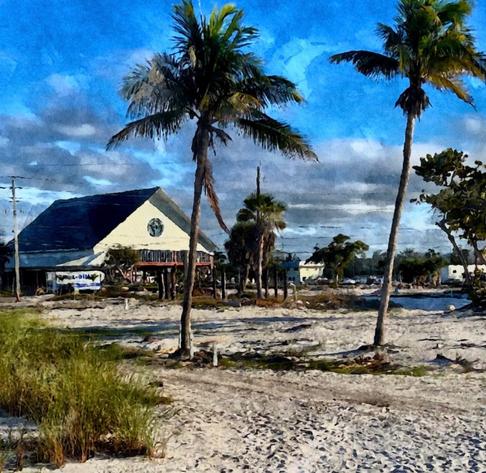
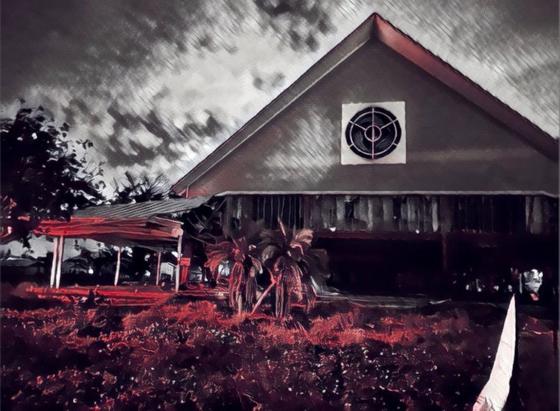
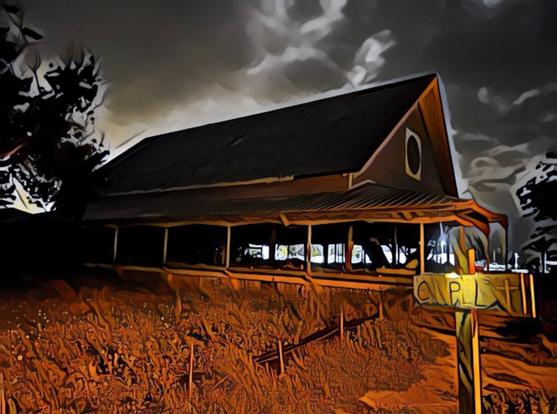
Resilient palm trees lean drunkenly – all in the same direction – pointing at the church. Yeah, yeah, yeah, I see it: this place of worship where I spent a childhood of sundays. The temple resembles the carcass of a fish washed ashore on a red tide. Few patches of rotten flesh flap in the sea breeze, clinging to the skeletal structure. A single glossy fisheye remains; aghast at the horror. It’s a wonder it remains. The fisheye. A magnificent stained-glass window intact. Nothing else salvageable. Just the window.
Have you seen the house?, one Banjax Brother or the other asks.
We’re gathered at a bar called the Whale, or where the bar once was. At present, the Whale is a party tent posing as a bar in a dirt lot where oysters & Heineken are served out of a cooler. There’s an unobstructed view of the Gulf of Mexico. The gulf is unchanged, unbothered. Amnesiac. Business as usual. Months ago, though, this unobstructed view would have been blocked by the houses which stood between the boulevard and the beach. I watch a dumb pelican face-plant into the gentle waves.
No, I tell one Banjax Brother and the other. I haven’t seen the house. Not yet. The eldest brother, the Commodore, tells me the house my father built withstood the storm. It wasn’t a knockout, the hurricane won by unanimous decision but the house never fell.
The Commodore’s Miami firm pays him enough of a king’s ransom to live like a Venetian doge along Sanibel’s canals. Sanibel, the more affluent island to the north, was not spared of the hurricane. The entire causeway from the mainland was wiped-out. Residents who had evacuated could not return. Residents who stayed behind had to fight-off pirates. Fucking pirates, the Commodore says. The weariness of his eyes does not match his showman’s grin. He puts his sunglasses back on and says again, fuck-king pirates. Every degenerate bastard from the Florida interior who could commandeer a boat set a course for Sanibel. Pillagers. Wreckers. Scavengers. Opportunists. Jean-shorted motherfuckers running amuck. A Florida Man shop-a-thon.
Ft Myers Beach took the brunt of Hurricane Ian, but the bridges connecting the island to the mainland held firm. The community was slowly allowed to return. Not all evacuated. The Commodore’s youngest brother, Lothario, remained behind. On his phone is a video he took of the seas rising to threaten his position. A position well-above the preferred sea level. It is terrifying to watch. The POV is as if he was on a cruise ship instead of the second floor of a concrete building. In the images, tall palms struggle to tread water in the waves. It is as if the entire sea has vacated the deep to swallow the island.
Jesus, Loth…, the Commodore scorns his kid brother, you and this damn video. You’re worse than Vic Neverman talking about his heart attack.
Huh?, I ask. Oh.
Fuckin’ with you, Vic, the Commodore says with his jury-seducing grin. Your heart-attack gets better every time I hear it, he says. How’s it ticking?
I’ll make a full recovery, I say. Despite the genetic minefield left behind by my ancestors.
I’ve got to know…, the little brother Lothario says. What’s it like masturbating after a heart attack?
I never missed a beat.
Laughter.
I should retire now. There will never be a better heart-attack masturbation joke.
And the beat goes on…, Lothario sings before switching to turn the beat around… want to hear percussion… turn it upside down. He’s clearly tended bar at too many karaoke nights.
Lothario is the Commodore’s little brother yet his size dwarfs us all. He’s built like a fucking grizzly. One night I made the mistake of introducing a woman to him. She came away dazed. Concussed almost. She admitted she wanted to climb him like a tree. As the Commodore orders more oysters from the Whale’s bar staff, Lothario tells me he was supposed to go on a date tonight with his acupuncturist’s receptionist, but he’s not feeling well. She’s offered to make him soup. Lothario winks and says, hopefully dick soup.
I mention to the Commodore with a nod to our surroundings how it is admirable the Whale keeps going even if they have to work out of a tent. They’ve little choice, the Commodore informs me. Bars blown down in the hurricane must continue selling alcohol or risk losing their liquor license. No rest for the weary. Eventually, the bars will rebuild. There is always a demand for vice. I don’t know about the churches. With the island’s population increasingly temporary, will there be a demand for worship? When the sunburnt visitors can stream their hometown podcast church? No, the churches will likely rebrand as Hard Rock Hotel & Casinos. And why shouldn’t they? God forsook us a long time ago.
The Commodore turns his prosecutor’s glare on his brother and asks, “dick soup”?, really?
I know, Lothario says and shakes his head with regret. It’s stupid. Forget I said that. Who wants a soup of dicks? Not me. That’s gross.
The Commodore tells me about Fantasies, how for a few weeks the gentleman’s club stayed open under a large circus tent. The stripper poles were load bearing. Old Johnnie White was there tapping the beer kegs. Dancers made good money. Survivors who needed distraction spent insurance paydays on feeling good with fleeting erections. It’s all so fucking post-apocalyptic, I say, or post-war Berlin.
Ft Myers Beach’s famous pier
You did warn us, Vic, the Commodore says. Chachee is convinced you knew all of this was coming. It is all written down in your Mosquito Key stories.
Nostradumbass, Lothario says with a laugh before immediately ensuring me he’s only kidding.
The Commodore presents the evidence of my foreknowledge, summarizing what I wrote many years ago. He says, you predicted Mosquito Key would sell it’s soul and change it’s name. Well, the north end of the island is now “Margaritaville Resorts”. You said the karmic price for this betrayal would be a hurricane which rises out of the Gulf and sinks the island. Sounds about right. You predicted the first American pope would be elected by reality television. We have our first American pope, but it was a president we got from reality TV. You said Mosquito Key would be infested with chupacabras. All of South Florida has become infested with pythons and iguanas. Close enough. And your protagonist always referred to a dead wife, but unbeknownst to the reader – at least unbeknownst until the end of the book – the wife is very much alive, but the unreliable narrator chooses a fantasy over revisiting the pain of his divorce.
How is your wife?, Lothario asks me. I hear she’s easy on the eyes, he says.
She’s long gone, I say. Rest in peace. Freak toaster accident. Tried to make PopTarts in the hot-tub.
Oh, Lothario says. Shit. Sorry bro.
The Commodore snorts a laugh. Are you going to see the house while it still stands?, he asks. Y’know people still talk about your dad around here.
Yeah. It is time. I leave the Banjax Brothers and continue my tour of the tumbled-down island.
I’m parked near Shamrocks Irish Pub where my parents gathered after baseball games and always for St Patrick’s Day. After the storm surge, it is no more than cinder blocks & rubble.
The Cottage is gone. Just up & disappeared. An American flag perseveres alone. I recall a 4th of July at this bar: out on the beach, a fight broke out between two coed spring breakers. It was horse-play between the two girls, but they wound-up tossing each other into the waves. I approached the prettiest of the ladies and offered her my dry shirt. Chivalry is not dead, but she turned down my offer. Instead, she countered by saying she would take my pants. Yeah. Shit. Honor-bound, I spent the rest of the night in my boxers, getting catcalled and/or ass-slapped by the patrons of the Cottage.
The Cottage
Lani Kai, the great green monstrosity of a landmark hotel, remains. It is deafeningly quiet. The damage isn’t as noticeable as the absence of life. Temporarily abandoned, this formerly frenetic building is silent. Walking the beach side at night, one notices the great void where Lani Kai stands; a darkness blotting out stars, moon, the lights of the boulevard. The downstairs beach bar is cold. There was a summer night long ago, in these sands, my college buddy Tusk showed the locals how a North Florida riverbilly dances. He tore off his shirt and flung it around like a lasso. His sidekick, Palatka Joe, fought off those who would fight Tusk. By the end of the night, Tusk would be in the waves, vomiting sick through his laughter. Fucking maniac. I pulled him out of the sea before he was carried off.
Full moon rising over Lani Kai
I finally venture far enough south to find the house where I grew-up. Where it would be. I drive by it at first, not realizing what this pile of sand represents. My father’s house has been bulldozed. If the neighboring house is any indication, there wasn’t much to take down. The neighboring house is a corpse propped on stilts with a crow’s nest in its empty ribcage. Too late for deathbed goodbyes, I gaze absently at the grave dirt.
home The Neighbor’s House
My unstable heart flops at this revelation. As if the mechanics shut the hood without tightening the screws, something tumbles inside me. This is a gruesome exercise. Confronting mortality like this.
Each 7/11 and CVS is boarded-up. Shutdown for renovation. The corporations will return to this beach. It will not be so easy for the families. The Commodore mentioned insurance payouts are for the value of the old houses which were, but the dollar figure often falls short of the expense to rebuild a house adhering to new building codes. Many families will be forced to leave. Foreign investors will swoop in. Jimmy Buffet’s empire will annex more margarita territory.
This particular shuttered CVS is where my pizza restaurant had been located. PizzaEtcetera. Pizza plus other shit. I was a legend here; the greatest pizza boy to ever work this coast. I was a legend, but still the most junior driver. When I wasn’t on the road, I was on dish duty. I mopped at the end of each night. I had to defend the dumpster against the siege machines of jihadist raccoons. I folded pizza boxes while the other drivers & cooks took their smoke breaks, contemplated sudoku, argued over crossword puzzles. It was the greatest job I ever had.
During the summer, when Ft Myers Beach is too hot for all but the most foolhardy residents, pizza business was slow. No one ordered food unless the weather was monsoonal. Summer storms were when I made my money. On clear sunny days, this was a ghost town. On one such afternoon, I saw Noelle jog past the pizzeria. I chased after. Waved my arms. She stopped, took out her ear-buds, eager to continue jogging onward. Hey. Hi. Okay. Bye. Watching from the pizza shop, the old drivers – drunks, gamblers, washed-up has-beens or never-beens – they cheered me on. I was celebrated by the cooks in the kitchen. They appreciated my enthusiasm. They appreciated my innocence. My unbroken heart. As the summer continued, I’d be in the back folding boxes as the old guys crossed words, soduku’d and kept watch over the boulevard. If Noelle, or anyone who might be Noelle, jogged by, they’d holler, “Vic!, time for your cigarette break!” I was the only driver who didn’t smoke. “Cigarette break” was code. When alerted, I would desert my pizza boxes and hurry out the front of the shop. Scanning for joggers, I’d give chase. Sometimes I would gain her attention and she’d slow down, jogging in place. Hi. Howdy. How goes? Other times she wouldn’t see me. Or ignore me. Either way, the old guys kept cheering me on.
As the years passed and my generation left the island in pursuit of glory elsewhere, I would only see Noelle, or the Banjax Brothers, at funerals or weddings. The last time I saw Noelle was at her own wedding. I didn’t attend, but crashed the post-party. Crashed it with the Commodore’s kid brother, oddly enough. I had run into Lothario at a 7/11 buying cigarette rolling papers. He rolled a joint, we got stoned & somehow teleported ourselves to the backyard of Noelle’s post-party. I saw the bride, but never approached. For whatever reason. The old pizza guys would’ve been disappointed. They would’ve accepted nothing less than the bride & I jumping into my Chevy Cavalier to speed-off into the night.
In the intervening years, I did hear Noelle divorced.
I heard you married, Noelle says as she picks at the seafood paella on the table between us. Married?, I say as a knee-jerk reaction, well no!, I mean, I am not married, not any more. Freak toaster accident…
Have you seen the house?, she asks and sips her lemon water. Examining Noelle over my beer, I cannot help but think this is unmistakably her. In a place where nearly all familiarity has been lost, she is as she always was. But more. New gestures I do not recognize. Eyes still youthful but with a wisdom gained from years of talking to cats. An excitable southern twang she picked-up detouring through Tallahassee. When she looks at me, she doesn’t recognize me for me. She sees my father. Which is what prompted her question about the house. I think about your dad a lot, Noelle says, we all do.
She asked about my cardiac event. Recalling the Commodore’s critique I keep my story brief. I’ll make a full recovery, I tell her. I’ll be fine as long as there isn’t a zombie apocalypse. In that scenario, I’d lose access to meds and a cannibalistic diet can’t be healthy. Americans are high in cholesterol, you’d think. Noelle gives a silent laugh. You crack me up, she says.
Fingers itching for a cigarette, I ask if she remembers me chasing her down the boulevard. Her eyes rise as she consults her memory. I remember…, she says, I remember the first time I realized you liked me. Oh?, I ask. It was at one of those weddings along the way. Or one of the funerals. Noelle says, you confronted me. I did?, I ask. I do not recall the event. You had been drinking, she suggests. That sounds more familiar, I say, but I would never… I can’t imagine, why would I confront you?
You told me my boyfriend was bullshit.
Oh. Ha.
You said I deserved more, Noelle says. Yeah?, I ask her, did I say you deserved someone like me? Noelle smiles and says, I think it was implied.
Noelle moved back to Ft Myers Beach two weeks before the hurricane struck. She was on the 3rd floor of her father’s bay front home as the seas rose around her. Holding glass window panes back, she watched in horror as the Gulf of Mexico swallowed the first floor of the building. A forty-foot fishing boat had loosened from its moorings and collided with the house as she held back the storm. She has a video. Jesus, I say as I watch from her phone.
How do you move past something like that?, I ask.
The PTSD?, Noelle asks. She says, I quit drinking for one. Ketamine therapy. Long walks on the beach.
Inside our tapas restaurant, the Spanish guitarist begins singing Guantanamera. There is not a large crowd tonight, but many here are Cuban and they adore their famous love song. As did my father. When we would drive through Miami, my dad would set the radio to the latin station. Inevitably, Guantanamera would play and my dad would sing along, bastardizing the lyrics to “one ton tomato…”
Noelle begins to tear at my story. Do you think he’s here?, she asks of my father’s ghost. I believe in that, that they check-in from time-to-time. He may be making his presence known to you through this song.
The spirit of Rodrigo?, I ask with a throat-clearing cough. I dunno, I say to Noelle. Are there any ghosts left on this island? I mean, wouldn’t the hurricane clean-out the cobwebs? Wouldn’t that storm surge wash-away the spirits?
Maybe so, she says. But maybe they can return. You returned, Noelle says. What made you come back?
Uh, well… I returned to see you, I say with an unsure smile on my dumb pelican face.
Noelle holds my gaze for an extended moment, a smirk on her lips, and she gives a slight tilt of the head. There’s your answer. Why he would return. He’d return to see you.
Pilgrimage complete, I depart the island. Not without first taking a fistful of sand to weigh down my pocket. Grabbing a piece of something while it lasts. Before anything more washes away.
View from Lover’s Key at the sand pile on southern Ft Myers Beach
#beachDive #chupacabra #climateChange #FloridaMan #FtMyersBeach #GhostStories #HardRockHotelAndCasino #haunted #HurricaneIan #Hurricanes #Margaritaville #MosquitoKeyChronicles #pizza #PizzaMan #postApocalypse #RisingSeas #strippers stewartstaffordblog
 Uncharted Dives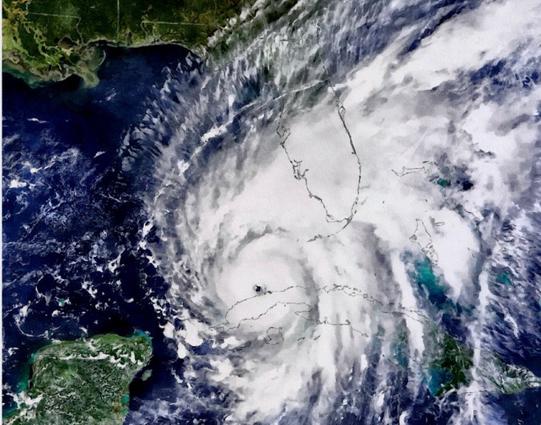
 Murphypop
 Your Autistic Life
 🍂:・*Fweeblies*:・🍂
 Shawn Langley


 NastyBluePal
 Modern Cryptozoology
 Gsnsp
Gsnsp