 Comité Laïcité République [Unofficial]
" Marc Bloch, Joséphine Baker, Robert Badinter... Pourquoi Emmanuel Macron multiplie les panthéonisations ?" (Marianne, 18 juin 26)

" Marc Bloch, Joséphine Baker, Robert Badinter... Pourquoi Emmanuel Macron multiplie les panthéonisations ?" (Marianne, 18 juin 26)
"Marc Bloch au Panthéon : une vie d'engagements" (La Croix l'hebdo, 20 juin 26)

"Les leçons de Marc Bloch pour la France d'aujourd'hui" (Le Point, 11 juin 26)

Marc Bloch : "Sur les lieux du martyre" (Le Point, 11 juin 26)

"« L'Étrange Défaite », résurrection d'un chef-d'œuvre" (Le Point, 11 juin 26)

"Marc Bloch, historien et résistant, va entrer au Panthéon, annonce Emmanuel Macron" (AFP, lemonde.fr , 23 nov. 24)

10 juin 1944 | Le récit du massacre d’Oradour-sur-Glane
Oradour-sur-Glane est en 1944 une terre d’accueil, un village à la fois paisible et dynamique.
Dans les jours précédents
Cette troupe sous-équipée est déployée près de Montauban, où elle commet des atrocités. Le 8 juin, une partie de la division, environ 8500 hommes, participent à ce déplacement jalonné de massacres, pillages, incendies, et atteignent le 9 juin Limoges, Guéret, et Argenton-sur-Creuse. Ils se dirigent vers Tulle et Limoges pour contrer la Résistance, suivant le plan du général Lammerding, commandant de la division, dans un rapport à sa hiérarchie en date du 5 juin visant à la criminalisation des “bandes” par la pression sur les populations civiles, ainsi qu’à l’application de mesures répressives brutales pour une “reprise en main de la zone”.
Le 9 juin, 99 otages sont pendus à Tulle, prélude au drame d’Oradour le 10 juin.
Oradour avant le massacre
La guerre a fait d’Oradour-sur-Glane en Limousin un refuge pour de nombreux Espagnols, Alsaciens et Juifs. Son activité commerciale et agricole attire les citadins en quête de ravitaillement, notamment grâce au chemin de fer qui dessert Limoges et Saint-Junien. Le centre-bourg dispose de commerces, services et de quatre écoles : le samedi 10 juin 1944, le village est animé.
Qui sont les exécuteurs ?
Les auteurs du massacre appartiennent au régiment Der Führer de la division Waffen SS Das Reich.
Créée en 1938, cette division est tristement célèbre pour ses exécutions massives de civils en Europe et sur le front de l’Est.
Reconstituée près de Bordeaux en 1944 après sa retraite du front de l’Est, elle intègre de nouvelles recrues.
Le jour du massacre
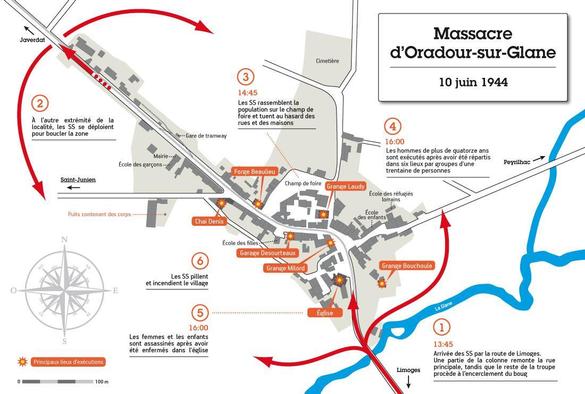
Le 10 juin, environ 150 Waffen SS menés par le capitaine Kahn, partent vers 13h pour Oradour. Alors que les premiers véhicules entrent dans le village, il est déjà encerclé et les premières exécutions ont déjà eu lieu aux abords du village.
Les habitants sont conduits vers le centre du village et rassemblés sur le champ de foire. Ceux qui ne peuvent pas suivre sont abattus. Les hommes sont séparés des femmes et des enfants, emmenés à l’église.
Les hommes sont placés dans des lieux clos et exécutés simultanément. Femmes et enfants sont massacrés dans l’église, que les soldats incendient.
En début de soirée, certaines troupes retournent à leurs quartiers, tandis que d’autres gardent la ville dévastée. Le lendemain, une section revient pour se débarrasser des corps.
Source du texte : https://www.visitlimousin.com/centre-de-la-memoire-doradour-sur-glane/le-centre-de-la-memoire-doradour/le-recit-du-massacre-doradour-sur-glane/
Source de l'image, Wikimedia Commons : https://commons.wikimedia.org/wiki/File:Massacre_d%27Oradour-sur-Glane2.jpg
#OradourSurGlane #10Juin1944 #Massacre #DevoirDeMemoire #Memoire #Histoire #SecondeGuerreMondiale #WWII #Occupation #Nazisme #WaffenSS #DasReich #DerFuhrer #CrimeDeGuerre #CrimeContreLHumanite #Barbarie #Resistance #Limousin #HauteVienne #Tulle #France #Patrimoine #CentreDeLaMemoire #Victimes #Civils #PersécutionsNazies #VictimesDuNazisme #Souvenir #Transmission #HistoireDeFrance #Libération #NeverForget #PlusJamaisCa #Commemoration #MemoireCollective #Tragedie #VillageMartyr #GenocideCulturel #Justice #VeriteHistorique #Education #RecitHistorique #PatrimoineMemoriel #Hommage #Limousin #Occitanie #OccitanieHisttorique
 vcallinan
 Claude Trudel
 Horzagger

 CBC North