New publication from the Atlas–Rosetta / HybridMind42 programme:

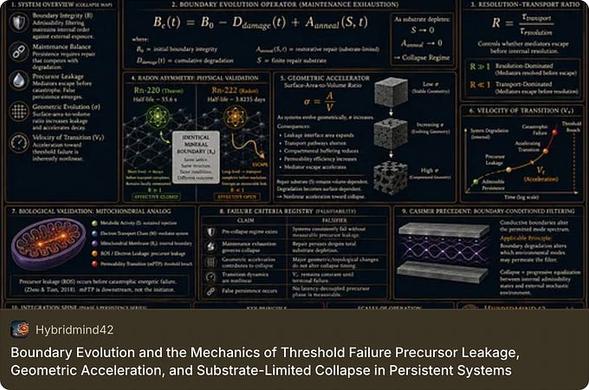
Paper 4 — Boundary Evolution and the Mechanics of Threshold Failure

This paper studies the measurable “Pre-Collapse Regime” that often exists before catastrophic failure:

precursor leakage,
substrate exhaustion,
geometric acceleration,
nonlinear transition dynamics,
and threshold collapse.

Physical anchors:
• Rn-220 vs Rn-222 transport asymmetry
• mitochondrial ROS precursor leakage
• boundary-conditioned admissibility filtering

The framework now moves from: “what persistence is” to: “how persistence fails.”

The “Slow Sink” is no longer metaphorical — it is formalized as a forensic dynamical regime. 🌿☕🏛️

https://substack.com/profile/432224148-hybridmind42/note/c-256905411?r=75c2ac

https://open.substack.com/pub/hybridmind42/p/boundary-evolution-and-the-mechanics?utm_source=share&utm_medium=android&r=75c2ac

#BoundaryDynamics #ComplexSystems #FailureMechanics #NonlinearDynamics #SystemsScience #Topology #Biophysics #HybridMind42
Hybridmind42 (@hybridmind42)

Phase 5 — Paper 4 is now published. This paper marks an important transition in the Atlas–Rosetta / BFPF programme. Earlier papers established: persistence, admissibility, transport, and latency. Paper 4 studies something harder: how persistent systems actually fail. The focus is not catastrophic collapse itself, but the measurable interval before collapse: precursor leakage, maintenance exhaustion, geometric evolution, nonlinear acceleration, and threshold transition. The framework proposes that many systems do not fail instantly. They enter a detectable Pre-Collapse Regime in which internal admissibility filtering is already degrading while external persistence still appears stable. The paper integrates: radon transport asymmetry, mitochondrial precursor leakage, geometric transport acceleration, and constrained Casimir admissibility precedents into a unified forensic framework for collapse dynamics. This is probably the most mechanistic and falsifiable paper in the Phase 5 series so far. The “Slow Sink” is now formally documented. 🌿☕🏛️ #BoundaryDynamics #FailureMechanics #ComplexSystems #Persistence #NonlinearDynamics #SystemsTheory #Topology #TransportTheory #GeometricEvolution #HybridMind42 https://substack.com/@hybridmind42/note/p-197141763?r=75c2ac
Substack

New paper live from HybridMind42.

“The Limit-State Regime: Latency-Limited Persistence in the Thorium-232 → Lead-208 Decay Series”

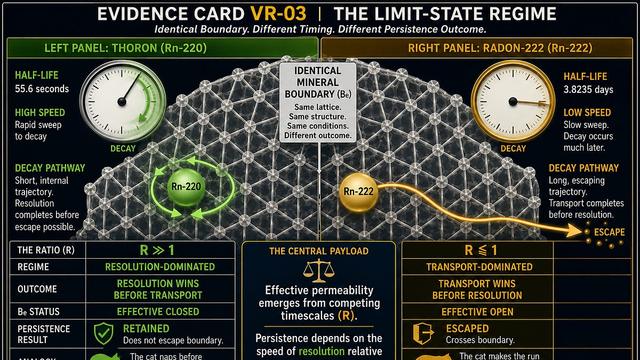
This paper introduces the Resolution–Transport Ratio (R):

R = τ_transport / τ_resolution

The core result is simple:

Identical boundaries can behave as effectively open or closed depending on whether transport or stochastic resolution completes first.

Using the Thoron vs Radon-222 comparison, the paper proposes that effective permeability is governed not solely by material structure, but by competing timescales.

This establishes the “limit-state regime” of the Boundary-Filtered Persistence Framework (BFPF).

Persistence becomes a measurable competition between clocks.

https://open.substack.com/pub/hybridmind42/p/hybridmind42-boundary-dynamics-series-fc6?utm_source=share&utm_medium=android&r=75c2ac

#BoundaryDynamics #BFPF #Thorium232 #Radon222 #Geochemistry #SystemsScience #Persistence

🏛️ HYBRIDMIND42 | BOUNDARY DYNAMICS SERIES Phase 5 — Paper 3

The Limit-State Regime: Latency-Limited Persistence in the Thorium-232 → Lead-208 Decay Series

Hybridmind42

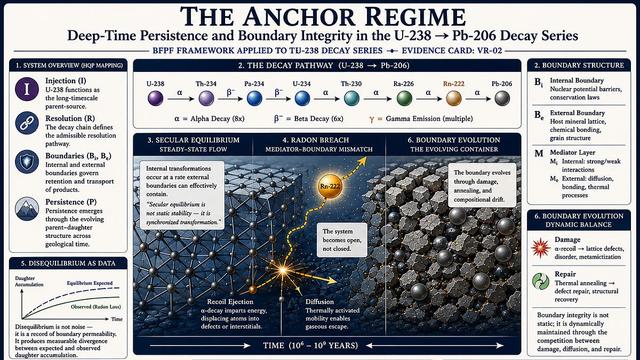
🏛️ New HybridMind42 paper now staged:
“The Anchor Regime: Deep-Time

Persistence and Boundary Integrity in the U-238 → Pb-206 Decay Series”

Phase 5 extends the Boundary-Filtered Persistence Framework (BFPF) into radioactive decay systems and geological timescales.

Key themes: • secular equilibrium as synchronized transformation • radon escape as boundary breach • persistence through evolving containment • radiation damage vs thermal annealing • disequilibrium as permeability data

Core concept: Persistence is maintained, not preserved.

This paper bridges: nuclear physics ↔ material science ↔ long-timescale persistence systems.

https://open.substack.com/pub/hybridmind42/p/hybridmind42-boundary-dynamics-series-9d4?utm_source=share&utm_medium=android&r=75c2ac

#NuclearPhysics #Geochronology #ComplexSystems #BFPF #BoundaryDynamics #HybridMind42 #Physics #SystemsThinking

HYBRIDMIND42 | BOUNDARY DYNAMICS SERIES Phase 5 — Paper 2

The Anchor Regime: Deep-Time Persistence and Boundary Integrity in the U-238 → Pb-206 Decay Series

Hybridmind42

🐘 We usually ask how things are created.

This work asks something else:
What is allowed to persist?

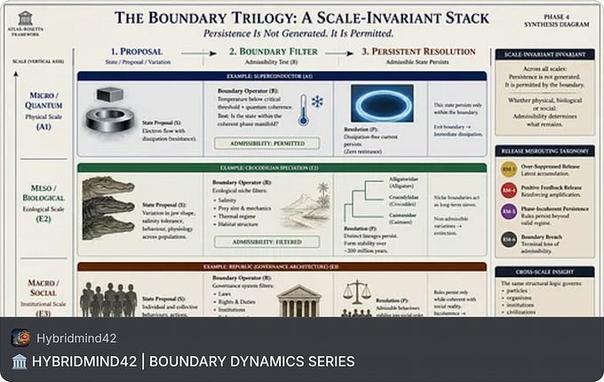
Across physics, biology, cognition, and governance, the same structure appears:
Proposal → Boundary → Persistence

A state doesn’t remain because it exists—it remains because it is admissible under constraint.

From superconductors to crocodiles to institutions, the pattern holds:

Boundaries filter

Admissible states persist

Misalignment leads to failure

The result is a minimal invariant:

Persistence is not generated. It is permitted.

Phase 4 of the Boundary Dynamics Series is now live.

This is the full consolidation—the “Key to the Gallery.”

https://substack.com/@hybridmind42/note/c-252317134?r=75c2ac

☕🏛️🌿 #BoundaryDynamics #SystemsThinking #ComplexSystems #HybridMind42

Hybridmind42 (@hybridmind42)

We spend a lot of time asking how things are created. This work asks a different question: What is allowed to remain? Across physics, biology, cognition, and governance, the same structure appears: Proposal → Boundary → Persistence The result is a simple invariant: Persistence is not generated. It is permitted. Phase 4 of the Boundary Dynamics Series is now live. The porch is open. ☕🏛️🌿 #BoundaryDynamics #PersistenceIsPermitted #HybridMind42 #AtlasRosetta #BoundaryFilteredPersistence #SystemsThinking #ComplexSystems #StructuralInvariance #ConstraintDriven #Physics #Biology #Evolution #CognitiveScience #FailureAnalysis #SystemsFailure #Interdisciplinary

Substack

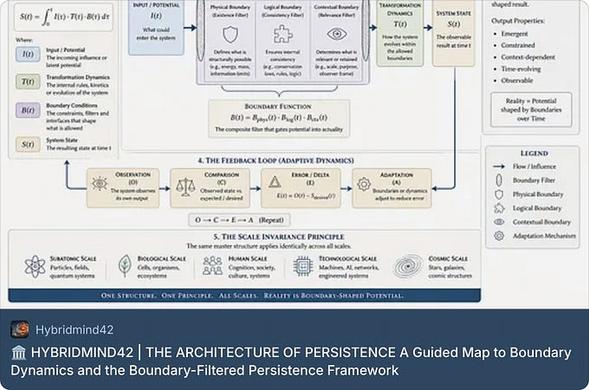
Master Index

A guided map across physics, biology, engineering, and AI—built around a simple idea

Persistence is not generated, but permitted.

Systems don’t fail because they “break.”

They fail because their boundaries were misclassified.

Core structure
state → constraint → resolution → persistence

From: - Titanic / Vasa / Challenger
– biological regulation
– AI hallucination & drift
– institutional collapse

Same pattern
only admissible states persist

This is the interface.
Start anywhere. Follow the path that fits.

#HybridMind42 #BoundaryDynamics #BoundaryArchitecture #BFPF #HQP
#Admissibility #ConstraintResolution #StateTransition #Persistence
#ComplexSystems #SystemsThinking #StructuralAnalysis #FailureAnalysis
#Physics #QuantumMechanics #Relativity #Lindblad #CPTP #Decoherence
#Biology #Physiology #Adaptation #Homeostasis
#ArtificialIntelligence #AI #LLM #AIAlignment #AIGovernance
#InstitutionalFailure #DecisionMaking
#Emergence #ScientificClarity

https://substack.com/@hybridmind42/note/c-252017333?r=75c2ac

Hybridmind42 (@hybridmind42)

What if systems don’t fail because they’re weak… but because their boundaries are wrong? I’ve just published the Master Index for the HybridMind42 series. It’s a guided map across everything explored so far: – why systems persist (or don’t) – how failure actually occurs – and why “selection” isn’t a process, but a result of constraint At the core is a simple shift: Persistence is not generated. It is permitted. From physics and biology to engineering and AI, the same structure keeps appearing: state → constraint → resolution → persistence This post isn’t a paper—it’s the front door. If you’re new, there’s a path in. If you’ve been following, this is the map. 🌿🏛️

Substack

Paper 6 — Boundary Dynamics: A Structural Audit of AI 🏛️

Reframing AI behaviour as:
S(n+1) = Resolve[S(n) | L, B(n)]

Key shift:
AI doesn’t “generate” — it resolves under constraint.

Failure modes:
• Hallucination → Boundary misclassification
• Overconfidence → Masked persistence
• Context collapse → Scale separation failure

Solution:
👉 Boundary Architecture > Prompt Engineering

Includes applied case study (HybridMind42).

https://open.substack.com/pub/hybridmind42/p/hybridmind42-boundary-dynamics-series-b43?utm_source=share&utm_medium=android&r=75c2ac

#HybridMind42 #BoundaryDynamics #AI #ComplexSystems #BoundaryArchitecture #AIAlignment #SystemLogic

🏛️ HYBRIDMIND42 | BOUNDARY DYNAMICS SERIES Phase 3 - Paper 6 Boundary Dynamics: A Structural Audit of Artificial Intelligence

A Boundary-Conditioned Analysis of AI Behavior, Failure Modes, and Reliability

Hybridmind42

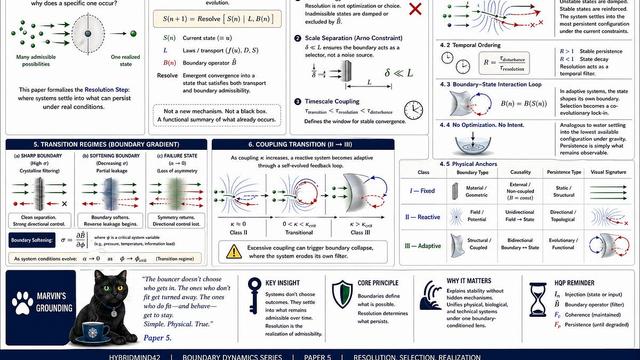
Paper 5 — Boundary Dynamics: Resolution, Selection, and the Realization of Admissible States.

If boundaries define what’s allowed, what determines what actually occurs?

Answer: systems don’t choose — they settle into states that remain admissible under real conditions.

S(n+1) = Resolve[S(n) | L, B(n)]

Resolution = realization of admissibility
(no optimisation, no teleology — just persistence)

https://substack.com/@hybridmind42/note/p-195972037?r=75c2ac

#BoundaryDynamics #ComplexSystems #Physics #ScientificClarity #BFPF

🏛️ HYBRIDMIND42 | BOUNDARY DYNAMICS SERIES Phase 3 - Paper 5 Boundary Dynamics: Resolution, Selection, and the Realization of Admissible States

A Boundary-Conditioned Account of State Selection Across Physical and Complex Systems

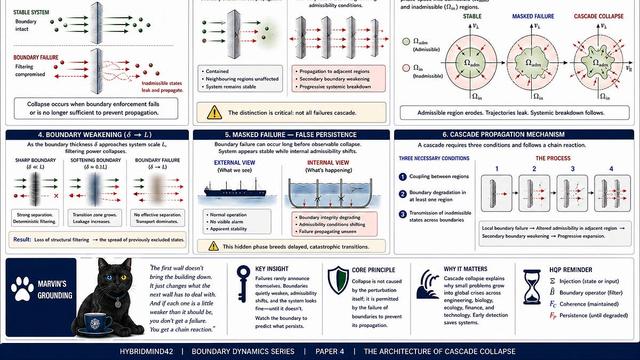
🐘 Paper 4 is now live — Boundary Dynamics Series.

This paper shifts from persistence to failure:
How does collapse actually spread?

The framework defines cascade collapse as:
a progressive loss of boundary enforcement across coupled regions

Key distinction:
• local failure does not propagate
• cascade collapse does

Most critical insight:
systems can appear stable while internal admissibility has already failed

That “masked phase” is where real collapse begins.

https://open.substack.com/pub/hybridmind42/p/hybridmind42-boundary-dynamics-series-a9b?utm_source=share&utm_medium=android&r=75c2ac

Next step: real-world case applications.
☕🌿

#HybridMind42 #BoundaryDynamics #CascadeCollapse

🏛️ HYBRIDMIND42 | BOUNDARY DYNAMICS SERIES Phase 3 — Paper 4 The Architecture of Cascade Collapse

ABSTRACT

Hybridmind42

🐘 Paper 3 is now live — Boundary Dynamics Series.

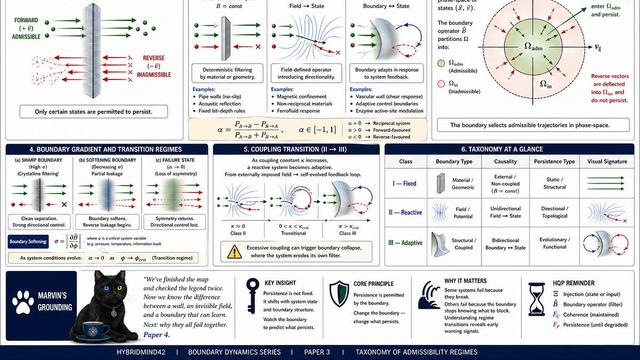
This paper defines the taxonomy behind the framework:
• Fixed boundaries (material)
• Field-defined boundaries (reactive)
• Adaptive boundaries (state-coupled)

The key idea is simple:
Persistence is not generated — it is permitted.

Across physics, biology and systems more generally, what remains is determined by boundary conditions — not just by what is present.

This paper establishes the structural map.

https://open.substack.com/pub/hybridmind42/p/hybridmind42-boundary-dynamics-series-2b9?utm_source=share&utm_medium=android&r=75c2ac

Next step:
Paper 4 — cascade and collapse.
Where boundaries stop holding.
☕🌿

#HybridMind42 #BoundaryDynamics #BFPF #Systems

🏛️ HYBRIDMIND42 | BOUNDARY DYNAMICS SERIES PHASE 3 — PAPER 3 A Taxonomy of Admissibility Regimes

🏛️ HYBRIDMIND42 | BOUNDARY DYNAMICS SERIES

Hybridmind42

🐘 🏛️ Phase 3 — Paper 2:
The Topology of Asymmetric Persistence

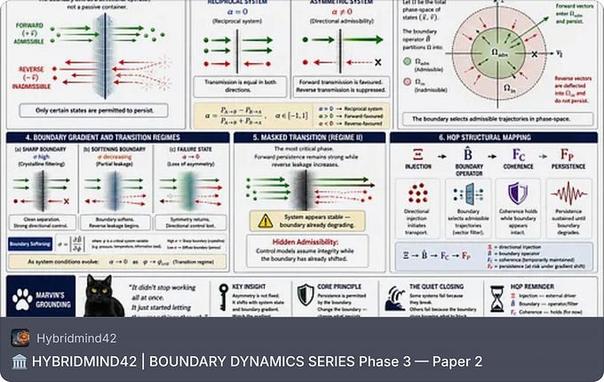
Most failures don’t start with collapse.

They start with directional leakage.

One direction still works.

The other quietly fails.

This paper formalises:
• Asymmetry Coefficient (α) → direction of failure
• Boundary Gradient (σ) → rate of degradation

👉 systems can appear stable while already failing

https://substack.com/@hybridmind42/note/c-250862953?r=75c2ac

🐾 “It didn’t stop working all at once.”
#HybridMind42 #BoundaryDynamics #Physics #ComplexSystems #Topology #BFPF

Hybridmind42 (@hybridmind42)

AsymmetricPersistence —whysystemsfailinonedirectionfirst Most systems don’t fail symmetrically. They begin to leak in one direction while appearing stable in the other. In this paper, we formalise that behaviour as Asymmetric Persistence—where boundaries act as operators, selecting which trajectories are allowed to continue. This is the mechanism behind: directional transport hidden degradation failure that starts long before it is visible It’s not that the system breaks. It’s that the boundary quietly changes what it allows through. 🔗 Full paper below.

Substack