The latest blog post on the Alternative Social Media blog is about Guifi.net, mesh networks, and the role of "persistence" in activism against Big Tech:

https://www.socialmediaalternatives.org/2026/05/27/guifi.html

#alternativesocialmedia

Guifi: Mesh Networks, Persistence, and Lessons for ASM

Dr. Paloma Viejo Otero recently presented research (co-authored with Dr. Eugenia Siapera and Efrain Foglia ) at the Statecraft, Sovereignty, and Digital Governance symposium at Goldsmiths University of London. At the symposium, Paloma talked about Guifi.net, a longstanding mesh network in Spain. The following interview, conducted by Robert W. Gehl via email, is based on that presentation and on a conversation between Paloma and Robert at a pub after a day at the conference.

The Network of Alternative Social Media Researchers
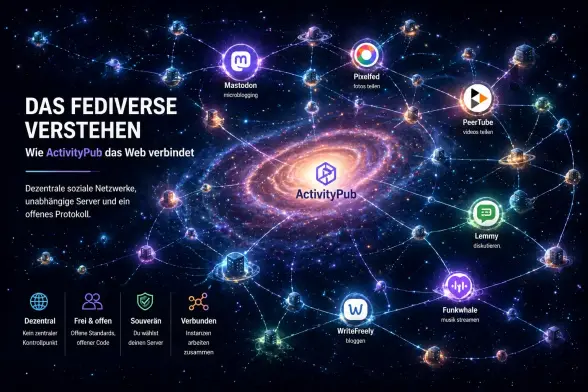
Understanding the Fediverse: How ActivityPub is Reshaping Social Media

In recent years, a new term has been gaining attention in discussions about alternative social networks: the Fediverse. But what exactly is it? How does the underlying protocol ActivityPub work—and which platforms are part of it?

What is the Fediverse?

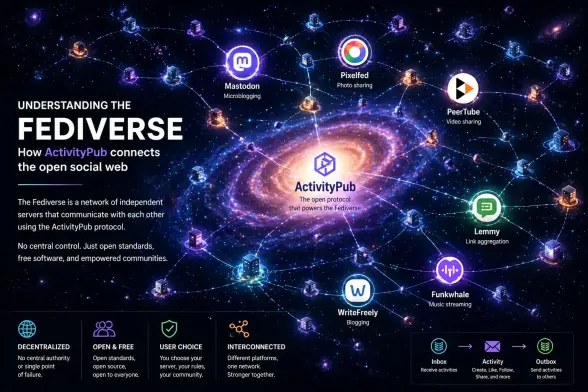
The word Fediverse is a combination of federation and universe. It refers to a network of independent servers (called instances) that can communicate with each other.

Unlike traditional social networks like Facebook or X (Twitter), which are centrally controlled, the Fediverse is decentralized:

Anyone can run their own server
Each instance has its own rules and moderation
Users can interact across different servers

The result is an open ecosystem instead of a single platform.

The Core: How ActivityPub Works

ActivityPub is an open standard (developed by the W3C) that defines how servers in the Fediverse communicate with each other.

At its core, ActivityPub is built around two main concepts:

1. Actors

Every user, group, or even bot is considered an actor.
Example:

@[email protected]
2. Activities

Everything that happens is described as an activity:

Creating a post → Create
Following someone → Follow
Liking content → Like
Sharing content → Announce

A Simple Example

Imagine you are on Server A and follow someone on Server B:

You click “Follow”
Server A sends a Follow request to Server B
Server B confirms the request
New posts are automatically delivered to Server A

All of this happens via HTTP and JSON—similar to modern web APIs.

The Inbox & Outbox Model

ActivityPub uses a clear communication structure:

Outbox: Where a user sends activities
Inbox: Where a user receives activities

Each server manages these and distributes content to other servers.

Benefits of ActivityPub
Decentralization: No single point of control
Interoperability: Different platforms can work together
User autonomy: You choose your server
Resilience: No single point of failure
Popular Platforms in the Fediverse

The Fediverse is not one platform, but many interconnected ones:

🐘 Mastodon
Microblogging (similar to Twitter/X)
The most well-known Fediverse platform
📷 Pixelfed
Image-focused (Instagram alternative)
🎥 PeerTube
Decentralized video hosting (YouTube alternative)
✍️ WriteFreely
Blogging platform
💬 Lemmy
Link aggregation (similar to Reddit)
🎵 Funkwhale
Music streaming in the Fediverse


Why the Fediverse Matters Now

Many users are looking for alternatives to big platforms due to:

Privacy concerns
Algorithmic control
Commercialization of content

The Fediverse offers a different approach: open, community-driven, and independent.

Challenges

Despite its potential, the Fediverse also comes with challenges:

A learning curve for new users
Different moderation standards across instances
A sometimes fragmented user experience
Conclusion

The Fediverse is more than just an alternative to existing social networks—it represents a fundamental shift in how we think about online communication.

With ActivityPub as its foundation, it enables an open network that puts control and diversity back into the hands of users.

#Fediverse #ActivityPub #Dezentralisierung #OpenWeb #SocialMedia #Web3 #Internet #DigitaleSouveränität #OpenSource #Protokolle #WebStandards #APIs #JSON #HTTP #SoftwareArchitektur #Mastodon #Pixelfed #PeerTube #Lemmy #Funkwhale #WriteFreely #Datenschutz #Digitalisierung #Netzpolitik #AlternativeSocialMedia #Community #Bloggen #TechBlog #DigitalTrends #Internetkultur
Das Fediverse verstehen: Wie ActivityPub soziale Netzwerke neu denkt

In den letzten Jahren taucht immer häufiger ein Begriff auf, wenn es um alternative soziale Netzwerke geht: Fediverse. Doch was steckt dahinter? Wie funktioniert das zugrunde liegende Protokoll ActivityPub – und welche Plattformen gehören eigentlich dazu?

Was ist das Fediverse?

Das Wort „Fediverse“ setzt sich aus Federation (Föderation) und Universe zusammen. Gemeint ist ein Netzwerk aus vielen unabhängigen Servern (Instanzen), die miteinander kommunizieren können.

Im Gegensatz zu klassischen sozialen Netzwerken wie Facebook oder X (Twitter), die zentral betrieben werden, ist das Fediverse dezentral organisiert:

Jeder kann einen eigenen Server betreiben
Jede Instanz hat eigene Regeln und Moderation
Nutzer können instanzübergreifend miteinander interagieren

Das Ergebnis ist ein offenes, vernetztes Ökosystem statt einer einzelnen Plattform.

Das Herzstück: Wie ActivityPub funktioniert

ActivityPub ist ein offener Standard (W3C), der definiert, wie Server im Fediverse miteinander kommunizieren.

Im Kern basiert ActivityPub auf zwei Konzepten:

1. Akteure (Actors)

Jeder Nutzer, jede Gruppe oder auch ein Bot ist ein sogenannter Actor.
Beispiel:

@[email protected]
2. Aktivitäten (Activities)

Alles, was passiert, wird als Aktivität beschrieben:

Post erstellen → Create
Folgen → Follow
Liken → Like
Teilen → Announce

Ein einfaches Beispiel

Angenommen, du bist auf Server A und folgst jemandem auf Server B:

Du klickst auf „Folgen“
Server A sendet eine Follow-Anfrage an Server B
Server B bestätigt diese
Neue Beiträge werden automatisch an Server A übertragen

Das Ganze passiert über HTTP und JSON – technisch ähnlich wie moderne Web-APIs.

Inbox & Outbox Prinzip

ActivityPub nutzt ein klares Kommunikationsmodell:

Outbox: Hier sendet ein Nutzer seine Aktivitäten
Inbox: Hier empfängt ein Nutzer Aktivitäten anderer

Jeder Server verwaltet diese Strukturen und verteilt Inhalte an andere Server.

Vorteile von ActivityPub
Dezentralität: Keine zentrale Kontrolle
Interoperabilität: Verschiedene Plattformen können zusammenarbeiten
Datensouveränität: Nutzer wählen ihren Server selbst
Ausfallsicherheit: Kein Single Point of Failure

Bekannte Plattformen im Fediverse

Das Fediverse besteht nicht aus einer Plattform, sondern aus vielen, die miteinander kompatibel sind:

🐘 Mastodon
Microblogging (ähnlich wie Twitter/X)
Der bekannteste Vertreter des Fediverse
📷 Pixelfed
Fokus auf Bilder (Instagram-Alternative)
🎥 PeerTube
Dezentrale Videoplattform (YouTube-Alternative)
✍️ WriteFreely
Blogging-Plattform
💬 Lemmy
Link-Aggregator (ähnlich Reddit)
🎨 Funkwhale
Musik-Streaming im Fediverse
Warum das Fediverse gerade jetzt relevant ist

Viele Nutzer suchen nach Alternativen zu großen Plattformen – aus Gründen wie:

Datenschutzbedenken
Algorithmische Kontrolle
Kommerzialisierung von Inhalten

Das Fediverse bietet hier einen anderen Ansatz: offen, gemeinschaftlich und unabhängig.

Herausforderungen

So vielversprechend das Fediverse ist, es bringt auch Herausforderungen mit sich:

Komplexität für Einsteiger
Unterschiedliche Moderationsregeln
Teilweise fragmentierte Nutzererfahrung
Fazit

Das Fediverse ist mehr als nur eine Alternative zu bestehenden sozialen Netzwerken – es ist ein grundlegender Perspektivwechsel.
Mit ActivityPub als technischem Fundament entsteht ein offenes Netzwerk, das Vielfalt und Kontrolle zurück in die Hände der Nutzer legt.

#Fediverse #ActivityPub #Dezentralisierung #OpenWeb #SocialMedia #Web3 #Internet #DigitaleSouveränität #OpenSource #Protokolle #WebStandards #APIs #JSON #HTTP #SoftwareArchitektur #Mastodon #Pixelfed #PeerTube #Lemmy #Funkwhale #WriteFreely #Datenschutz #Digitalisierung #Netzpolitik #AlternativeSocialMedia #Community #Bloggen #TechBlog #DigitalTrends #Internetkultur
What is 'alternative' about alternative social media?
Reviewing literature on alternative social media, we provide an overview of what scholars consider alternative, and reflect on what it means to study ASM

Read more here:
https://test.roelof.info/log/what-is-alternative-about-asm/

#alternative social media #fediverse #literature review #STS #written work
We are now on #twtxt

https://b0nfire.xyz/twtxt.txt

"a few years late, eh?"

It's at a friend's behest, and it doesn't cost me anything but a text file and a little care.

Smaller, incremental updates and planning posts will be made there, there's even a photo there that isn't here. 😲

wowzers! Check out twtxt: https://github.com/buckket/twtxt

#alternativesocialmedia #smallweb #indiewebsocial #indieweb

Wie viele Europäische Start-ups für eine Alternative zu den Big-Tech Plattformen wie Meta und TikTok gibt es bereits?

Mir fällt wedium ein. Lass mal sammeln. Mich interessiert, was sie anders machen wollen.

#alternativesocialmedia #eusociamedia #digitalact

Tumblr has changed how interactions with posts work and people are PISSED.

https://www.tumblr.com/changes/811285635102130176/its-very-clear-that-you-all-have-strong-feelings

Basically, they've gone from a distinctive "everything is a chain and you see _all_ of the downstream activity from your post/reblog" approach to a Twitter/Bluesky/Mastodon-style "you reblog and the OP sees interactions (probably) or you quote-post and the OP sees nothing more".

Which… yeah, sure, great for Likes, because now you get to like _specific_ posts within the chain of half-a-dozen rather than having "you've liked one post in this chain therefore you liked the whole chain".

But it's DREADFUL for small creatives who get reblogged by a big account that adds a comment saying "You should check this out ☝" because that breaks the chain and the OP doesn't see future interactions including replies. Which is a bit shit on the "small creatives and niche fandoms" site 😐

(People can _choose_ to click the reply on the OP and reply directly… but that requires a change of behaviour, and how many users are ACTUALLY going to change behaviour like that?! 🙄)

#Tumblr #AlternativeSocialMedia

Reblog by @changes

💬 42131  🔁 118078  ❤️ 63063 · It’s very clear that you all have strong feelings about Tumblr and about this change. We hear you. The passion people have for how Tumblr works is one of the things th…

Tumblr