 poleguy looking for lost tools
Making it match the sim.
Clock shows one clock between last data transition and rising edge of we_n, scope shows two.
Getting closer!
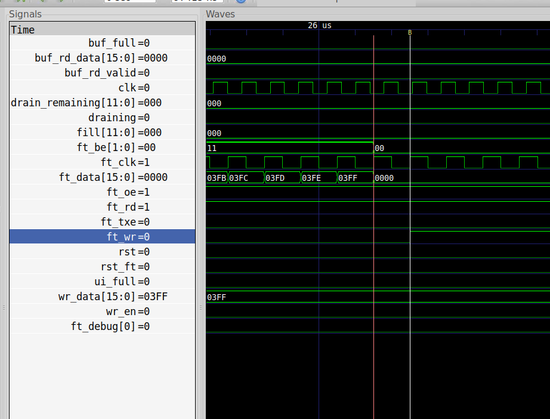
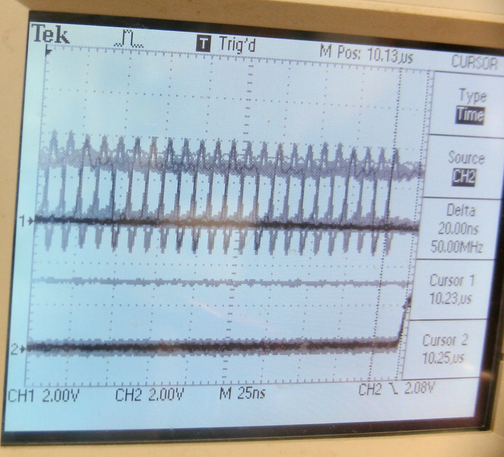
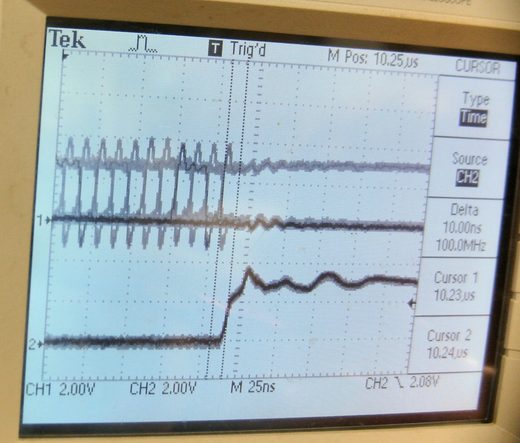
Making it match the sim.
Clock shows one clock between last data transition and rising edge of we_n, scope shows two.
Getting closer!
Start rtl counter with a timer that is initialized 10 seconds from a 32bit wrap point so that the software handling of wrap-around is well exercised during development.
#rtl #fpga #verilog #vhdl #xilinx #alchitry #eureka #protonpack #software #softwaredevelopment #hardware #embedded #fensterFreitag
Uhoh... my usb devices just went MIA. Is there a fire in the lab? ...running out there now to check. After I feed the cats.

I plugged it in to USB... it powered on.
I went to plug in the second USB and as the metal made contact it suddenly powered off...
I saw no magic smoke.
It sure looks dead. I hope it's not a design flaw... because I just ordered two replacements.
https://forum.alchitry.com/t/regulator-failure-on-1v8-from-adp5052acpz-r7-on-pt-board/3546

#Alchitry Pt #FPGA board has a Br Break out board. It's all differentially routed. But wow, not an exemplar break-out for 6+GHz capable pairs. Even if it were for 10MHz signals, that breakout pattern is terrible. Swiss cheeze.
I guess for only fifteen bucks it's good enough, but yeah, maybe for the next spin you could hook up more than one ground pin? At least the pinout on the FPGA board seems to have a good number of ground pins.
But now I should inspect the Pt layout closely.
More in alt.

@PaulaMaddox I didn't actually post to the forums yet, but I got it working. I had the FT600 board underneath the FPGA board and it did not work. I then tried it with the FT600 board on the top (because I wanted to probe it) and then it suddenly worked with the loopback test.
Great success for day one!
It's not clear what the problem with in the other configuration, but that can wait till another day.
YAY, #neorv32 built with a VERY simple memory interface which I've connected to LEDs on my #Alchitry #FPGA board
I can now send data via memory to my own custom blocks (I think).
Next step is to figure out the memory mapping proper.


#Retroputer #FPGA Update
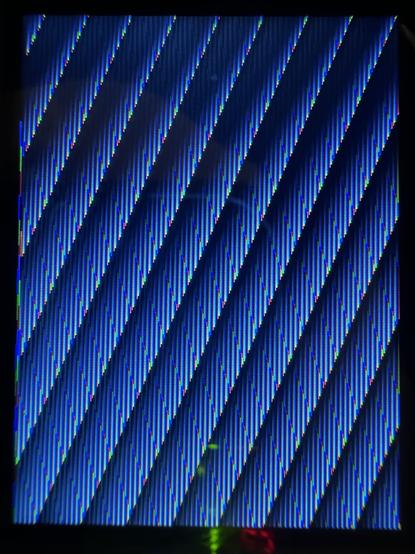
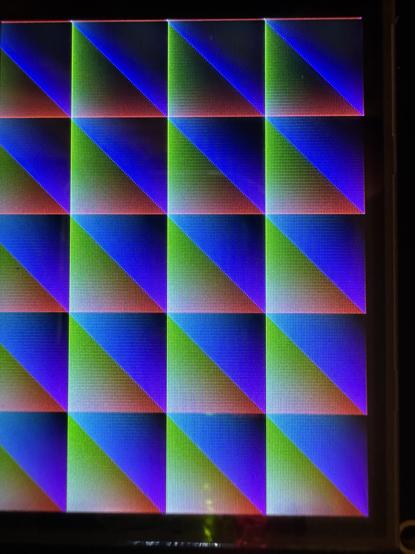
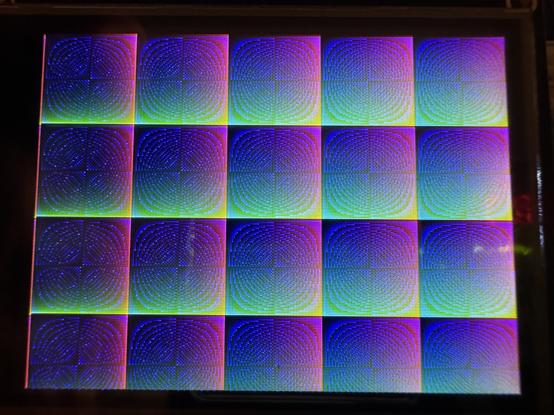
Bought a 2.4" TFT ILI9341 from @adafruit and connected it up via 4-line SPI using #Alchitry Br (breakout board). I added an I/O device so the CPU can send D/C select bits and data bytes using a FIFO buffer.
After a bit of a false start (involved adapting Adafruit's init sequence and experimentation), we have something coherent on the screen!
Super slow to fill the screen w/ #BASIC (using OUT commands), but validates that my understanding mostly matches reality. Woot!
 Paula Maddox
 Kerri Shotts