Vladimir Hamed-Troyansky

634 Followers
477 Following
43 Posts
Assistant Professor at UC Santa Barbara. Historian of #migration, #refugees, #MiddleEast, #Caucasus. Author of Empire of Refugees (SUP, 2024).
Departmental profilehttps://www.global.ucsb.edu/people/vladimir-hamed-troyansky
Publicationshttps://ucsb.academia.edu/VladimirHamedTroyansky
Twitterhttps://twitter.com/VHTroyansky

My first book, Empire of Refugees: North Caucasian Muslims and the Late Ottoman State (February 2024), is available to preorder! Stanford University Press is running a 30% discount on its titles through the end of February 2024! https://www.sup.org/books/title/?id=33134

Based on research in Ottoman Turkish, Arabic, and Russian in 20+ archives in 10 countries, this book examines the migration and resettlement of about a million Muslim refugees (Circassians, Chechens, Dagestanis, and others) from Russia to the Middle East and the Balkans.

The book demonstrates that, between 1860 and World War I, the Ottoman government created a refugee regime, providing safety, free land, and financial aid to Muslim refugees fleeing European occupation. It predated refugee systems set up by the League of Nations and the United Nations.

Please consider ordering this book for your library.

#histodon #histodons #middleeast #turkey #jordan #russia #refugees #migration
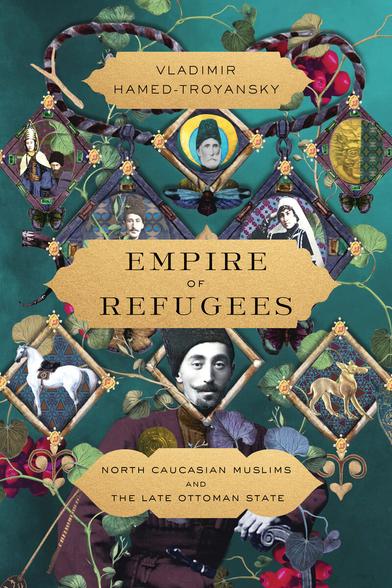
Empire of Refugees: North Caucasian Muslims and the Late Ottoman State - Vladimir Hamed-Troyansky

Between the 1850s and World War I, about one million North Caucasian Muslims sought refuge in the Ottoman Empire. This resettlement of Muslim refugees from Russia changed the Ottoman state. Circassians, Chechens, Dagestanis, and others established hundreds of refugee villages throughout the Ottoman Balkans, Anatolia, and the Levant. Most villages still exist today, including what is now the city of Amman. Muslim refugee resettlement reinvigorated regional economies, but also intensified competition over land and, at times, precipitated sectarian tensions, setting in motion fundamental shifts in the borderlands of the Russian and Ottoman empires. Empire of Refugees reframes late Ottoman history through mass displacement and reveals the origins of refugee resettlement in the modern Middle East. Vladimir Hamed-Troyansky offers a historiographical corrective: the nineteenth-century Ottoman Empire created a refugee regime, predating refugee systems set up by the League of Nations and the United Nations. Grounded in archival research in over twenty public and private archives across ten countries, this book contests the boundaries typically assumed between forced and voluntary migration, and refugees and immigrants, rewriting the history of Muslim migration in the nineteenth and early twentieth centuries.
Happy to share my new article, "Letters from the Ottoman Empire: Migration from the Caucasus and Russia's Pan-Islamic Panic," published by Slavic Review. https://doi.org/10.1017/slr.2023.164

For years, I have been searching for Muslim refugees' letters exchanged between the #Ottoman and Russian empires in the 1850s–1914. I was lucky to find quite a few: in archives in Tbilisi, Baku, Moscow, Vladikavkaz, and Makhachkala and private collections in #Jordan and Dagestan. The article explores the secret transborder #letter exchange of Caucasus Muslims and reactions by #Russia.

I argue that Muslims' letters from the Ottoman Empire fueled the Russian government's paranoia about Pan-Islamism that purportedly threatened Russia's colonial project in the #Caucasus. The Pan-Islamic panic shaped Russia's migration policies and colonial governance, including bans on Muslim pilgrimage to Mecca, emigration, and return migration.

#histodon #histodons #history #MiddleEast #Turkey

Letters from the Ottoman Empire: Migration from the Caucasus and Russia's Pan-Islamic Panic | Slavic Review | Cambridge Core

Letters from the Ottoman Empire: Migration from the Caucasus and Russia's Pan-Islamic Panic - Volume 82 Issue 2

Cambridge Core

I have a new article in Kritika! It is on the attempted return of the North Caucasian diaspora in the Middle East to its homeland within the Soviet Union and the Russian Federation since the 1960s. https://doi.org/10.1353/kri.2023.a904386

The article looks at the relationship between North Caucasians—especially #Circassians—in #Turkey, #Jordan, and #Syria with the #Caucasus. It focuses on (a) #Soviet propaganda tours for the diaspora and (b) diasporic efforts to secure the right of return to #Russia.

I show that the Soviet government's and the Circassian diaspora's goals did not align. The USSR wanted to extend its soft power in the Middle East through the diaspora, while Circassians wanted a pathway to repatriation. Yet these contacts in the 1960s–80s paved the way for transnational Circassian activism and repatriation demands after 1991. The article is based on archival research in Nalchik & fieldwork in Jordan and Istanbul.

Feel free to send me a message for a full pdf of the article!

Project MUSE - Welcome, Not Welcome: The North Caucasian Diaspora's Attempted Return to Russia since the 1960s

Niche topic warning!

I'm building a database of the administrative hierarchy of the Ottoman empire: ottgaz.org.

My core preliminary source is a huge spreadsheet called Osmanlı Yer Adları. #Ottoman historians know it well.

I've imported it wholesale, and now I'm finding and fixing errors that make the whole thing fall apart.

Today I find that this KEY province was misdated by 4 CENTURIES...oh well! #gazetteer #digitalHumanities

Happy to share my chapter, with translations from #Arabic and #Russian, on Chechen refugee migration in the gorgeous sourcebook Russian-Arab Worlds: A Documentary History, edited by Margaret Litvin, Eileen Kane, and Masha Kirasirova.

“Population Transfer: Negotiating the Resettlement of Chechen Refugees in the Ottoman Empire (1865, 1870),” pp. 60-68. https://academic.oup.com/book/46574/chapter-abstract/408283820

In 1865, #Russia organized the transfer of over 23,000 #Muslims (Chechens, some Ingush, Kabardians, Ossetians) out of the #Caucasus.

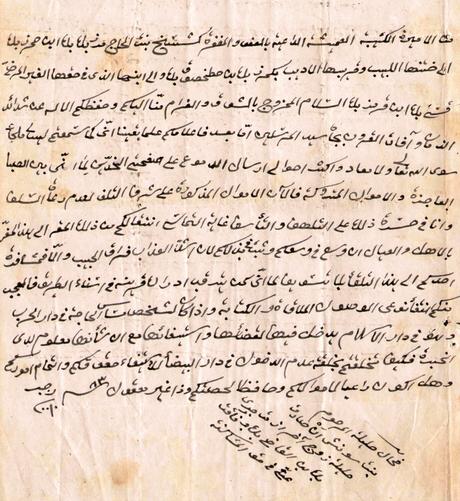
One of the documents that I translated (with Khalid Obeid) is a fascinating 1870 petition to the #Ottoman government by Jantemir, a #Chechen #refugee leader in Ra’s al-‘Ayn in northern #Syria. See the original image here: https://global.oup.com/us/companion.websites/9780197605769/res/ch6/

If you would like a copy of the chapter, please drop me a message.

This set of translated primary sources would make an awesome primary source assignment for an UG #syllabus on the #MiddleEast, the Ottoman Empire, or #migration.

Population Transfer: Negotiating the Resettlement of Chechen Refugees in the Ottoman Empire (1865, 1870)

AbstractThe half century before World War I saw mass population movements from Russia to the Middle East. One of the largest of these was the migration of Musli

OUP Academic
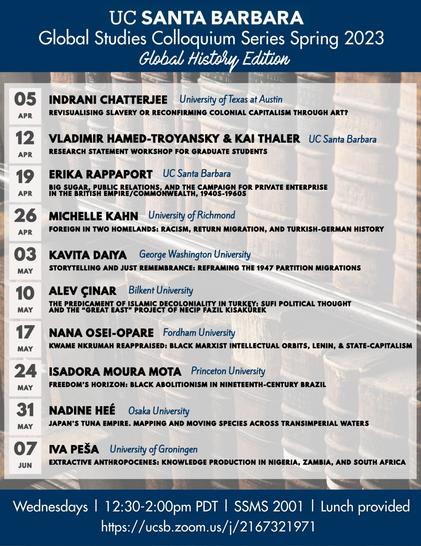
Please join us this spring on Zoom for a series of #GlobalHistory talks. I am co-organizing it with Dr. Anshu Malhotra at UC Santa Barbara, and we are excited about this brilliant lineup of speakers and topics. We start at 12:30 pm PDT (3:30 pm EDT, 9:30 pm CEST) every Wednesday.
#histodons #history #middleeast #turkey #germany #india #pakistan #ghana #nigeria #zambia #southafrica #brazil #migration
@avielroshwald Thank you. And congratulations to you on your new book!!

I am very happy to announce that my first book, Empire of Refugees: North Caucasian Muslims and the Late Ottoman State, will be published by Stanford University Press in 2024. https://www.sup.org/books/title/?id=33134

This book examines the #migration of about a million #Muslim #refugees from the #Caucasus to the #Ottoman Empire, with chapters on resettlement in Anatolia, the #Balkans, and the Levant. It also tells the story of the making of the Ottoman refugee regime between 1860 and World War I.

This book, a product of 10 years of work, is grounded in archival research in #Turkey, #Jordan, #Russia, #Bulgaria, #Romania, #Georgia, #Armenia, #Azerbaijan, the UK, and the USA; and interviews with people in the #Circassian, #Chechen, and other North Caucasian diasporas. I am very grateful to everyone.

The absolutely gorgeous book cover is based on the work of Jordanian collage artist Zaina El-Said. Please check out her beautiful art here: https://www.instagram.com/zainaelsaid/

#histodons #histodon #history #MiddleEast

Empire of Refugees: North Caucasian Muslims and the Late Ottoman State - Vladimir Hamed-Troyansky

Between the 1850s and World War I, about one million North Caucasian Muslims sought refuge in the Ottoman Empire. This resettlement of Muslim refugees from Russia changed the Ottoman state. Circassians, Chechens, Dagestanis, and others established hundreds of refugee villages throughout the Ottoman Balkans, Anatolia, and the Levant. Most villages still exist today, including what is now the city of Amman. Muslim refugee resettlement reinvigorated regional economies, but also intensified competition over land and, at times, precipitated sectarian tensions, setting in motion fundamental shifts in the borderlands of the Russian and Ottoman empires. Empire of Refugees reframes late Ottoman history through mass displacement and reveals the origins of refugee resettlement in the modern Middle East. Vladimir Hamed-Troyansky offers a historiographical corrective: the nineteenth-century Ottoman Empire created a refugee regime, predating refugee systems set up by the League of Nations and the United Nations. Grounded in archival research in over twenty public and private archives across ten countries, this book contests the boundaries typically assumed between forced and voluntary migration, and refugees and immigrants, rewriting the history of Muslim migration in the nineteenth and early twentieth centuries.

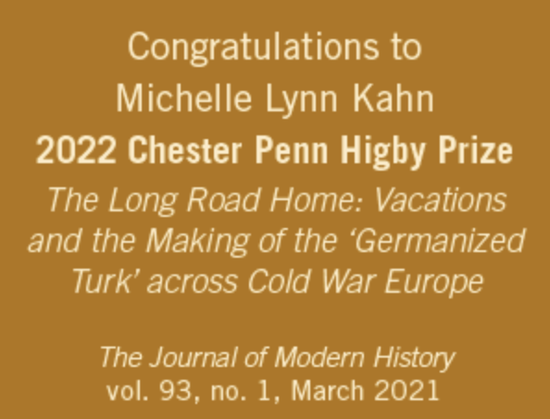
I am excited and humbled to announce that I won the 2022 Chester Penn Higby Prize for my article on Turkish-German migration, awarded by the @[email protected] Modern Europe Section and @[email protected]. You can read it for free in the Journal of Modern History (link+abstract below).