GDCh Division of Biochemistry
The #YoungScientistAward of the @gdch Division of Biochemistry is open for applications and nominations!
If you are or have supervised a PhD with an outstanding publication or PhD thesis, make sure to check out the award and apply/nominate!

| Homepage | https://www.universiteitleiden.nl/en/staffmembers/stephan-hacker#tab-1 |
| https://twitter.com/StephanHacker2 | |
| Bluesky | https://bsky.app/profile/stephanhacker2.bsky.social |
The #YoungScientistAward of the @gdch Division of Biochemistry is open for applications and nominations!
If you are or have supervised a PhD with an outstanding publication or PhD thesis, make sure to check out the award and apply/nominate!
Finally, he discussed the application of AI to predict the mechanism-of-action of an antibacterial compound on the example of enterololin, which they identified as an antibiotic against pathogenic Escherichia coli. (4/4)
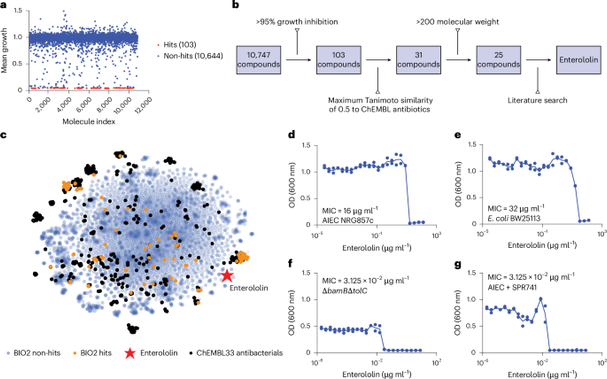
Enterololin is a narrow-spectrum antibiotic that selectively kills Enterobacteriaceae in vitro and in a mouse model of adherent-invasive Escherichia coli gut infection. AI-guided mechanism-of-action studies identified LolCDE as its molecular target.
He then talked about the use of AI to predict antibacterially active compounds that can be made from commercial fragments in straightforward chemical reactions and how they applied this strategy to the discovery of synthecin, active against S. aureus. (3/4)
https://link.springer.com/article/10.1038/s44320-026-00206-9
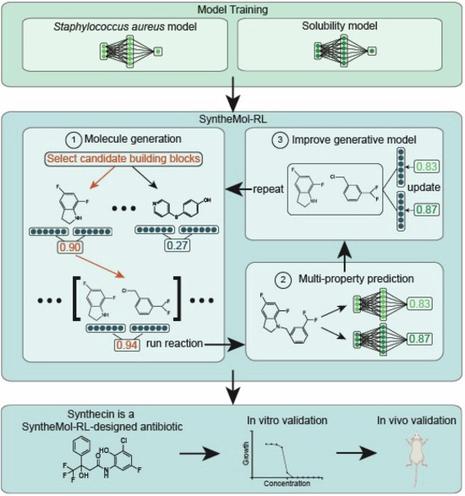
The rise of antibiotic-resistant pathogens such as Staphylococcus aureus has created an urgent need for new antibiotics. Generative artificial intelligence (AI) has shown promise in drug discovery, but existing models often fail to propose compounds that are both effective and synthetically tractable. To address these challenges, we introduce SyntheMol-RL, a reinforcement learning-based generative model that can rapidly design synthetically accessible small-molecule drug candidates from a massive chemical space of 46 billion compounds. SyntheMol-RL improves upon our prior Monte Carlo tree search (MCTS)-based SyntheMol model by generalizing across chemically similar building blocks and enabling multi-parameter optimization. We applied SyntheMol-RL to generate candidate antibiotics against S. aureus by optimizing for both antibacterial activity and aqueous solubility, and we found that SyntheMol-RL generated molecules with improved predicted properties compared to both the previous MCTS version of SyntheMol as well as an AI-based virtual screening baseline. We synthesized 79 SyntheMol-RL compounds that were unique relative to the training dataset and found that 13 showed potent in vitro activity, of which seven passed our structural novelty filters that compared them to known antibiotics. Furthermore, one hit compound, synthecin, demonstrated efficacy in a murine wound infection model of methicillin-resistant S. aureus (MRSA). These results validate SyntheMol-RL’s ability to generate synthetically accessible candidate antibiotics and position SyntheMol-RL as a powerful tool for drug design across therapeutic domains.
Initially, he introduced The ESKAPE Model that they are hosting to democratize the use of AI to predict antibacterial activity against the ESKAPE pathogens. (2/4)
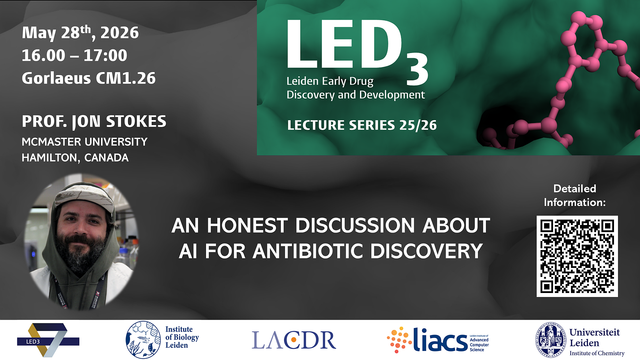
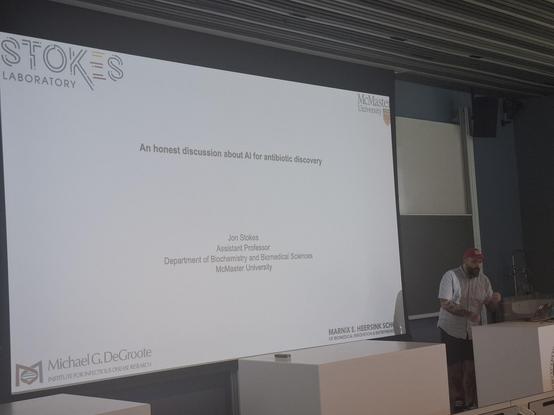
Jon Stokes gave an inspiring and highly interactive @LED3hub Lecture. He talked about the power and the limitations of AI for antibiotic drug discovery. (1/4)
#Chemistry #ChemBio #DrugDiscovery #Antibiotics #AI #MachineLearning
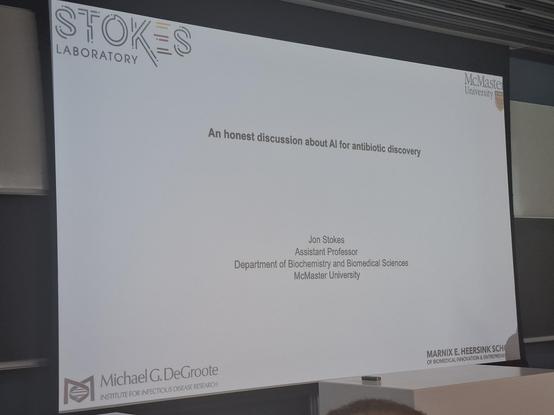
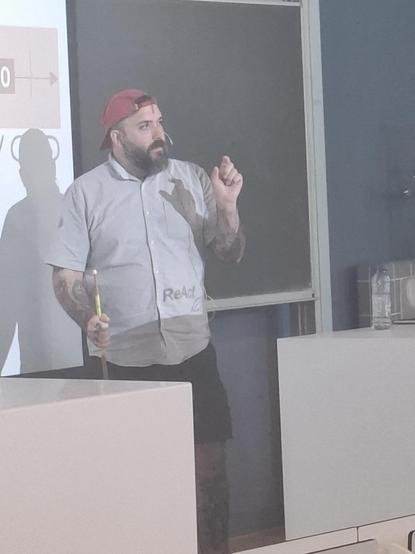
We are very happy that Jon Stokes from McMaster University visited us today for a LED3 Lecture. He gave "An honest discussion about AI for antibiotic discovery".
Interesting paper by the groups of Jongmin Park, Juyong Lee and Hankum Park in Nature Communications. They developed muscle-specific PROTACs engaging the E3 ligase KLHL41. Great to see the most potent molecules with covalent KLHL41 ligands.
https://www.nature.com/articles/s41467-026-73252-4
#Chemistry #ChemBio #TPD
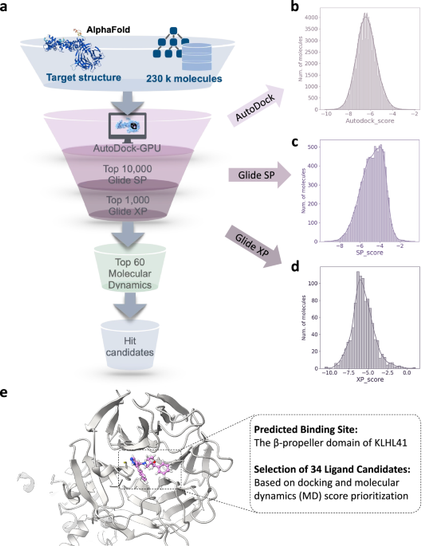
PROTACs rely mainly on ubiquitous E3 ligases, limiting tissue selectivity. Here, the authors identify a ligand of muscle specific E3 ligase KLHL41 and develop a covalent PROTAC (cKBD-1) that enables potent, muscle-specific protein degradation in vitro and in vivo.

 LED3hub