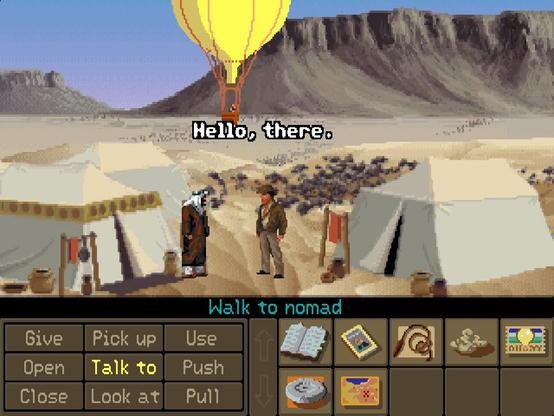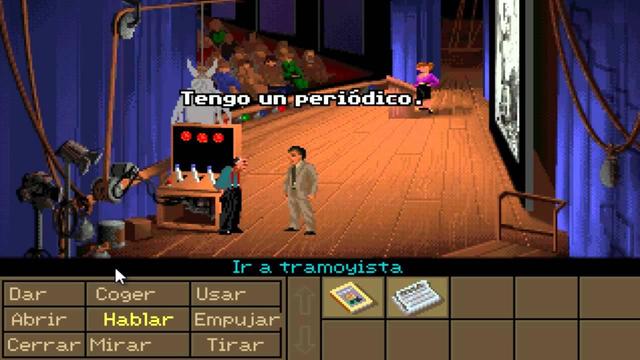
English speakers of the fedi. In a software with the interface in English, Reading a menu with verbs such as Save, Open, Close, Edit, Format etc., do you read them as imperative (an order: "do this") or as an infinitive (the "base form" of the verb, like "to do this")?

Are you a native speaker or have English as a second language?

#Dev #ux #ui #software #interface #translation #uiux #uxui #gui

Native speaker, imperative
25.7%
Native speaker, infinitve
18.2%
Second Language, imperative
20.9%
Second Language, infinitive
35.2%
Poll ended at .
Iff English is your second language, how are these verbs tusually translated to *your* language in software interfaces?
Imperative in English, Imperative in my language
19.3%
Imperative in English, Infinitive in my language
24.6%
Infinitive in English, Imperative in my language
4.2%
Infinitive in English, Infinitive in my language
51.9%
Poll ended at .
@eltonfc That's the neat part! They don't.

@eltonfc I mean, if by infinitive you mean it has to have "to" on front of the verb ("to save" etc.), then mechanically, the English version is "imperative," while my interpretation is "infinitive" because in French it's translated as such.

If not, then it's infinitive for both.

@jenesuispasgoth @eltonfc I'm a native English speaker and I parse menus the same way. Even though 'File' on its own is *technically* imperative I *read* it as infinitive.

(tbh the 'To + verb = infinitive' rule is trying to pretend English works like Latin. The root verb can have an infinitive sense for most native English speakers I think.)

@jenesuispasgoth @eltonfc Just voted and I see the native speakers are leaning towards 'imperative' but I am sceptical. I mean (eg) 'File save [this document]' is *not* grammatical. Nobody is 'file saving' anything. They are 'Save'-ing within the *category* of 'File'-ing. Maybe English menus should say 'Filing', 'Editing' etc.
@jenesuispasgoth @eltonfc And no I will not be dying on this hill, lol.
@runoutgroover
I don't interpret the "File" menu as a verb but as a noun. The menu does not contain suboperations of the operation of filing; it contains operations related to the file object. I think this is backed up by other menus. For example, Inkscape has File, Edit, View, Layer, Object, Path, Text, Filters, Extensions, and Help. Edit is the only one I would read as a verb. (All of them, except maybe Extensions, can be read as either a noun or a verb, though the verb senses of Object and Text are probably excluded by context.)
@jenesuispasgoth @eltonfc
@eruonna @runoutgroover @jenesuispasgoth @eltonfc as a non native English speaker, i relate to this
@eruonna @eltonfc @jenesuispasgoth @runoutgroover yes. When the word can be a name I tend to read it as a name and not a verb, too (non native speaker)
@runoutgroover @jenesuispasgoth @eltonfc oh that's interesting. I've never thought of File as a verb at all. I've also read that one as a noun.
Like below this are all the things you can do with a File.
@eltonfc also, it's more and more likely to have a machine translation, in which case the answer is "poorly".

@eltonfc I've chosen "infinitive in my language", which is mostly true, but sometimes they are translated as nouns.

And I hope "second language" which sounds very vague for me means plainly "foreign", i.e. "not unconsciously learned in childhood".

@eltonfc Interesting yet unsurprising results already. I suspect the reason translations at least in Latin languages went for the infinitive is because they just wouldn’t know what form/person to use.

French would look weird in imperative:
(Tu)   Enregistre
(Vous) Enregistrez

Recently French online shops decided to go with « Je confirme » or « Je commande », as in present tense for “I confirm” , “I order” for actions.

Anyways as always when it gets too complicated latin languages settle down on infinitive (Enregistrer).
@santi @eltonfc
Interesting to realize that the UI can be seen on one side or the other. Usually, it is seen on the machine side: you tell the machine what you want IT to do (eg. "Enregistrer"). But in the recent example you gave, it is seen on the user side: you tell the machine what YOU want to do (eg. "Je confirme"), which actually makes more sense.

@eltonfc oh, that's an interesting question. I never really thought about it and I think it... explains some things?

Do I understand correctly, the question is whether I interpret "close" as "i want (the computer) to close the file" versus "computer, close the file"?

Because now I realize i've never ever talked to a computer the way people talk to chatbots and maybe that's one of the reasons it feels really weird. Well, in addition to all those other reasons.

So yeah, infinitive in every case and every language for me. I'm communicating a desire for a thing to be done, not giving orders.

Edit: and yeah, at least in Latvian and Russian it is and always was infinitive. Saglabāt, сохранить, etc. Never even crossed my mind it's completely ambiguous in English.

@eltonfc and for some verbs imperative makes no sense to me at all.

Surely, when I click "rename file" the actual command is "present me with an input field to enter a new name"? I'm the one doing the renaming. The stupid piece of metal is just logging my actions to the best of its ability.

@virtulis @eltonfc

To me:

"Rename file [to a name I will provide]."

I wonder how much this has to do with growing up with command-line interfaces vs graphical ones.

@mattdm @eltonfc hmm perhaps, but then a follow up question: what about writing a todo list for yourself?

@virtulis @eltonfc

You mean, not from a menu?

Not sure I understand the question :)

@mattdm @eltonfc no, I mean if you take a piece of paper and write a list of things you need to do today, is that different from writing a command on the command line, and if yes, why

@virtulis @eltonfc

For me, that's very different. That's a mnemonic device — a list of things to not forget. Computer commands are "do this".

The high level commands, of course, cause complex functions to be run, but underneath it's all just sugar on top of instructions that are like: "Move the value in this memory buffer to that one. Now add 1 to the value in that buffer. Now compare that value to another buffer, and if it is equal, switch to this other set of instructions."

To me, menu items are like that.

_However_, interacting directly in a GUI is different. Like, typing into a word processor or drawing with a paint program. There, the metaphor takes over more. Feels more like I'm actively doing stuff, directly, rather than giving commands — even though it is just another interface to the same thing.

@virtulis @mattdm @eltonfc oh. To me a todo list is clearly imperative. It's a list of instructions to myself. Wash this, find that, pack those, etc.

@swift @virtulis @eltonfc

Do you write in that way, or do you write laundry, toothbrush, soup (or whatever)?

@mattdm @virtulis @eltonfc for a todo list, I write as described. For, say, packing to go away, I will enumerate the list of things to pack. But if I had that as part of a wider list, it probably would be under a heading of "pack: [list of items]"
@virtulis @mattdm @eltonfc Of course one would use imperative there! After all, they are commands to yourself. (I wonder if they use the first person imperative in Hungarian that has it? In Finnish you are forced to use the second person, like the future me is a totally different person.)

@tomminieminen actually, at least in Mastodon's translations, the substantive form of the verb is used: "Follow" is translated as "Követés".

@virtulis @mattdm

@mattdm @virtulis @eltonfc That's what the ellipsis is for, "Rename…"

@mattdm
> I wonder how much this has to do with growing up with command-line interfaces vs graphical ones

Great point! I started using and programming computers before graphical OS interfaces were really a thing (first computer was a Commodore 64).

A CLI command means I dictate a step, the computer performs it, and when programming; I dictate a series of step, the computer performs them, in the given order. The imperative is right there in the words "command" and "program".

@virtulis @eltonfc

@strypey @mattdm @virtulis @eltonfc

This is a really good point--I started out entirely in GUI environments and only a few years later started using CLIs. I do think about GUI buttons as infinitives and CLI as imperative (though, as a native speaker, the main reason why I think about the grammatical difference is because of taking second languages--perhaps the reason why I think the way I do is because la.wikipedia.org uses infinitives).

@mattdm @virtulis @eltonfc

To me, a Brit, it’s [I want to] Rename File. I had to ponder this, though, because I genuinely wasn’t sure how I think about it, at first. Perhaps with a GUI I’m hoping to do something, whereas with a CLI I can be more confident and use the imperative 😆

@zygous @mattdm @virtulis @eltonfc Yeah, I had to think about this for a while as well.
Both for GUI and CLI I settled on "now I want this to happen", not "barking an order".

That's true both for "save" icon and "rm" or ":wq".

I'm wondering whether this will eventually approach certain combinations of BigFive or HEXACO :)

@mattdm @virtulis @eltonfc I did grow up with command line interfaces, but strangely, even there, I've never really considered the commands to be orders. Possibly because at the time 'English' and 'computer terms' became similar but different things in my head.

@virtulis
> I'm the one doing the renaming

You're *requesting* that it be renamed. If the silicon wafer doesn't make the right electrons flip about, that name isn't going to change, whatever you might have to say about it.

This is true if you issue the instruction in assembly, or even pure binary. It's an invocation to a nonhuman agent system, not an action (although typing in the binary is an action).

@eltonfc

BTW this is a great example of how languages aren't just neutral containers for meaning. They encode philosophies, which become implicit in what's being said.

This becomes obvious to fluent speakers of 2 or more languages, but is often invisible to the monolingual. Even to those who learn a bit of vocab and a few stock phrases in other languages (eg I'd like a beer, where is the toilet, bring me the bill).

#philosophy #language #semiotics

What if some thoughts exist beyond words, waiting for a language not yet invented to give them form? Perhaps silence holds entire unwritten philosophies.

@seaborgium1234
> Perhaps silence holds entire unwritten philosophies

I think it does, yes. The 2 aren't mutually exclusive of course ; )

It's probably the taoist/ Buddhist influence on my thinking, but I tend to think there is a kind of void beneath the experiential surfaces of the world that contains all potential, including both written *and* unwritten philosophies.

@eltonfc I don't understand the question. But in Swedish, the "Close" alternative would be "Stäng", which is an imperative. The infinitive would be "Stänga".
@jjj what motivates de question is that in English, the infinitive and imperative forms are identical. In Portuguese, they are translated in the infinitive: "Fechar" instead of "Feche" or "Fecha"
@eltonfc I understand that. As I wrote it is the same in Swedish. I don't understand what you mean with how they are usually translated. That would depend on the original text, I can't say how often either is used in general.
@jjj my point is that the same string "Close" is translated to Swedish in the imperative form and to Portuguese in the infinitive form. I'm curious how it's done in other languages.

@eltonfc Ok, I understand now, I think.

The results of your polls are very interesting and surprising to me. I didn't know of this difference.

@eltonfc @jjj I'm a bit curious now, what form would you use for labels for push/pull on a door e.g? or if you had a physical switch with labels for open/close, or so

(They'd all be imperative in swedish, and I think the UI commands/tooltips are sort of an extension of the same "kind" of label, so at least to me imperative also feels natural)

@firefly In portuguese they are in the imperative: "Empurre/puxe" instead of "Push/pull".

@jjj

@eltonfc @jjj hmm okay, I'm curious how the UI elements ended up in the infinitive then ^^

@firefly well, the push/pull labers are instructions to the person reading them. Computer buttons are instructions that the person reading them is giving to the computer.

I gues a better Analogue would be the label on a physical button that does something, like the ones you press on a bis requesting a stop. Or "Open door"

@jjj

@eltonfc @jjj “infinitive and imperative forms are identical” apenas nas flexões verbais em que acontece o bare infinitive, não? Que é quando precedido de verbos modais ou alguns verbos específicos. Eu aprendi que exceto esses casos a flexão infinitiva exige preposição “to”
@eltonfc I have simply never used computer interfaces with my native language, so I can't say.
@eltonfc quer resposta em português também??
@leonardof arrgh limitação do Moshidon que não mostra o idioma, só o botão para mudar

@eltonfc this is interesting, I answered (imperative, imperative) but that seems to be in the minority

that said, I think for quite a lot of cases (any ending in -a I think, which is quite common) there'd be a similar ambiguity in Swedish

@eltonfc funny thing is, in Polish, even if they tried to make it infinitive - eg. "Zapisać" - it could still be interpreted as imperative, just more formal / military-style.

But no, they translate it as "Zapisz", which is the friendly / direct type of imperative.

@eltonfc I can answer this second one: neither :D Hungarian translations settled mostly on nominalising the actions in menus and buttons, thus "saving", "opening" (mentés, megnyitás), instead of statements (ment, megnyit) or imperatives (ments, nyiss meg).

Some items ended up with other nouns: nézet (the view), súgó (prompter, whisperer; for Help)

@eltonfc
Having worked with a bunch of Germans, Prussians speaking English use imperatives all the fucking time and don't seem to understand what they are doing or why it might be bad. Bavarians OTOH use English like a normal speaker so it isn't something inherent to translating German to English.
@eltonfc
One of the many reasons I don't use local language settings.
@eltonfc Example of imperative in English, infinitive in Spanish. Conjugation in Romance languages can get complex and the infinitive offers a way to describe the action while minimising accidental complexity. This will always be useful, but it was probably essential in the resource constrained environments of the 70s and 80s where UIs were born.
@eltonfc This is really interesting to me because I speak both Catalan and Spanish natively, and in Catalan they are translated primarily as imperative and in Spanish as infinitive