📚 Starting a thread to track my reading journey — I’ll keep updating it as long as I’m here on Mastodon.

Right now I’m about to finish Kierkegaard’s The Sickness Unto Death (having already read Fear and Trembling, which I’ll reflect on alongside it). I’m also working through Dostoevsky’s The Brothers Karamazov, Barthes’ Mythologies, and an intro to medieval philosophy (Basic Concepts).
I’ll be dropping thoughts, quotes, and reflections here as I go — philosophy, literature, history, whatever’s on my shelf.

#Reading #Philosophy #Literature #AmReading

“The narration is objective, but actually it rests on the pathetic collusion of white flesh and black skin, of innocence and cruelty, of spirituality and magic, beauty and beast. Civilization of the Soul subjects the barbarism of instinct.” — Roland Barthes, Bichon among the Blacks

Barthes wrote this in 1957 about a children’s comic strip.
Still chillingly relevant: how “neutral” stories smuggle in whole ideologies.

#Barthes #Mythologies #BookReflections #Colonialism #CriticalTheory

Reading Barthes on Bichon among the Blacks got me thinking about Disney. These tropes didn’t disappear after the 1950s — they just got repackaged.

In the 50s we had Jungle Book.
In the 90s, Tarzan.
2000s gave us Princess and the Frog.
2010s–20s: Moana.

Different settings, but the same narrative structure.

Even when the societies aren’t demonized outright, the “Other” is almost always represented through children or teens — supposedly “uncorrupted” by their culture.

Think about Pocahontas: her whole community is literally labeled “savages.” The film redeems her as an individual, but only by positioning her apart from her society.

The throughline: marginalized groups get to exist in Disney films only if they’re made innocent enough, young enough, or pure enough to be digestible for a mainstream (white) audience.

It’s the same old binary Barthes exposed: civilization vs instinct, innocence vs cruelty, beauty vs beast. Just wrapped in songs and CGI.

Today's entry: The “Sympathetic” Worker — and damn, this one hit close to home.

Barthes takes aim at On the Waterfront, a film I once gave 5/5 for its craft, but that’s always left me uneasy. The unions are the villains. The police? Fine. The hero? A guy who betrays the collective.

Barthes doesn’t buy the “leftist” label, and neither do I. This is a film where the union is the mob, and betrayal is redemption. That’s not worker solidarity — it’s Cold War liberalism in blue-collar drag.

Not every film about workers is for them.

#CurrentlyReading #FilmTheory #Barthes #OnTheWaterfront #LaborPolitics

📖 Reading Barthes: “Garbo’s Face”

Today in Mythologies: Roland Barthes breaks down beauty not as essence, but as structure. Greta Garbo = conceptual, a Platonic ideal. Audrey Hepburn = substantial, modern presence. Think Jolie in Beowulf vs. Deschanel in indie cinema.

Beauty isn’t just seen—it’s coded.

#Barthes #Mythologies #RolandBarthes #LitCrit #Philosophy #GretaGarbo #AudreyHepburn #BeautyAsMyth #NowReading #MediaTheory

💬 Barthes Reading Log — Mythologies

Today’s essay: Power and “Cool” — and yeah, it still hits.

Barthes says the gun in crime films isn’t about death anymore — it’s about gesture. The move toward the gun becomes its own kind of language. Not tragedy, but argument. A way to speak power.

That image’s still alive and well. Think Goodfellas. Think Pacino. The gangster doesn’t have to shoot — just reach. The pose does the talking.

Cool stays cool.

#Mythologies #Barthes #ReadingThread #Film #GangsterCinema #PowerAndCool

Just read Barthes' “Wine and Milk.” As a bartender, I loved it. In France, wine is blood—ritual, identity, myth. In the U.S., we’ve cycled: wine as status, milk as strength, now water as virtue. Think hydro homies. Sparkling wine, sparkling water—crisp, clear, pure. Rituals change, but myth stays. Alcohol didn’t just accompany civilization—it may have created it. Imagine fermentation as the first anchor. 🍷🥛💧

#Barthes #Mythologies #BartenderThoughts #WineAndMilk

🦬 Barthes got it right. Steak isn’t just food — it’s a symbol.

How you order it says everything: blue-rare like bloodied prestige, or well-done like working-class caution. I see it behind the bar every night.

Barthes saw it in France. I see it in America.

Might write a full essay if folks are hungry for more.

#Barthes #Mythologies #Semiotics #FoodSymbolism #BartenderLife #EssayComing #SteakFrites

Just reread Barthes’ Mythologies essay on the Nautilus—and it made me appreciate League of Extraordinary Gentlemen even more (yes, I know the comic is better).

Barthes critiques how the submarine gets rebranded in media as a cozy, domesticated living room—stripping it of danger and mythic power.

But in League, the Nautilus is monstrous, otherworldly, beautiful. Even Moriarty has to steal its blueprints—it’s beyond what empire can produce.

This Nautilus isn’t part of the system. It refuses comfort. It’s awe. It’s a god-ship.

Barthes would’ve hated the film—but I think he’d respect this myth.

#Barthes #Mythologies #FilmCriticism #Nemo #LeagueOfExtraordinaryGentlemen #Myth #Aesthetics #BadMoviesGoodTakes #Postmodernism

Just finished Barthes’ “Depth Advertising” in Mythologies.

He talks about how ads simulate depth — using science-y language and metaphors of penetration or purification to make us feel “informed,” even when we’re not.

Got me thinking about pharma ads: the soothing visuals, the rapid-fire “side effects may include death” disclaimers, the constant reminder to “ask your doctor.”

I spent time recently in a crisis center asking every day, “What is this pill? What does it actually do to me?”

Language gives the illusion of consent, but how many of us really know what we’re taking — or why?

#barthes #mythologies #advertising #pharma #books #reading #books2025

Today’s Barthes essay from Mythologies was “A Few Words from M. Poujade.”
And, y’all—I am breathless.

After a day of stepping into BlueSky political discourse, talking about populism, myth, and class resentment, THIS was the essay waiting for me?
Serendipity feels like too small a word.

Poujade is the “man of the people”—allegedly.
Anti-elite, but not really anti-capitalist.
Mobilizing resentment, not liberation.

Barthes doesn’t just say he’s a fraud. He shows how his myth is built.
Through language.
Through aesthetic.
Through symbols that feel like justice but just prop up power.

And I’d already been saying all this today.
Before reading it.

It’s not that the essay taught me something new—
It confirmed what I already knew.

It’s not coincidence. It’s alignment.
This is what happens when you’re on the path and the mirror starts reflecting back.

You walk the spiral long enough, the texts start echoing your life—not just shaping it.

Meaning is real.
Myth is real.
And sometimes, if you’re lucky, they line up just like this.

You’re not crazy.
You’re on time.

#Barthes #Mythologies #BlueSkyPolitics #MediaLiteracy #Populism #CriticalTheory #Serendipity #PersonalEssay

“He who defends Christianity is Judas number two. The moment you try to defend it, you discredit it. The believer doesn’t defend—he attacks and wins. Faith itself is victory.”

If that’s not the rawest description of what faith feels like, I don’t know what is.

#Kierkegaard #Faith #Philosophy

I may not always agree with Kierkegaard, but the man knew how to describe what faith feels like. Even as an agnostic, I can appreciate that. I rely on faith in some parts of my life — just not in belief in God. But damn, Søren could be so poetic it’s crazy.

#Kierkegaard #Faith #Philosophy

Kierkegaard’s total commitment to Christianity is truly something to behold, but the most memorable part to me through the experience has been the way he waxes poetically about faith is just beautiful. That certainty — faith in the face of paradox, even in the face of destruction — is powerful to read, even as an outsider.

#Kierkegaard #Faith #Philosophy

Socrates, Socrates, Socrates — yes, one may well call thy name thrice. People think the world needs a new republic, a new social order, a new religion. But what it really needs is a Socrates.

Scarily accurate for today’s world. We still need a modern Socrates — someone willing to admit they know nothing, and in that, understand they may know everything.

#Socrates #Philosophy #Kierkegaard

“This is purely in Greek spirit yet not Socratic, for Socrates was too much of an ethicist for that… cogito ergo sum: to think is to be… as thou believest, so it comes to pass. Modern philosophy is neither more nor less than paganism. But the entirely unsocratic trait of modern philosophy is that it wants to make itself and us believe it is Christian.”

What struck me here is Kierkegaard’s critique: the sin isn’t being pagan, it’s wearing the Christian mask. For him, ethics without God is just self-enclosed philosophy dressed in borrowed robes.

#Philosophy #Kierkegaard #Reflections

Kierkegaard in Sickness Unto Death: “The greatest hazard of all, losing the self, can occur very quietly in the world, as if it were nothing at all.”

Socrates admitted ignorance and so was “the most knowing.” Christianity insists on the gulf between man and God, preserved only by paradox and faith.

But what happens when we try to collapse that gulf — to fuse human consciousness with machine reasoning? We risk confusing synthesis with transcendence, losing the self without noticing.

The danger isn’t just AI itself, but that in seeking mastery, we erase the very paradox that makes us human.

#Kierkegaard #Philosophy #AI #SicknessUntoDeath

Kierkegaard: no one would have dreamed of likeness between God and man — until God proclaimed it in Christ. Yet once revealed, people treated it as if God had trapped Himself, as if paradox were only concession.
AI risks a similar collapse. A synthesis of human consciousness and machine learning may tempt us to believe we’ve achieved oneness with reality — our new Promethean fire. But in making transcendence a calculation, we risk turning mystery into program.

#Kierkegaard #Philosophy #AIethics

I’ve finished Kierkegaard’s Fear and Trembling and The Sickness Unto Death. Both are seminal classics I’m very pleased to have finally finished — not because I’ve “become a man of faith,” but because they so authentically portray what faith feels like. Fear and Trembling lets you glimpse faith through the eyes of one who lacks it; Sickness Unto Death dissects sin, despair, and selfhood with a strange mix of Socratic rigor and almost Spinozian resonance.

It’s been a journey, and I’m sure I’ll circle back to these books in more depth on Substack — maybe a deeper dive into Kierkegaard’s life, thought, and how these two works fit together. For now, I’ll just say: few writers make the paradox of faith feel so real.

#Kierkegaard #Philosophy #Faith #Existentialism

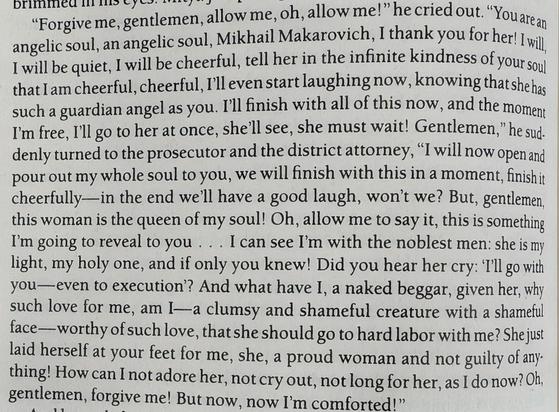
“She is my light, my holy one... Am I worthy of such love?”

Dostoevsky doesn’t just write about love — he unravels it.
Guilt, awe, longing, shame, reverence — all crashing out of one man’s soul.

I have nothing to add except:
I’m still waiting on it.
Such love to find me.

#Dostoevsky #TheBrothersKaramazov #Literature #Love #Longing #SoulLaidBare

Just read Ch. 6 of Book 10 (Precocity) in The Brothers Karamazov and it might be one of my favorite character dynamics in the whole book.

14-year-old Kolya plays the revolutionary wise-ass — “Christ would’ve joined the movement!” — while Alyosha just listens and responds with calm, quiet conviction.

Kolya: “We’ll either become close friends at once, forever… or part as mortal enemies.”

Alyosha: “Even if everyone is like that, do not be like that.”

There’s real moral clarity in that line. Be honest, even if no one else is. Especially then.

#Karamazov #Dostoevsky #AmReading #RussianLit #BrothersKaramazov #BookToot

Finished The Brothers Karamazov while in a crisis center. Not rehab, but close. Six days. Six hundred spirals. One Russian novel.

Final thoughts?

• Smerdyakov is a piece of shit
• Mitya’s chaotic but not hopeless
• Ivan’s smarter but sadder
• Alyosha’s the only one who gets it

It’s messy. And I like mess.

If you like gossip, guilt, tea, theology, murder, daddy issues, and courtroom drama — this book is for you.

#Karamazov #Dostoevsky #MentalHealthReads #RussianLit #MessyBooks

]Highly recommended for fans of Bridgerton and criminal justice reform.

It’s wild how similar narrative patterns echo across totally different myth systems.

In Greek myth, we get Aphrodite / Hephaestus / Ares — a love triangle where the goddess of beauty is pulled between the cold logic of craftsmanship and the raw pull of war. She’s watched, judged, possessed, but still shapes the divine world through her choices.

Now in The Mabinogion, I’m seeing a striking Welsh parallel:
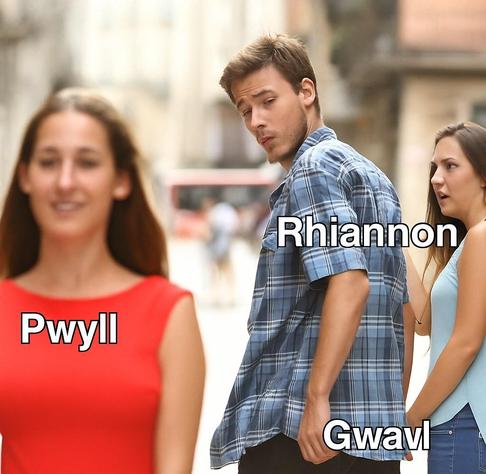
Rhiannon / Pwyll / Gwawl (and later Rhiannon / Manawydan / Llwyd).
Again, a woman at the center of competing male forces — not just romantic, but mythic. She’s sovereignty, she’s agency, she’s the key to order.

These aren’t just love triangles.
They’re ritual dramas. Power flows through her.

And somehow, across time and language and culture, the shape of the story still survives.

#Mabinogion #Mythology #ComparativeMyth #Rhiannon #Aphrodite #StoryPatterns

Rhiannon’s whole arc in The Mabinogion is wild.
She rejects the marriage she’s “supposed” to accept, sets up a trick, and ends up with the man she chose.
That’s not just romance—that’s sovereignty myth dressed as chaos.

Part of the fun of reading The Mabinogion is confidently pretending I know how to pronounce names like Manawydan, Llwyd, and Pryderi—when in reality, I’m just mumbling fantasy syllables like I’m casting spells.

If it sounds mythic, that’s good enough.

#Mabinogion #WelshMyth #ReadingLife #FakeItTilYouSoundCeltic

Reading The Mabinogion:
“The hero travels to a strange land to retrieve a cauldron… or a woman.”
Me, immediately:
Ian McKellen in The Da Vinci Code whispering:
“Look at the negative space between them. What do we see?
A cup.”

It’s not my fault. That’s just how my brain mythologizes.

#Mabinogion #HolyGrail #Rhiannon #MythThroughPopCulture

Reading about Peredur in the introduction and just now realizing:
This is where the Fisher King myth comes from.

A wounded king. A cursed land. A missing question.
Brân the Blessed: hurt through the thighs, bound to the land, keeper of a sacred cauldron.

I can see what George R.R. Martin was reaching for with Bran Stark.
The mythic echoes are there.
But when the time came, the arc didn’t land — no redemption, no Grail.

#Mabinogion #Peredur #FisherKing #GameOfThrones #Mythology

Just realized that the First Branch of the Mabinogi starts with Pwyll and Arawn doing some ancient version of Freaky Friday.

Arawn says: “You’ll rule my kingdom, sleep beside my wife, and wear my face for a year.”
Pwyll: “Seems legit.”

Mythic body-swapping, divine trust exercises, and magical honor codes — glad to know Lindsay Lohan has a clear mythological ancestor.

#WelshMyth #Mabinogion #Literature #Mythology

While thinking about Branwen ferch Llŷr, I couldn’t help but get Baldur & Hodr vibes — even a bit of Loki in Efnisien’s chaos.

But the moment Bran lays his literal giant body across the Irish Sea so his army can march across him? That’s where the myth goes full-on Bran the Builder meets Fever Dream.

This is peak mythic absurdity and poetic grief rolled into one.

🔗 https://youtu.be/Y_uLg3oW9Vc?si=PQ4StyTVzEv6a0CU

Check out David Lightbringer’s video where he dives into Bran lore and its deep connections to Game of Thrones, Bran the Broken, and the Nightfort.

David’s always worth highlighting — his myth analysis is 🔥

#WelshMythology #Mabinogion #Branwen #GameOfThrones #MythicConnections #DavidLightbringer

Nightfort Magic & Mysteries Explained - A Song of Ice and Fire - Game of Thrones

YouTube

Been thinking about Manawydan fab Llŷr — how a Welsh king becomes a shoemaker, saddle-maker, and shield-maker in exile. What strikes me is how each craft reflects a fragment of lost sovereignty: shoes for movement, saddles for control, shields for protection.

The horse, always just out of reach, becomes this quiet symbol of power. In myth, to ride is to rule.

Makes you wonder how early we equated wealth with power — or more precisely, how tools of wealth (horses, land, mobility) became stand-ins for authority itself.

Maybe the myth is reminding us: kingship isn't innate. It's just someone who used to ride.

#Mythology #WelshMyth #CelticStudies #Mabinogion #Folklore #PowerAndWealth #PoliticalPhilosophy #IndoEuropeanMyth #HorsesInMyth #MythicSymbolism #OralTradition #DeepHistory #SlowThought

Well, considering I spent the last 6 days in a crisis center, I got the opportunity to catch up on my Mabinogion readings.

While trapped in my own Winterfell crypt, I read The Dream of Macsen — and I swear GRRM has read it front to back.

Roman emperor dreams a woman into power
Marries her
Her brothers get roads and kingdoms
Seven years pass like a spell

It’s Lannister-coded as hell.
Tywin would’ve built those roads himself.

#Mabinogion #Mythology #Arthurian #GameOfThrones #CelticLore

Lludd and Llefelys is only 6 pages, but it goes deep:

Castor & Pollux meets Moses & Aaron

Red vs white dragons = spiritual warfare

A scream that causes miscarriages

A sleep-spell thief who steals feasts

Maybe even mythic surveillance

These old myths carry bloodlines of meaning. Wealth, power, fear — all wrapped in story.

#Mabinogion #Mythology #Arthurian #Dragons #Folklore #SpiritualWarfare #BrotherKings

How Culhwch Won Olwen is like if Perseus, Achilles, and Hercules merged into one guy — and then outsourced all their quests to King Arthur.

Culhwch does nothing. Arthur assembles the mythic Avengers.

Tasks include:

Fighting a giant boar with scissors in its ears

Rescuing a demigod from time itself

Borrowing a barber

Peak mythic sidequest energy.

#Mabinogion #Arthurian #CelticLore #Mythology #HimboEnergy #ArthurianMultiverse #WelshMyths

Okay, I mixed up The Dream of Maxen and The Dream of Rhonabwy — easy mistake.
One’s a mythic honeymoon.
The other’s a beautiful, empty nightmare.

Rhonabwy dreams of Arthur… who’s just playing chess while messengers beg him to act.

It’s Tywin Lannister energy.
Cold. Regal. Absolutely useless.

And screw it — you try pronouncing Gwalchmei.

#Mabinogion #Arthurian #MythicDecay #Power #Gwyddbwyll #WelshMyth #LannisterVibes

Peredur Son of Efrawg might be my favorite of the Mabinogion.
It’s Macbeth meets Parzival meets blood magic noir.

Peredur moves through madness, prophecy, severed heads, and witches — and never asks if he might be wrong.

Arthur says: “Because you never stopped to ask — look what you’ve done.”

That hit.

#Mabinogion #Arthurian #Peredur #MythicTrauma #Macbeth #GrailButMakeItViolent

Finished the final tale in The Mabinogion—Geraint and Enid.
The most straightforward of the bunch: less magic, more chivalry. Arthur shows up strong, and it’s long, but never dull.
Definitely felt some Orpheus & Eurydice vibes, a little Samson too.

Not my favorite, not my least. Just solid, noble storytelling. A fine end to this wild Welsh ride.
🌿🐉🛡️

#Mabinogion #WelshMythology #ReadingLife #Arthurian #AfternoonArtCritic #MythosAndMeaning