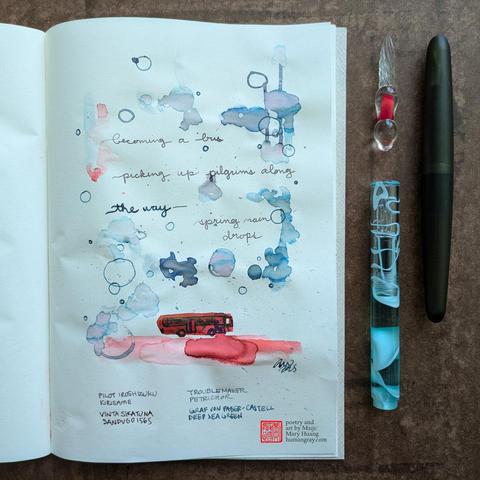
close to hearing it
the gentle pitter patter
roof leak lullaby

šŸŒ§ļø Commentary, wip photo, and ink palette used: https://www.pillowfort.social/posts/3299390

#haiku #ink #FountainPenInk #poetry #MastoArt #CreativeToots

maiji: roof leak

[image set: 1) Photo of open notebook next to two glass dip pens, one pointed and one slightly sanded down with a blunt tip. The page shows a haiku written in ink, illustrated with abstract lines of pale shimmery blue, purple, green, grey reminiscent of drops and ripples of water: "close to hearing it / the gentle pitter patter / roof leak lullaby". Poetry and art by Maiji/Mary Huang, humangray.com. 3) Eight swatches laid out in neat rows next to a mini flashcard set being used as an ink colour swatchbook. 3) 2) In-progress photo showing shiny wet puddles of ink on the page, next to a ceramic cup of water, a waterbrush, a tiny crumpled piece of tissue with the same colours as the inks used, and the two glass dip pens.] Tricycle runs a monthly haiku prompt/challenge, and March 2023’s theme was ā€œroof leakā€. (They pick three winners to highlight each month - you can see them here, and read the commentary!)I had a few directions I considered taking this, and the version above was helped along by a mini epiphany. Sleep has always been a tricky thing for me. I do sleep deeply, and remember many of my dreams, and also lucid dream more frequently than most people, it seems - but I don’t sleep a lot at all. I’m also very sensitive to noise, which often makes it harder to fall, and stay, asleep. Four consecutive hours of sleep seems to be my general limit (it’s usually much less than that) that I consider a pretty good bout. One morning near the end of March (and the deadline for haiku submissions), I woke up to a very annoying disruptive knocking. I grabbed my phone to try to record it, thinking the recording could help for reporting the noise. I soon discovered I had difficulty recording it because… the sound of the rain outside my bedroom window was actually louder. And I had a bit of that deeper oh moment. The pitter patter of the rain didn’t bother me because of my perspective of it. After I got up, I finalized the wording of this haiku. The oft-repeated 5-7-5 syllable (or Japanese on, which isn’t the same thing) structure is actually not always followed by poets in any language (a lot of my poems from 31 days would count as haiku, for example). And most of the haiku I read in English are translations of Japanese haiku, so the syllable count isn’t usually retained anyways. So I found it a little tricky consciously follow the formal structure in English, but also interesting and fun to work within the specific format constraints.The month-long time frame was also helpful in being able to support a bit of mindfulness practice, and work with intentionality. Write a bunch over time, come back and tweak a little and edit, try it several times with the seasonal word in different places (e.., challenging myself to try some starting or ending with the seasonal word, other times in the middle). I tend to want to post something online as soon as I’ve finished it, so this was a nice exercise in being patient and not being so tied to doing something for the sake of anything other than just doing it.The illustration was fun to do as a meditative practice as well, picking some vibey colours from my collection, then blobbing and circling and dripping and wiping abstract patterns to illustrate the theme. The booklet uses Tomoe River paper.I’m currently working on my April haiku. You’ll see it next month! :)

Pillowfort

shh don't disturb them
heads bowed in quiet study
water narcissus

🌼 Commentary, wip photo, and ink palette used: https://www.pillowfort.social/posts/3353610
šŸ’§ Haiku Ink series: https://humangray.com/haiku-ink-series

#haiku #ink #FountainPenInk #poetry #MastoArt #CreativeToots

maiji: narcissus

[image set: 1) Photo of open notebook next to two glass dip pens, one pointed and one slightly sanded down with a blunt tip. The page shows a haiku written in ink, illustrated with strokes and blobs of ink that look like yellow flowers with long green stems and leaves nodding over ripples of water. 2) Eight swatches laid out in neat rows next to a mini flashcard set being used as an ink colour swatchbook. 3) In-progress photo showing shiny wet puddles of ink on the page surrounded by the glass dip pen, crumbled tissue stained with golden brown ink, small vials of ink and a ceramic cup with water.] shh don't disturb themheads bowed in quiet studywater narcissus - Poetry and art by Maiji/Mary Huang, humangray.com April 2023's haiku in the haiku ink series. If it weren't for the specific prompt, I don't think I otherwise would have ever used "narcissus" in a haiku. "Narcissus" has a melodic, sophisticated sense to it. I feel like "daffodil" is more my "haiku style", because it feels charming and approachable. I think, anyways, haha.Here I have the vision of a cluster of little scholarly flowers in quiet contemplation. As you may know from my hua series, in Chinese, narcissus is ā€œwater xianā€ - xian being a kind of immortal. At a recent sangha session, we reflected on how encounters with nature can support mindfulness. As everyone shared their personal experiences and thoughts, the greater sense of being, of inner peace/calm that it can bring however temporary, I had a teeny tiny insight. I thought, mmm it's funny how all of us have these stories about things like going out for a walk in the trees, sitting by the water... And it's funny that when I think about nature, I have this sense of nature as this thing out there that I go and visit, some kind of vacation or departure from the usual. But as I reflected, I realized... actually, I am nature! I'm not some separate thing from nature. I and every other human being on this planet, is an expression of what we call nature, this interesting/funny/miraculous coming together of all these elements in this shape, wandering the universe and blobbing around and doing our thing. It's really amazing.Of course, it's easy to not be consciously aware of that, to forget that in the day to day. Placing ourselves in a very visible, tangible environment that engages our senses is a powerful reminder of... our true nature, I suppose. It also reminded me of that famous Zen koan of the original face. It goes something like: "what was your face before your parents were born?" or "what was your original face before you were born?" or some variation of that. That feeling of going out in nature as some kind of remembering who/what you really are, your true face - I had that very brief moment of "oh!" beyond just intellectual musing, and then it passed.Narcissus in quiet study. I wonder that sometimes it's not so much "anthropomorphizing" or "humanizing" something so much as... nature-izing ourselves? Just words.I actually finished May's prompt early this month. Look forward to seeing it at the end of next month, while I look forward to learning what June's prompt is soon...!

Pillowfort

high rise hazy moon
your almost forgotten face
floats past the buildings

šŸŒ• Commentary, wip photo, and ink palette used: https://www.pillowfort.social/posts/3420508
šŸ’§ Haiku Ink series: https://humangray.com/haiku-ink-series

#haiku #ink #FountainPenInk #poetry #MastoArt #CreativeToots #moon

maiji: hazy moon

[image set: 1) Photo of open notebook next to two glass dip pens, one pointed and one slightly sanded down with a blunt tip. The page shows a haiku written in reddish-brown ink, illustrated with strokes and washes forming a scene of high-rise buildings at night in shades of grey tinged with blue and purple, clustered together beneath a smoky full moon tinted with pink and lavender. 2) Eight swatches laid out in neat rows next to a mini flashcard set being used as an ink colour swatchbook. 3) In-progress photo showing the page with handwritten text and outlines of the buildings with light splotches for the windows. In the background is a sketchbook propped up displaying thumbnail roughs of the composition. Around the page are glass dip pens, a waterbrush, small vials and a bottle of ink, and ink bottle packaging.] high rise hazy moonyour almost forgotten facefloats past the buildings - Poetry and art by Maiji/Mary Huang, humangray.com Living in a city full of condos and light pollution, in conjunction with pandemic and late night safety concerns, sometimes days can go by without seeing the moon. Or other things, and people…I found this prompt way harder than the previous ones for March and April. The ā€œoriginalā€ Japanese kigo (seasonal word in haiku) would be oborozuki 朧月, and it’s a Supremely Classic Kigo in my mind, basically exactly the kind of thing I think of when I hear kigo. It has a long history in literature and art and appearing in so many places. ā€œOboroā€ is a word that refers to a shrouding kind of mist slightly obscuring or dimming the moon; the kanji is formed by a ā€œmoonā€ radical combined with the character for dragon (the full traditional Chinese character, as modern Japanese uses a simpler kanji for dragon). It’s the same oborozuki given as a reader sobriquet to the character Oborozukiyo (ā€œMisty Moon Nightā€)  in the Tale of Genji, and the reference in Houzouin Inshun’s Noble Phantasm/special move OboroUraZuki (ā€œHazy Inverted Moonā€) in Fate/Grand Order, to name just two examples that you may have seen if you’ve followed my posts long enough! So I think the difficulties come from having so many pre-existing conceptions and associations with it and struggling to do something that doesn’t feel like I’ve encountered it a bajillion times before. And to make it more personal instead of mystical. I didn’t want to get too lofty with this - conceptually speaking, anyways (it seems kind of funny to say ā€œI didn’t want to get loftyā€ for a poem about a floating moon). I wanted to still capture a kind of grounded, ordinary feeling. Tricycle gave two options for the prompt, the alternative being ā€œblurry moonā€, which felt really unusual to me. ā€œBlurryā€ has an appealingly simple, almost childlike quality to it, and I wrote a number of haiku with that in mind.… But in the end, with this direction, the alliteration of ā€œhigh-rise hazyā€ was too much to resist. Maybe next time.

Pillowfort

Thumbs drawing circles
on grandpa's bare feet - he smiles
like he's in heaven.

A memory of special days with Yeye, my grandpa. ā¤ļø

šŸ‘£ Commentary, wip photo, and ink palette used: https://www.pillowfort.social/posts/3521261
šŸ’§ Haiku Ink series: https://humangray.com/haiku-ink-series

#haiku #ink #FountainPenInk #poetry #MastoArt #CreativeToots #family #grandfather #grandpa

maiji: barefoot

[image set: 1) Photo of open notebook next to two glass dip pens, one slightly sanded down with a blunt tip. The page shows a haiku written in sepia ink, illustrated with swirls and circles forming the shapes of flowers and two footprints. 2) Eight swatches laid out in neat rows next to a mini flashcard set being used as an ink colour swatchbook. 3) In-progress photo showing an open notebook with handwritten text and outlines of the two footprints at an early stage of the illustration. Around the notebook are bottles and vials of ink, the glass dip pen on a ceramic watercup, and a fountain pen and small pen/pencil bag lying on another notebook.] Thumbs drawing circleson grandpa's bare feet - he smileslike he's in heaven. - Poetry and art by Maiji/Mary Huang, humangray.com Yeye, my grandfather, is the one who brought us to Canada, who helped raise me as I grew up here. He was, and is, a cornerstone of and inspiration for my life in so many ways. He died at 94 after an eventful year full of health ups and downs and frequent trips to emergency. Nearly every free moment - all the weekends, all the holidays, all the time off work - we spent at his side. One of my strongest impressions throughout that period was the feeling of gratitude for all the time we were able to spend with him. That year I made a discovery: Yeye really loved foot massages! I don’t remember how it started exactly, but I think he might have made some comment about feeling cold, and we’d already given him thick socks and a heated blanket. I used to accompany him on walks, but as time passed he spent more and more of it sitting or lying in bed. I suppose it crossed my mind this was something else I could do for him during our visits. Looking back it seems obvious, but it’s amazing to think that none of us, to my knowledge, had ever thought of giving him a foot massage until then.So I gave him foot massages every time I saw him. We found and tried different lotions and my mom dug up various little manual wood massage tools to use as well. He never failed to exclaim how this was the best thing ever, which was funny because all his life he had a reputation as quite a serious and reserved person. Near the end, when he was too weak to speak anymore, he would still make little wiggling hand gestures to indicate that he would like a foot massage. It’s the least I could give him. Thank you, Yeye, for everything. Appropriate to the theme of feet, my mind ran all over the place with this kigo. I started off thinking about my own feet, about the sensations of the soles of my feet against the floor, and about how our feet really ground us in so many ways, and how easy it is to take them for granted despite the load they bear for us every single day. When’s the last time we really looked at our feet? Really felt the curves and shapes of our toes, arches, heels? And felt the things we can feel with our feet? That was my general train of thought. Then one morning I thought of somebody else’s feet - my grandfather’s, and all the memories of that treasured time with him before he died, and I started writing haiku in that direction. I struggled a lot with it, trying to figure out how to capture something that was so simple but somehow kept coming out super complicated in such few lines. After a while of growing very frustrated with my attempts, I took a break from haiku. When I came back to it, I worked in several other directions instead. But I kept returning to this idea. It just felt really special if I could... just... create and share something about those memories, no matter how small. I even went about sketching a composition and picking inks (faded, nostalgic colours) even though I still wasn’t happy with any of the actual haiku attempts. I guess I was trying to set my brain up with the assumption that I would make it work somehow! Finally late one evening, about a week before the end of June submission deadline, I did another ~7 or so iterations on another concept before coming back to this one - and it seemed to flow a little more easily this time around. Another ~4 drafts later, I had this version.Punctuation and capitalization with English haiku is always an interesting creative decision. In the previous haiku in this series, I didn’t use any capitalization or periods. That's generally my preference, giving the poems a bit more of a floating ephemeralness. With this piece it felt right to make it more grounded - that it was a real thing I shared with my grandpa, of a particular time and space.Something interesting happened while I was making the art. The Ferris Wheel Press Ink, Cream of Earl [Grey], doesn’t really look like its swatches. This was a small sample I had lying around for a while, and some kind of aging/ fading or chemical reaction must have taken place in the vial. As you can see the ink actually looks rather green compared to the rosy swatch! It startled me a little when it came down on the paper, but I just kept going. It seemed fitting, actually - another reminder of the constant transformation that my grandpa, and all of us, go through in our brief, transformative existences.Thank you for reading and walking this cherished memory lane with me!

Pillowfort

somewhere deep beneath
the white lotus flowers lie
the roots of our soup

🄣 Commentary, wip photo, and ink palette used: https://www.pillowfort.social/posts/3625094
šŸ’§ Haiku Ink series: https://humangray.com/haiku-ink-series

#haiku #ink #FountainPenInk #poetry #MastoArt #CreativeToots #lotus #LotusRoot #soup

maiji: lotus

[image set: 1) Photo of open notebook next to two glass dip pens, one slightly sanded down with a blunt tip. The page shows a haiku written in ink of swirling blues, greens and yellow-brows, creating an underwater-seaweed-and-bubbles impression, with circles at the bottom of the image evoking the shapes of lotus roots. 2) Eight swatches laid out in neat rows next to a mini flashcard set being used as an ink colour swatchbook. 3) In-progress photo showing an open notebook at an early stage of the illustration, where it is just the lines of poetry bordered by green lines and drops of ink with shapes resembling leafy pads. A hand holding a waterbrush hovers over the page, and a glass pen, vials of ink, ink bottle, sketchbook and pen can be seen lying around. 4) An angled closeup of the illustration with fresh wet blobs of ink.] somewhere deep beneaththe white lotus flowers liethe roots of our soup - Poetry and art by Maiji/Mary Huang, humangray.com There are a lot of aspects to haiku, and of course people have different tastes. A good haiku can look deceptively simple, evoking really powerful stories by painting all the things around the story and letting the reader’s own mind fill the gap with emotive colour. This is something I aim (try, hope) to do in a lot of my creative work, text or image-based. With varying degrees of success.One of the main things I love is when a haiku can break down into three clear moments or segments but also work as one seamless sentence. I don’t often manage to do that, so I was happy with where I was able to net out.When finalizing "lotus", I spent an inordinate amount of time debating between the use of ā€œofā€ versus ā€forā€ in the last line, ā€œthe roots of / for our soup. ā€œForā€ is interesting because it gives it a sense of direction and purpose - the roots exist in service of the soup, we are hunting for roots for our soup, the roots will be transformed into the soup.ā€œOfā€ has a more neutral, floating taste to it - even a sense of interdependence. The roots exist; they are the basis and foundation of our soup. But soup is not the only purpose of their existence - or perhaps, it is not only the soup that owes its existence to the existence of the lotus flower roots. Or perhaps they are not separate things at all.In the end, I realized if I were writing it Chinese or Japanese, the meaning in my head would simply be ā€œofā€. So ā€œofā€ it was.I usually only share one WIP photo, but here I loved the underwater bubbling-up look of the glistening ink drops at the angle!

Pillowfort

summer afternoon
my father's harmonica
hasn't sung one note

šŸ”… Commentary, wip photo, and ink palette used: https://www.pillowfort.social/posts/3770415
šŸ’§ Haiku Ink series: https://humangray.com/haiku-ink-series

#haiku #ink #FountainPenInk #poetry #MastoArt #CreativeToots #summer #SummerAfternoon #harmonica

maiji: summer afternoon

[image set: 1) Photo of open notebook next to two glass dip pens, one slightly sanded down with a blunt tip. The page shows a haiku written in bold coral ink with scribbles of cloud and grass-like shapes in blue, pink, brown blending into each other and forming purples, mauves and taupes where they meet. 2) Eight swatches laid out in neat rows next to a mini flashcard set being used as an ink colour swatchbook. 3) In-progress photo showing an open notebook at an early stage of the illustration, where it is just the lines of poetry in bold coral with drops of ink splattered around it. Around the open book are paper towels, an open sketchbook with scribbled drafts, a dip pen resting against a ceramic water pot, a bottle of ink and the edges of the swatchbook. 4) An angled closeup of the illustration showing the gold shimmer coming through parts of the ink.] summer afternoonmy father's harmonicahasn't sung a note - Poetry and art by Maiji/Mary Huang, humangray.com What do you think of when you hear (or see) the words ā€œsummer afternoonā€? What kind of mood does that stir in you? This haiku went through quite a number of different ideas, all of them playing with sights, activities, sensations, and so on that, to my imagination, evoke a feeling of things that could go on and on. A lazy summer afternoon kind of feeling, when there’s nothing you have to do, and anything you do do feels like it could stretch into forever. You know what I mean?Lazy afternoons do make my mind wander, and funnily enough I found that happening in what I was writing too. The poems started to stretch out in that wondering direction, juxtaposing the sense of things feeling like they could go on forever with a sense of looking back - or looking forward - from a vantage point where we know that the things won’t - or didn’t.One afternoon I went out for a walk, poetry on the brain and sorting things out in my head. All along the trail I listened to the sound of cicadas chirping noisily in the fields. They’re such an ubiquitous sound at this time of the year, and I wrote a few ā€œsummer afternoonā€ haiku with them as well, but it didn’t feel quite ā€œthereā€. While meditating on sound, however, I suddenly recalled: when I was very little, my father was usually away due to work. As a child I rarely saw him except in the summer. I do remember late summer afternoons, the shadows of evening seeping in as we sat in the backyard, and hearing tunes flow from his harmonica. He’s retired now, and I haven’t heard him play in years.For this illustration, I didn’t really have a strong sense of the visual direction, and in a lot of ways I think it came out more scattered and haphazard and messier than most of the other pieces to date. This makes perfect sense because my mind was feeling scattered and haphazard and messy. You can actually see in the WIP that I changed one of the words at the last second, scribbling over it and wiping it out and rewriting anew underneath. Also, I wanted to use warm colours for a summer afternoon, especially the colour orange. But I don’t have any orange inks, and I didn’t want to use some of the more yellow inks I have already used in the series this soon, and since one of the original objectives of this series was to use up my existing inks, it didn’t make sense to buy an orange ink… I picked some colours I thought could give me that warm vibe, and it created an energy that probably wouldn't have happened without that constraint. Overall, it’s interesting seeing how this turned out, especially when I step back and look at it as part of the whole haiku ink series.

Pillowfort

dreaming of being
as undiscriminating
as a drop of dew

ā˜” Commentary, wip photos, and ink palette used: https://www.pillowfort.social/posts/3910958
šŸ’§ Haiku Ink series: https://humangray.com/haiku-ink-series

#haiku #ink #FountainPenInk #poetry #MastoArt #CreativeToots #dew #Buddhism

maiji: dew

[image set: 1) Photo of open notebook next to two glass dip pens, one slightly sanded down with a blunt tip. The page shows a haiku written in dark black-purple ink, with abstract, layered patches of dripping purple and teal inks. At the bottom of the page is a drawing of a blade of grass with a large dewdrop hanging from its underside. 2) Eight swatches laid out in neat rows next to a mini flashcard set being used as an ink colour swatchbook, spread out like a fan. 3) In-progress photo showing an open notebook at an early stage of the illustration, where it is just the lines of poetry in black-purple and the outline of the blade of grass with a few dark green patches. On the back of the previous page, the bold pink inks of the previous month's haiku ink illustration are visible. Around the open book are paper towels blotted with rainbow ink colours, part of an open sketchbook, a dip pen resting against a ceramic water pot, various bottles of ink and a small sample vial. 4) An angled closeup of the illustration showing the words "drop of dew" and the dew dangling from the blade of grass. Silver shimmer can be seen through the ink.] dreaming of beingas undiscriminatingas a drop of dew - Poetry and art by Maiji/Mary Huang, humangray.com My first thought on seeing the kigo (haiku seasonal word/prompt) for September was ā€œOh, manā€. ā€œDewā€, like ā€œblurry/hazy moonā€, carries so much history and meaning, especially if you’re into Buddhist poetry. It is very easy to fall into wondering how can you do justice to it in any kind of barely original way. And the masterful examples provided didn’t help alleviate that feeling - certainly not the fact that one of them was Issa’s famous haiku, which I’ve illustrated and talked about before. But it was also a really great reminder to approach things with a beginner’s mind. How do I forget what I know, and look at this with fresh eyes? And then, how do I step outside of that too, without expectations, without discriminating between ā€œfreshā€ and ā€œnot freshā€? Practice in action. Suddenly it seemed obvious.This was actually the first attempt at the prompt. I wrote a handful of other approaches after, but nothing else seemed to capture my thoughts as clearly as the moment I wrote this one. I don’t think it’s that remarkable or original, but I think it captured exactly what I was feeling.The closing gatha of the Diamond Sutra asks us to see all things as being no different from various ephemeral phenomena - like a dream, a bubble, and a drop of dew. But beyond helping us to understand impermanence and the jewel-like preciousness of every moment, a drop of dew also does something else. It falls anywhere, on anything, and it doesn’t discern ā€œgoodā€ or ā€œbadā€ wherever it may end up. Sometimes I wish I had that presence of mind to not fall into the trap of prejudging everything that comes my way. To be brave enough to let something be what it is. Actually, I don’t know that ā€œbraveā€ is necessarily the right word. It is, simply, what it is.

Pillowfort

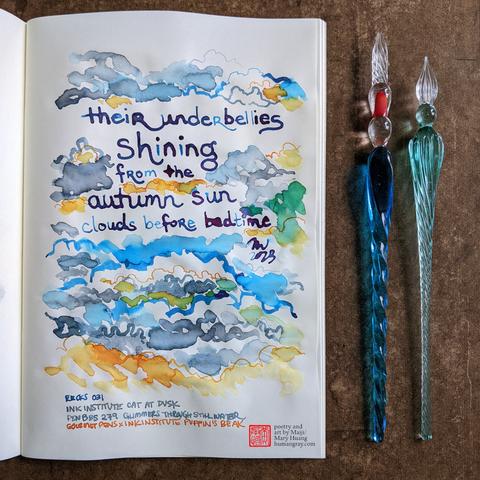
their underbellies
shining from the autumn sun
clouds before bedtime

(October's kigo inspired a double feature!)

ā˜ļø Commentary, wip photos, and ink palette used: https://www.pillowfort.social/posts/4028390
šŸ’§ Haiku Ink series: https://humangray.com/haiku-ink-series

#haiku #ink #FountainPenInk #poetry #MastoArt #CreativeToots #autumn #nature #clouds

maiji: autumn sun

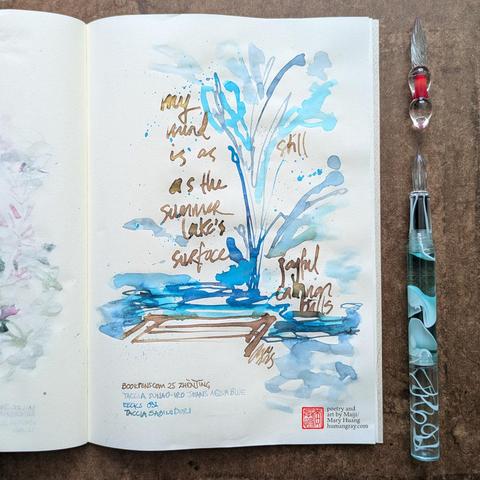
[image set: A series of photos showing two haiku illustrated with ink, followed by closeup detail shots, swatches of the inks used, and work-in-progress photos. 1) Photo of open notebook next to two glass dip pens. The page shows a haiku written in vivid blue ink with layers of multicoloured clouds rendered in greys, blues, yellows, oranges and greens where the inks blend. 2) Similar photo of open notebook, with a page showing a haiku written in dark gold ink in the centre of a glowing tree rendered with trunk/branches and foliage of sepia, brown, yellow, orange, gold and fine splatters of ink. 3 and 4) Detailed closeups showing the shifting colours and glittering effects in the various inks used. 5 and 6) Two photos showing ink swatches laid out in neat rows next to a mini flashcard set being used as an swatchbook. 7 and 8) In-progress photos of early stages of the illustrations, where it is just the lines of poetry with a glass dip pen starting to rough out surrounding outlines of clouds or tree trunk/branches. Past the in-progress art is an open sketchbook with rough sketches, ink bottles, waterbrushes and other art supplies.] their underbelliesshining from the autumn sunclouds before bedtimeearlier this monththe tree outside my windowwas the autumn sun - Poetry and art by Maiji/Mary Huang, humangray.com It's a double feature for October's haiku!Initially I was cool to the kigo ā€œautumn sunā€. The immediate vibes when I read the phrase were "how nice... not evoking anything in particular" for me. But then something funny started happening. As I started writing, more and more haiku kept coming out. Every time I went out or looked around, there was another idea, another angle. In the end this ended up being probably the most prolific and diverse month of haiku ink to date! There were so many options and directions to choose from. So I ended up finalizing two, in recognition and celebration of the eventfulness of October.Both of these are actually different views from the same window. ā€œClouds before bedtimeā€ was a moment I recall as being later in the day. It was still light outside - the sky was quite bright blue. I’d taken a break to do some eye stretches (looking at objects in the distance then gradually closer, looking left/right and up/down etc.), and turned my head to look out the window. That’s when I noticed: in between the high-rises, past the buildings, the clouds in the sky were flat and white - save for their undersides, which were shining gold. I’d never seen that before - or at least, I’d never noticed that I’d seen it before. For the cloud bellies, I picked an ink with a lovely gold glitter, making them sparkle when you tilt the page.ā€œThe tree outside my windowā€ was the last poem written while reviewing everything near the end of the month. I noticed several poems talking about the brilliantly yellow leaves of the tree outside - which was by then almost completely bare. Hard to believe those poems had just been written a few weeks prior… While working on this piece, I discovered a new technique! I’ve always loved the flicking-a-brush textural effects you can get with paint. I discovered you can do the same thing with the ink on the grooves of a glass dip pen, using a waterbrush to flick them off!I like that in both of these haiku the autumn sun is not the star (metaphorically anyways, haha). Instead, it highlights (spotlights?) something else. What I also like is that these poems are by and large descriptions and observations of nature, but the presence of the observer as also participating in the scene through the act of observation being related to their (my) perspective - my window, my bedtime (though I suppose it could also be the clouds’ bedtime!) is quite palpable.Inks usedautumn sun (clouds before bedtime) Gourmet Pen x Ink Institute Puffin's Beak Eecks 031 Ink Institute Cat at Dusk PenBBS 279 Glimmers Through Still Water autumn sun (the tree outside my window) BookPensCom 25 Zhenjing Dominant Industry Autumn Forest Gourmet Pens x Ink Institute Puffin's Beak Ink Institute Cat at Noon

Pillowfort

(and here's the second!)

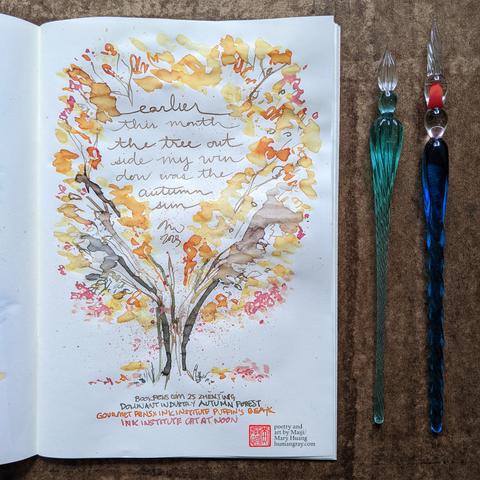
earlier this month
the tree outside my window
was the autumn sun

šŸ‚ Commentary, wip photos, and ink palette used: https://www.pillowfort.social/posts/4028390
šŸ’§ Haiku Ink series: https://humangray.com/haiku-ink-series

#haiku #ink #FountainPenInk #poetry #MastoArt #CreativeToots #autumn #nature

maiji: autumn sun

[image set: A series of photos showing two haiku illustrated with ink, followed by closeup detail shots, swatches of the inks used, and work-in-progress photos. 1) Photo of open notebook next to two glass dip pens. The page shows a haiku written in vivid blue ink with layers of multicoloured clouds rendered in greys, blues, yellows, oranges and greens where the inks blend. 2) Similar photo of open notebook, with a page showing a haiku written in dark gold ink in the centre of a glowing tree rendered with trunk/branches and foliage of sepia, brown, yellow, orange, gold and fine splatters of ink. 3 and 4) Detailed closeups showing the shifting colours and glittering effects in the various inks used. 5 and 6) Two photos showing ink swatches laid out in neat rows next to a mini flashcard set being used as an swatchbook. 7 and 8) In-progress photos of early stages of the illustrations, where it is just the lines of poetry with a glass dip pen starting to rough out surrounding outlines of clouds or tree trunk/branches. Past the in-progress art is an open sketchbook with rough sketches, ink bottles, waterbrushes and other art supplies.] their underbelliesshining from the autumn sunclouds before bedtimeearlier this monththe tree outside my windowwas the autumn sun - Poetry and art by Maiji/Mary Huang, humangray.com It's a double feature for October's haiku!Initially I was cool to the kigo ā€œautumn sunā€. The immediate vibes when I read the phrase were "how nice... not evoking anything in particular" for me. But then something funny started happening. As I started writing, more and more haiku kept coming out. Every time I went out or looked around, there was another idea, another angle. In the end this ended up being probably the most prolific and diverse month of haiku ink to date! There were so many options and directions to choose from. So I ended up finalizing two, in recognition and celebration of the eventfulness of October.Both of these are actually different views from the same window. ā€œClouds before bedtimeā€ was a moment I recall as being later in the day. It was still light outside - the sky was quite bright blue. I’d taken a break to do some eye stretches (looking at objects in the distance then gradually closer, looking left/right and up/down etc.), and turned my head to look out the window. That’s when I noticed: in between the high-rises, past the buildings, the clouds in the sky were flat and white - save for their undersides, which were shining gold. I’d never seen that before - or at least, I’d never noticed that I’d seen it before. For the cloud bellies, I picked an ink with a lovely gold glitter, making them sparkle when you tilt the page.ā€œThe tree outside my windowā€ was the last poem written while reviewing everything near the end of the month. I noticed several poems talking about the brilliantly yellow leaves of the tree outside - which was by then almost completely bare. Hard to believe those poems had just been written a few weeks prior… While working on this piece, I discovered a new technique! I’ve always loved the flicking-a-brush textural effects you can get with paint. I discovered you can do the same thing with the ink on the grooves of a glass dip pen, using a waterbrush to flick them off!I like that in both of these haiku the autumn sun is not the star (metaphorically anyways, haha). Instead, it highlights (spotlights?) something else. What I also like is that these poems are by and large descriptions and observations of nature, but the presence of the observer as also participating in the scene through the act of observation being related to their (my) perspective - my window, my bedtime (though I suppose it could also be the clouds’ bedtime!) is quite palpable.Inks usedautumn sun (clouds before bedtime) Gourmet Pen x Ink Institute Puffin's Beak Eecks 031 Ink Institute Cat at Dusk PenBBS 279 Glimmers Through Still Water autumn sun (the tree outside my window) BookPensCom 25 Zhenjing Dominant Industry Autumn Forest Gourmet Pens x Ink Institute Puffin's Beak Ink Institute Cat at Noon

Pillowfort

no chrysanthemums
just steam curling in petals
tea with Basho’s ghost

 Commentary, wip photos, and ink palette used: https://www.pillowfort.social/posts/4202468
šŸ’§ Haiku Ink series: https://humangray.com/haiku-ink-series

(3 of the inks in this piece are tea-themed!)

#haiku #ink #FountainPenInk #poetry #MastoArt #CreativeToots #tea #chrysanthemums #basho

maiji: basho's ghost

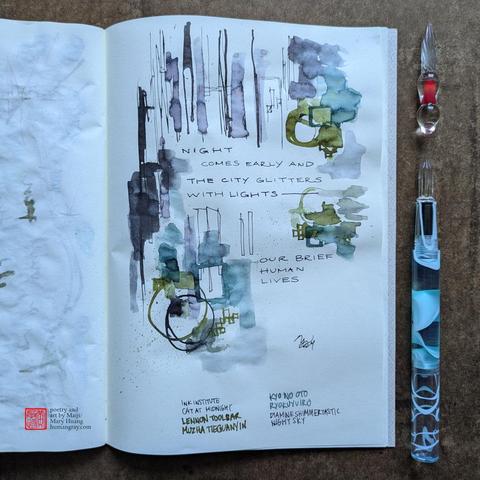
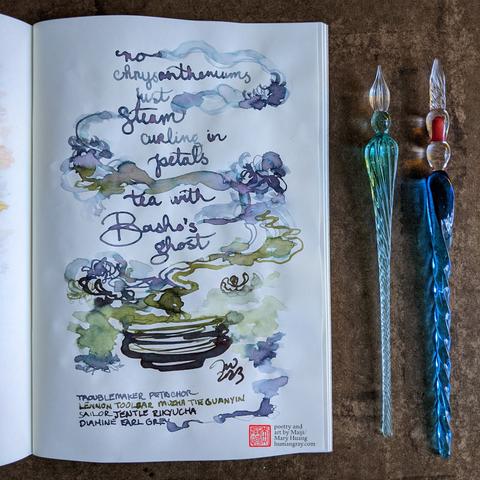
[image set: Three photos. 1) Open notebook next to two glass dip pens. The page shows a haiku written in hazy blue-tinged purple ink with wispy trails as if it were steam rising from a dark black-green tea bowl. The steam also has pale yellow-green flower petal-like shapes blooming from it. 2) Ink swatches laid out in neat rows next to a mini flashcard set being used as an swatchbook. 3) Work in progress shot of a glass dip pen resting on a page where just the letters and the beginnings of ink trails have been drawn. Visible on and around the notebook: a ceramic water cup, an ink sample cap, and an open sketchbook with rough sketches of the haiku composition and studies of Buddhist monk statues.] no chrysanthemumsjust steam curling in petalstea with Basho’s ghost - Poetry and art by Maiji/Mary Huang, humangray.com I was super intrigued by November’s kigo! Basho is, of course, that renowned giant of haiku (though in his day it wasn’t yet called haiku). From Tricycle's explanation of the kigo:A note on Basho’s ghost: Each year, Japanese haiku poets write hundreds of thousands of verses commemorating the death of Matsuo Basho on November 28, 1694. These poems nearly always include the season words Bashooki (ā€œBasho Memorial Dayā€) or okina no ki (ā€œMaster’s Anniversaryā€). But neither of these strikes much of a cord outside of Japan. This month’s season word is an adaptation of that classical theme, recognizing late autumn as the season of Halloween, All Souls Day, and Day of the Dead—a time when the nights are longer and the veil between worlds is thinner, making it possible to commune with the spirits of the dead . . . including Basho.The morning I read those words, I had just made tea with some snacks - in this case, Alishan Oolong with sour gummies and candied Buddha’s Hand (a kind of citrus fruit). I immediately thought of this Basho classic I had illustrated before. Chrysanthemums are associated with fall and winter, so it felt very timely.In East Asian culture and in Buddhist practice, we often give thanks to our ancestors. We can think of ā€œancestorsā€ as referring not only to those related by blood, but also to our teachers from all the traditions that influence and inspire our life in its many aspects. Their existence continues through our actions - just as we live on in the ways our actions have rippled, and continue to ripple, through the people and the world around us.This is an expression of gratitude for all my ancestors, all those who have inspired me in what I believe and what I do. A moment to enjoy tea thoughtfully, and a moment of rest communing with the ghost of Basho.Inks usedI used all 3 tea-themed inks I had in this! Sailor Jentle Rikyucha Lennon Toolbar Muzha Tieguanyin Diamine Earl Grey Troublemaker Petrichor

Pillowfort

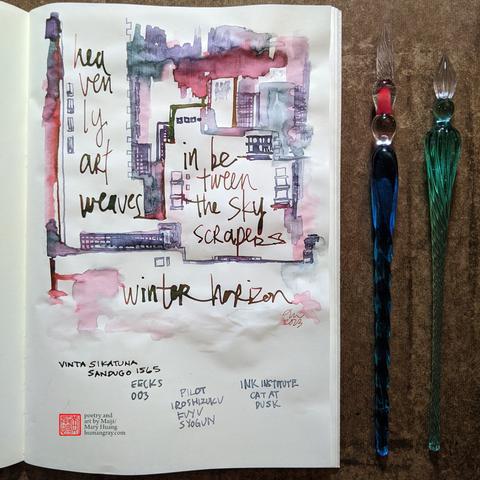
heavenly art weaves
in between the skyscrapers
winter horizon

ā˜ļø Commentary, wip photos, and ink palette used: https://www.pillowfort.social/posts/4271032
šŸ’§ Haiku Ink series: https://humangray.com/haiku-ink-series

#haiku #ink #FountainPenInk #poetry #MastoArt #CreativeToots #winter #city

maiji: winter horizon

[image set: 1) Photo of open notebook next to two glass dip pens, one slightly sanded down with a blunt tip. The page shows a haiku written in burnt red ink, with melting purple, grey, red inks forming a vivid sky past lines and shapes of condo towers dotted with windows. 2) Eight swatches laid out in neat rows next to a mini flashcard set being used as an ink colour swatchbook, spread out like a fan. 3) In-progress photo showing an open notebook at an early stage of the illustration, with the text and blocked out portions of the sky in gradient ink. Around the open book is a sketchbook with pen and pencil crayon roughs, a tissue blotted with rainbow ink colours, a pen, various ink sample vials, a bottle of ink and a dip pen resting in a ceramic water pot. 4) An angled closeup of the illustration showing the glowing green sheen and the silvery glitter that is visible when the page is tilted.] heavenly art weavesin between the skyscraperswinter horizon - Poetry and art by Maiji/Mary Huang, humangray.com Thanks to December’s prompt, I paid a lot of attention to the sky at the end of 2023.For me, the words ā€œwinter horizonā€ conjure up the sense of a sparse, wide open view stretched out before and above me. One of the most immediate things I realized was that living in the city, you don’t tend to get much actual horizon the way I imagine it. Instead, it’s more like little slices and bits of it in between the density of the urban environment. Some may consider this a loss of experience. It’s certainly a different experience. Those slices and pieces can still be glorious when you pay deep attention! Whenever I looked, I saw amazing everyday sights. I watched cottony clouds drifting lazily and wafting apart; or wide swaths of clouds settle like thick woolen blankets stretched over the city, with light cracking through. I observed tall slits of wondrously vibrant and smooth gradient colour stretching vertically as far as I could see.All of my poems this month were based on that idea of the sky peeking through between the tall buildings. Some were playful; others had more vivid imagery to describe the particular traits of what I could see of the horizon. This final version was based on phrasing that came to mind during meditation. ā€œHeavenly artā€ seemed to me to convey a tiny bit of the sense of the sacred that we can experience, when we are open to it.Composition-wise I tried to play a bit with the layout of the words a bit more. Not sure how successful it was, but it was interesting. The colour palette ended up very similar to the other urban environment haiku I had, Hazy Moon, though there are no inks that repeated between the two. The main visual difference though, is that if you tilt this illustration, one of the inks has a very dark green sheen!Inks used Vinta Sikatuna Sandugo 1565 Eecks 003 Pilot Iroshizuku Fuyu-syogun Ink Institute Cat at Dusk

Pillowfort

sitting at the foot
inside cold mountain’s shadow
how the mind sparkles!

ā›°ļø Commentary, wip photos, and ink palette used: https://www.pillowfort.social/posts/4401985
šŸ’§ Haiku Ink series: https://humangray.com/haiku-ink-series

#haiku #ink #FountainPenInk #poetry #ColdMountain #HanShan #MastoArt #CreativeToots

maiji: cold mountain

[image set: 1) Photo of open notebook next to two glass dip pens, one slightly sanded down with a blunt tip. The page shows a haiku written over an illustration of a mountain range, parts of the mountains diffused like ink clouds. The drawing and text are created with three different grey inks, transitioning from a red/purplish-grey to a cool bluish grey to a glittery greenish-silver. 2) Eight swatches laid out in neat rows next to a mini flashcard set being used as an ink colour swatchbook, spread out like a fan. 3) In-progress photo showing an open notebook at an early stage of the illustration, with only the line of the mountains on the page running through the three different ink colours. Around the open book is a sketchbook with rough drafts of the illustration lying on pieces of chipboard, boxes, a ceramic water pot, a tissue blotted with rainbow ink colours, and a glass dip pen hovering over the page. 4) An angled closeup of the illustration showing the silver glitter in the word "sparkles!"]sitting at the footinside cold mountain’s shadowhow the mind sparkles!- Poetry and art by Maiji/Mary Huang, humangray.comThe first kigo of the year, ā€œcold mountainā€, is not only a place, but also a person - the poet known as Han Shan (ā€œCold Mountainā€). Tricycle Magazine explained:A note on cold mountain: This month’s season word belongs to the ā€œLandscapeā€ category for winter because it refers to the Earth and its topography. But it is also the name of an 8th century Taoist-Buddhist poet who abandoned civilization to live in the remote Tiantai Mountains of Eastern China. Of the 600 poems said to have been written by ā€œCold Mountain,ā€ only 320 remain today. These were transcribed by a third party who gathered them from the monastery walls and rocks and cliff faces where Han Shan wrote them, because he never committed his work to paper.Han Shan is a giant of Chinese and Buddhist poetry. So I started off with thoughts around the word ā€œunfathomableā€ - the idea that a tiny person like me can barely comprehend not only the scale and height/depth of a mountain, but also the perspective of an enlightened, clear-eyed poet.I was actually feeling very sluggish the day I wrote the version I ended up finalizing. I had skipped my usual teas and was getting by most of the day on a tisane (herbal tea), and feeling very much not up to vigorous creativity. I decided I would at least try to clean up and tweak my notes, also look up some visuals of mountains for colour inspiration. I found a visual of layered mountain silhouettes, and two thoughts came to mind: ā€œWouldn’t it be lovely to do a completely grey piece!ā€ and ā€œIt’s been really clouded over and grey lately!ā€ That had actually served as inspiration for a recent meditation I facilitated on buddhanature: the sky is always there, just like the clarity of our minds. It's just that sometimes things are clouded over. As I looked through my grey inks, Mirror Flower Water Moon jumped out at me, and this glittery ink made me think of the word "sparkle". Instead of the intimidating idea of Cold Mountain’s shadow, my mind lit up at the thought of sheer wonder: the ability to touch reality, even for just a moment, through the insights of poetry. Instead of being discouraged by what I can't do, being amazed that it can be done and that I can experience its results. And it just felt right.A reminder sometimes when I don’t feel like doing something, try just taking a step. The smallest, simplest step, like opening a file or writing something. Who knows where it will lead?Inks used  PenBBS #261 Mirror-Flower Water-Moon Pilot Iroshizuku Kirisame Ink Institute Cat At Dusk Pilot Iroshizuku Fuyusyogun

Pillowfort

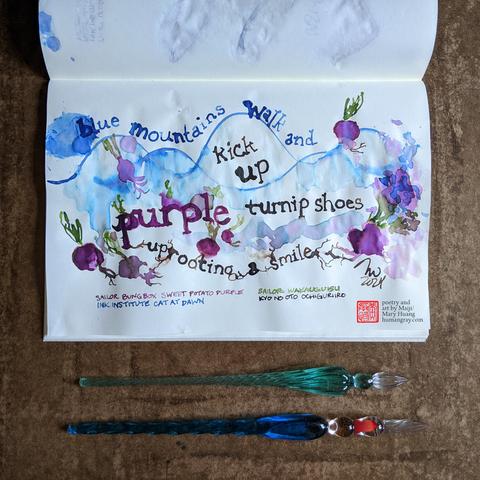
blue mountains walk and
kick up purple turnip shoes
uprooting a smile

šŸ˜„ Commentary, wip photos, and ink palette used: https://www.pillowfort.social/posts/4552118
šŸ’§ Haiku Ink series: https://humangray.com/haiku-ink-series

#haiku #ink #FountainPenInk #poetry #MastoArt #CreativeToots #turnip #turnips #BlueMountains

maiji: turnip

[image set: 1) Photo of notebook in a landscape orientation above two glass dip pens, one slightly sanded down with a blunt tip. The page shows a handwritten haiku with words jumping up and down over a playful illustration of wavy blue mountain forms, and blobby purple turnips flying or splattering everywhere. 2) Eight swatches laid out in neat rows next to a mini flashcard set being used as an ink colour swatchbook, spread out like a fan. 3) In-progress photo showing an open notebook at an early stage of the illustration, with only wet blue wavy mountain lines and writing. A large blue splatter covers the "b" in the word "blue", with further splatters on the previous pae and the board the notebook is resting on.] blue mountains walk andkick up purple turnip shoesuprooting a smile - Poetry and art by Maiji/Mary Huang, humangray.com ā€œThe blue mountains are constantly walking[...] To doubt the walking of the mountains means that one does not yet know one’s own walking.ā€- Dogen, Sansuikyo (Mountain and Waters Sutra), translated by Carl Bielefeldt * The term translated as blue, ao, in both Chinese and Japanese can be green or blue. So other translations include ā€œgreen mountainsā€ or ā€œverdant mountainsā€. This poem is about finding turnips and carrying them around because they’re neat. I mean that in both an abstract/metaphorical way, and a literal (but also kind of metaphorical) way. If that doesn’t make much sense, it’s probably because words are limited and so are my abilities as a poet.Longer (than usual) commentary beneath the read-more.[READ-MORE]As you might have guessed, February’s kigo was ā€œturnipā€. I found it difficult. For some people it may not be an elegant word suitable for poetry, but I don’t mind that at all; I love ā€œordinaryā€ words. My main issue was that my agricultural and culinary experiences are minimal. It was really interesting to read Tricycle’s explanation, and the example haiku used to illustrate (an extremely powerful piece by Sister Benedicta O.S.H. with a deceptively simple yet layered backstory). And also just funny because it seems a lot of people find this kigo hard to work with! Writing haiku is easy, writing (ā€œgoodā€) haiku is hard. If you’ve been following this series for a while you’ll know by now that, for me, a lot of it is about experiencing and appreciating the process, being open and curious, playing with colours and whimsy at least once in a while, and sometimes just being willing to stick with something to see how it evolves over time. True for haiku, true for life. My first thoughts were literally: ā€œWhat do I do with a turnip? Also I’m useless in the kitchen.ā€ Then I immediately realized that was a haiku. So here it is, even though I didn’t illustrate it:What do I do witha turnip? In the kitchenI’m also useless.- Maiji/Mary HuangI did play with that a bit more, and after a while moved on to other directions, writing several pages worth of turnips over the course of the month. Turnips also started not-so-randomly crossing my path outside of haiku, and not just from me looking for them while shopping for groceries! My favourite encounter was reading an article about Gloria Steinem and coming across these fantastic lines where she talks about a letter she received:ā€œThere was a little girl who was in first grade, and she was complaining to me on lined paper that the boys got the better part of the playground. She said, ā€œWe girls are as angry as turnips.ā€ [She laughs.] I thought: that kid is going to be a writer.ā€ So unexpected and perfect that it made me smile!.At the beginning of February, I had picked up ā€œThe Mountains and Waters Sutraā€ by Shohaku Okumura, which is a commentary on Dogen’s Sansuikyo. I struggled through most of the first chapter. The words weren’t difficult - it’s written in a pretty conversational manner - but anyone who’s studied this sutra (or Dogen in general) can probably attest to the fact it can be difficult to wrap your head around, even if you have familiarity with Buddhist language and logic. And poetry. (It’s a very poetic work!) Chapter 1 took me a while to get through, picking it up for a few pages here and there, on and off. Then near the end of February after a sangha session on a completely unrelated topic (Buddhist disclaimer: recognizing of course nothing is ever unrelated; they may only appear to be so, superficially), I picked it back up and found myself sticking monkeys everywhere throughout Chapter 2 Blue Mountains Are Constantly Walking. (Some context: To help prevent myself from taking copious notes when reading, I bookmark pages with particularly compelling passages to come back to after I finish the entire book. That way I can decide at that point, with a bigger picture perspective, if I still find it compelling enough to write down. It also helps me to keep a flow going when reading, and not make it feel like laborious studying. To that end, I keep this pile of little monkey-shaped sticky notes and reuse them endlessly as mini bookmarks.)My experience of Buddhist practice is a lot about dismantling preconceptions and digging deeper - reconnecting to a truer understanding of a bigger picture, a relativity about yourself and the world and how everything relates to everything else - within a framework that can offer immense meaning and compassionate purpose. And that sentence is just a bunch of words. But basically, things are what they are. The names and labels and systems and ideas we have about them are constructs we create and employ to help us navigate what we need to. They’re not meaningless - they do exist at various levels, and they can be very useful. But constructs are relative and contextual, and they are not the actual things themselves, and they can also be the cause of much delusion and suffering if we treat them as some kind of ultimate reality. We cause ourselves and others a lot of pain when we keep trying to apply a very limited perspective of something to every situation. And everything is a ripe opportunity to be aware, to be reminded, to practice that ongoing dismantling and reconnecting, and to let the world delight you in lovely, ordinary, extraordinary ways.Anyways. This poem is about finding turnips and carrying them around because they’re neat![/READ-MORE] On the illustration: I decided to go landscape for this piece, because why not! Early while working on this, I spilled my ink and it splattered on the piece itself, on my board, and on the back of the previous month’s work, as you can see in the WIP photo above. I was feeling pretty chill that day so it didn’t bother me too much, and I just splattered with another colour on the opposite diagonal to even it out. It helped that the entire piece was meant to have a silly and playful vibe!Inks used  Sailor Bungubox Sweet Potato Purple Ink Institute Cat At Dawn Sailor Jentle Wakauguisu Kyo no Oto Ochiguriiro

Pillowfort

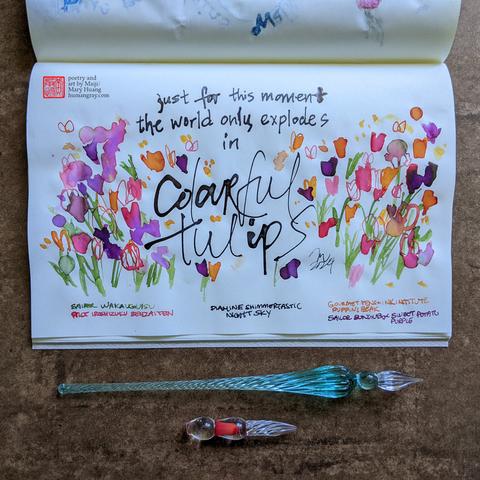
just for this moment
the world only explodes in
colourful tulips

🌷 Commentary, wip photos, and ink palette used: https://www.pillowfort.social/posts/4692279
šŸ’§ Haiku Ink series: https://humangray.com/haiku-ink-series

#haiku #ink #poetry #FountainPenInk #tulip #flowers #colourful #colorful #FlowersOfMastodon #BloomScrolling

maiji: tulip

[image set: 1) Photo of notebook in a landscape orientation above two glass dip pens, one of which is just a tip. The page shows a handwritten haiku with words centered in blobs of colour representing colourful flowers. 2) Ten swatches laid out in diagonals next to a mini flashcard set being used as an ink colour swatchbook. 3) In-progress photo showing an open notebook at an early stage of the illustration, with only the text and the beginning splotches of petals and stems, next to an open bottle of ink and some tissue.] just for this momentthe world only explodesin colourful tulips - Poetry and art by Maiji/Mary Huang, humangray.com Time is such a strange relative thing. It feels like it's been forever since I made/shared a haiku ink piece, but it's always only 1 month between each of them. Back when I was working on February’s turnip, I had actually mused to myself that "turnip" is so similar to "tulip", and wouldn’t it be amusing to see that as a spring kigo. So when March’s kigo was revealed, it made me smile!It’s only two words, but ā€œcolourful tulipsā€ is intensely visual. It immediately brings to mind fields bursting with a fresh, joyful brightness. What a contrast to other kinds of explosions we can experience in this world. I’ve been thinking a lot lately about the remarkable abilities we have: the ability to see and marvel at colourful tulips; the ability to think about, experience, and understand suffering; the ability to imagine and long for something better; and the ability to do all three at the same time.Long thoughts below the cut. [READ-MORE]These days it can feel like there's an impossible amount of suffering in this world. So much to grieve over, and so much work to do, to what end? In the sanghas I practice with, we have members who are activists in an array of areas, from education and labour rights and healthcare to racial injustices and wars and genocide and the climate crisis. The sangha - the community - is one of the ways we support each other through the difficult work. Both everyday difficulties, and difficulties that can feel so overwhelming and existential. The theme of March was nourishing joy and happiness. This is not frivolous. If anything, this is essential in the face of great suffering. In our practice we reflect a lot on not only the big actions, but also the little actions, the little things that we do for others and for ourselves to be able to carry the big things. Every little thing contains seeds of big things in them. It’s not possible for suffering to not exist. At the same time, it’s not possible for joy and happiness to not exist either. In every moment, both are manifesting somewhere, everywhere in the world, whether we’re aware of it or not.Something that always amazes me time and time again is how much there is behind any thing - any object, any being, any situation. There is so much we don’t see that we take for granted because it feels like it was always there, it was always this way. Take, for example, these words, and the fact that you’re reading them right now. How easily I’m typing them at this moment, trusting that on the other side of the screen someone else will see them and be able to read and access my ideas, what’s on my mind. Somehow, if we both understand English, a significant amount of meaning will be transmitted. And yet, if the reader doesn't understand the language the writer is working in, this is just a meaningless jumble of patterns. And we've come up with so many jumbles of patterns to communicate! How different English is from Mandarin or Japanese, for instance, or from American Sign Language! How amazing that we evolved to create something called language, not just once but over and over and over, that we have this ingenuity and ability to develop and parse so many different symbols and approaches, process them and be able to transmit something that is completely invisible, but has a tangible impact on the physical world!Sometimes I despair, especially when I have arguments, even pointless ones, with my family and friends. These include people whom I love dearly and who have been part of my life for as long as I can remember. If I can’t see eye to eye with them, how can anyone hope of finding common ground to achieve peace or resolve any issues anywhere?Sometimes I manage to see clearly enough to realize: that’s one way of looking at it. Here's another.Knowing that we can't see directly into anyone’s experience, knowing that all forms of communication are imperfect, knowing that we can have misunderstandings and difficulties with even the people closest to us… how absolutely astounding that any group of people can come together to accomplish things, whether they seem small or great, over time. Against all odds, cities have been built, movements have been created. Against all odds, we've made things, lost them and rediscovered them and shared them and built on top of them, over thousands and thousands of years. Against all odds, we have people who dedicate themselves and work together with others of similar spirits to alleviate suffering in so many different ways, in so many different places around the world, despite all the differences in our backgrounds and our experiences. It's nothing short of miraculous. As miraculous as being able to look out at a field of tulips growing.[/READ-MORE]For the sharp-eyed, you may have noticed something different in this month's photo. Yes, this piece uses five inks instead of the four in all the previous pieces in the series. And also something else. [READ-MORE]I broke my glass dip pen. [Photo of two broken tips (head and tail) of a shattered glass dip pen lying on the ground with specks of dust everywhere.]This is actually my old, original dip pen, which already had a chipped tip that I previously sanded down for safety. Instead of a consistent fine point, it makes interesting blobby lines that I use a lot in this series. It was sitting near the edge of my work surface and I accidentally knocked against it while moving supplies around, and it fell from about waist-height. Miraculously (again!) the tip itself didn't shatter, just the handle. I wasn't too upset, because it had already been damaged and I was using it on "borrowed" time for so long. And also because I thought about that story of the broken tea bowl (and then hilariously broke my tea bowl about a month after this incident).I sanded its bottom down for safety. I'm going to try to use it for illustrating this month's haiku ink![/READ-MORE]Inks used Sailor Jentle Wakauguisu Pilot Iroshizuku Benzaiten Gourmet Pens x Ink Institute Puffin's Beak Sailor Bungubox Sweet Potato Purple Diamine Shimmertastic Night Sky

Pillowfort

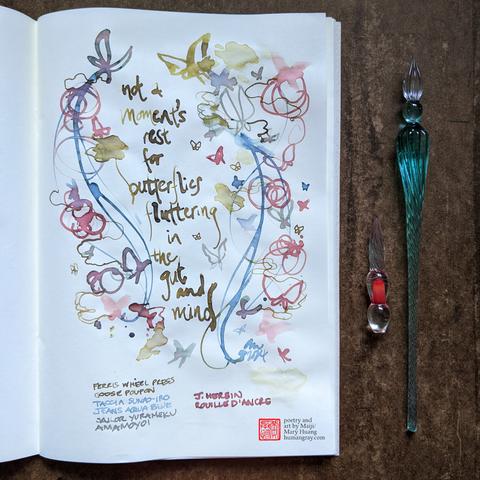
not a moment's rest
for butterflies fluttering
in the gut and mind

šŸ¦‹ Commentary, wip photos, and ink palette used: https://www.pillowfort.social/posts/4802708
šŸ’§ Haiku Ink series: https://humangray.com/haiku-ink-series

#haiku #ink #poetry #FountainPenInk #butterfly #butterflies

maiji: butterfly

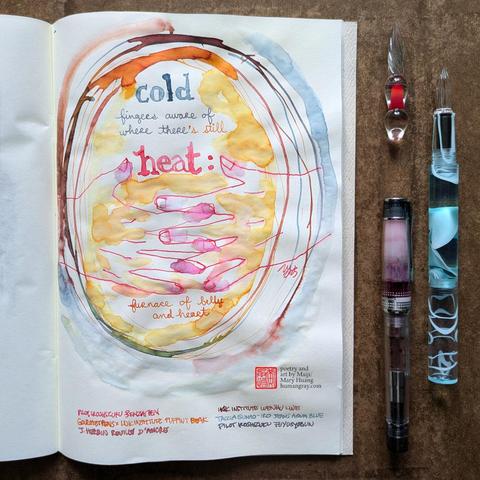
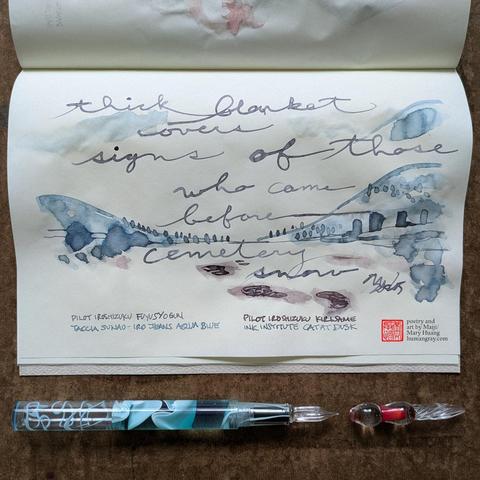
[[image set: 1) Photo of notebook next to two glass dip pens, one of which is just a tip. The page shows a handwritten haiku with words in a golden taupe colour, with swirling ink lines creating the impression of loose motion lines, squiggles and swirling butterflies in faded pinks, silvery purples and light blues. 2) Ten swatches laid out in diagonals next to a mini flashcard set being used as an ink colour swatchbook. 3) In-progress photo showing a glass dip pen tip hovering opver and open notebook at an early stage of the illustration. Only the text and some of the beginggling swirl lines are on the page, with blobs of ink clearly in the midst of drying.] not a moment's restfor butterflies flutteringin the gut and mind - Poetry and art by Maiji/Mary Huang, humangray.com It's hard to believe it’s been over a year since I started the haiku ink series on a whim! This haiku was for/created in the month of April. It was a busy time in many aspects of my life. Work, creative projects, sangha activities, commitments with friends; everything was blooming and flourishing. Part of it was, I think, the simple fact that spring was much more solidly setting in, the weather was warming up, people want to do things. It was also National Poetry Month, which always makes me extra aware of poetry everywhere!As beautiful and vibrant as these things can be, even positive things can be overwhelming. In Zen practice, we often try to avoid overthinking things. Instead of treating the mind as the centre of our being, we may focus on body sensations to help bring us back to where we truly exist: here. Now. To not be swallowed up in rumination on the past, or carried away by anxieties about the future. This is something that I, as someone with constant hamster wheel mind, desperately need reminders of sometimes. When I meditate, I sometimes put my hands on my stomach, so I can feel my belly, the movement from breathing and the warmth of being alive, and ground myself more in those feelings, instead of letting my mind spiral.I remember one of my first times helping to facilitate a meditation - possibly my first ever time - I opened it by acknowledging all those nervous feelings and worries and anxieties. About feeling like I had butterflies in my stomach. But also... isn't the idea of butterflies fluttering everywhere, keeping me company, kind of a fun and lovely idea? It was helpful to not have to pretend it's not there. To feel those butterflies. And by the simple act of letting them flutter, allow them to settle.Inks used Sailor Yurameku Amamoyoi Taccia Sunao-iro Jeans Aqua Blue Ferris Wheel Press Goose Poupon J. Herbin Rouille d'Ancre

Pillowfort

found seashell planet
floating home in an ocean
of water of stars

🐚 Commentary, wip photos, and ink palette used: https://www.pillowfort.social/posts/4829399
šŸ’§ Haiku Ink series: https://humangray.com/haiku-ink-series

#haiku #ink #poetry #FountainPenInk #seashell #space #planet #ocean #Buddhism #interbeing

maiji: seashell

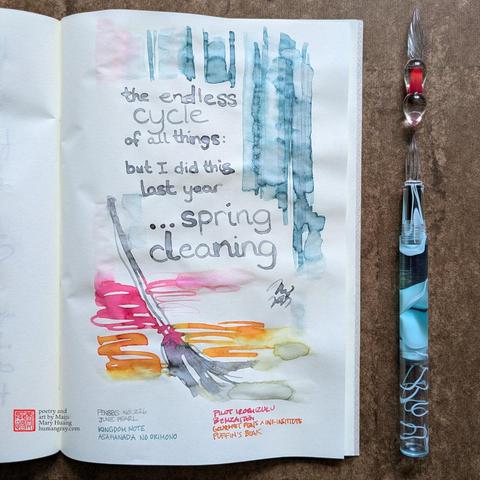
[[image set: 1) Photo of notebook next to two glass dip pens, one of which is just a tip. The page shows a handwritten haiku with words in glittering silver, pale blue and green tones, surrounded by swirling lines evoking the shapes of seashells and water. 2) Ten swatches laid out 5x2 rows next to a mini flashcard set being used as an ink colour swatchbook. 3) In-progress photo showing a glass dip pen tip hovering over an open notebook at an early stage of the illustration, with the text and swirls at each corner of the page. An open sketchbook and ceramic water pot can be seen in the background. 4) Closeup of finished piece at an angle, showing the gold and silver glitter in the inks.] found seashell planetfloating home in an oceanof water of stars - Poetry and art by Maiji/Mary Huang, humangray.com The keigo for May was ā€œseashellā€. Here I consider a seashell from a non-human perspective, and compare it to a planet from a human perspective. In each perspective, both things are homes. They may exist at very different scales, but they're not so different. And just as the universe contains a seashell, a seashell contains a whole universe.This haiku is a reflection and convergence of many things I love. If you’ve been following my Pillowfort, you’ll know I’ve been drowning in (exploding with…) Star Ocean 2 nostalgia for a while. Funnily enough, months before it all happened, I’d started outlining an idea for a dharma talk for my sangha, an extended personal reflection on two questions: ā€œWhere do you live?ā€ and ā€œWho are you?ā€ We explored these questions through the lens of beginner’s mind and Buddhist practice to support finding meaning, compassion, purpose and peace in everyday life. Two of the many ways we looked at them from were: the incredible scale of the universe, and how we form a sense of personal identity and a connection to something vaster than our individual selves. Due to scheduling, I ended up doing a different talk earlier, and this one got scheduled for May—which ended up being right in the midst of my Star Ocean 2 explosion. The week I facilitated, it struck me that I was inadvertently (basically) offering a Star Ocean-themed dharma talk. I was so amused at this bringing of worlds together. Everything is interconnected! More below the cut. [READ-MORE]At one point, we reflected on astronauts going into space. We don't think of astronauts as being ignorant or naive. We see them as a kind of elite representation of humanity when it comes to carrying and representing the most cutting-edge science, technology and knowledge we've achieved. Alongside this, there are many anecdotes of an astronaut seeing, for the first time, Earth in space: not as an image and not as a video but actually there before them. Seeing the blue oceans and the brown and green landmasses and the drifting white clouds hanging in space. And having this incredibly visceral, spiritual experience ofā€”ā€Wow. That’s my home.ā€ And when they return to Earth, they find they have a very different perspective.One of the most wonderful things about these dharma talks is that they offer a jumping point for everyone to share their own experiences. It’s truly the personal insights from everyone on the theme that make it so powerful and inspiring. One memorable comment (which I received permission to share, as this period is typically confidential so that people have a comfortable, safe space to reflect) was from a writer who also facilitates sessions. She offered a beautiful reflection that brought both questions together: that when thinking about ā€œwho I amā€, instead of any of the things we often distinguish ourselves and others as— gender, race, ethnicity, culture, politics, whatever—she sometimes tries to think of herself as an Earthling. A scale at which trivial differences can start to disappear, and you can relate to the world with a much greater perspective on what matters.In Buddhism, there is the term ā€œtrichiliocosmā€ (in Sanskrit: trisahasramahāsahasralokadhātu, literally ā€œthree thousand million world elementā€), which you may encounter when studying sutras. A trichiliocosm is a ā€œthird-order worldā€. This means a world that contains a thousand second-order worlds, which each contain a thousand first-order worlds. Worlds all the way down! If that’s confusing-sounding, I find it helpful to note that an alternate modern translation for trichiliocosm is ā€œgalaxyā€. A galaxy contains solar systems, and solar systems contain planets. Three levels of worlds.In context, trichiliocosm is usually used to emphasize the idea that there are countless worlds, each with their own sentient beings, as well as their own bodhisattvas and buddhas. Whether or not you see this as literally true, the reality is we are sentient beings in a world of many worlds—worlds of different perspectives and experiences, as well as worlds of humans, worlds of animals, plants, and more. When we can directly experience and understand this as reality and not just as a theory, it can offer such an incredible appreciation of how vast and wondrous everything is. And at the same time how small and precious everything is, and how every single moment of existence is a miraculous treasure. And, I hope, that it can move us to value and take care of where we live, and everything that lives on it, and to not realize the value of something only when it is no longer there.I shared a few resources to help with appreciating a sense of scale: An animation showing the relative size of planets and stars: There are lots of videos and images with this concept; I just like the music in this one a lot. (I stopped the video after Sirius because usually at that point people’s brains, including my own, are exploding, and also because time was limited. But the entire thing is impressive.) An article on the Laniakea supercluster, which is our current level of understanding of the scale of our spatial home, ā€œwhere we liveā€. People really liked the picture of the little dot showing our giant home, the Milky Way Galaxy, in our even more gigantic home! [/READ-MORE]Inks used PenBBS #261 Mirror Flower Water Moon PenBBS #226 June Pearl PenBBS #279 Glimmers in Still Water Diamine Shimmertastic Night Sky

Pillowfort

disappearing light
they once helped us read at night
long ago, fireflies

šŸ”¦ Commentary, wip photos, and ink palette used: https://www.pillowfort.social/posts/4911773
šŸ’§ Haiku Ink series: https://humangray.com/haiku-ink-series

#haiku #ink #poetry #FountainPenInk #firefly #fireflies #nature #conservation

maiji: firefly

[[image set: 1) Photo of notebook next to two glass dip pens, one of which is just a tip. The page shows a handwritten haiku with deep mauve, blue and green blobs and lines with dots of yellow reminscent of dots of light hovering around foliage. 2) Eight swatches laid out in angled 4x2 rows next to a mini flashcard set being used as an ink colour swatchbook. 3) In-progress photo showing a glass dip pen tip hovering over an open notebook at an early stage of the illustration with text and dark purple and yellow splotches of ink. Around the notebook are several open bottles of ink. 4) View of the back page of the illustration, showing yellow, purple and mauve ink splotches bleeding through and appearing yellow, blue and green on the other side.] disappearing lightthey once helped us read at nightlong ago, fireflies - Poetry and art by Maiji/Mary Huang, humangray.com Compared to some of my previous poems, writing and illustrating the June haiku felt relatively effortless - quick to conceive, quick to complete. Not that it necessarily means it's better, or even good, or anything, haha. But when I saw the kigo "firefly", several things came to mind immediately, a little sequence of flashes in my brain as it quickly made a connection between a series of ideas. I thought about the Tale of Genji, where fireflies romantically light up your lover's face so you can see their beauty in the darkness. And then I thought about old Chinese stories about scholars catching fireflies in bags so that they could study at night. My mom used to tell me stories about this too. And then I thought about how I can't remember the last time I saw a firefly in person. In fact, I'm not terribly confident I haven't only imagined seeing them myself, thanks to their magical appearances and poetic symbolism in countless stories, endless media, flitting and flickering throughout my childhood dreams as if they'd always been there.And then I thought about firefly conservation. Yale Environment 360: A Summer Light Show Dims: Why Are Fireflies Disappearing?  Xerces Society for Invertebrate Conservation: Firefly Atlas / Firefly Conservation Inks usedIt's always interesting to see what happened to the inks bleeding through the other side of the sheet. In this case, some of them transformed quite a bit! Kyo no Oto Yamabukiiro Sailor Yurameku Amamoyoi Taccia Sabimidori Colorverse Vortex Motion

Pillowfort

we trod on fine lace
stitched for us along the path
by sun and shade tree

🌳 Commentary and ink palette used: https://www.pillowfort.social/posts/5281762
šŸ’§ Haiku Ink series: https://humangray.com/haiku-ink-series

#haiku #ink #poetry #FountainPenInk #trees #nature #shadows

maiji: shade tree

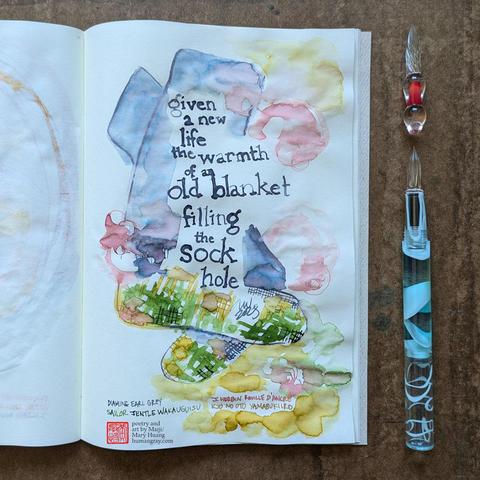
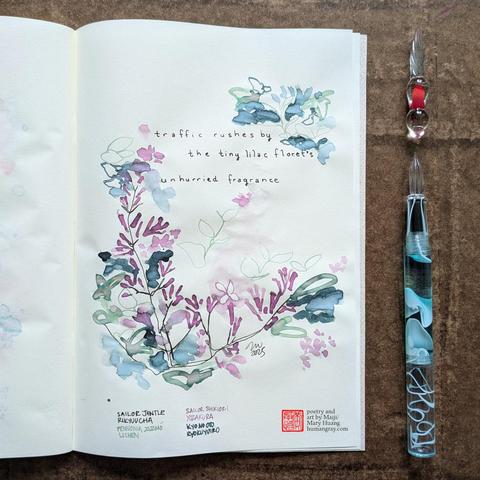
[image set: 1) Photo of notebook next to two glass dip pens, one of which is just a tip. The page shows a handwritten haiku surrounded by layered ink splotches and squiggles in pink-purple and pale greens, creating interesting colour mixes and turquoise fringes to illustrate the idea of layered, textured shadows. 2) Eight swatches laid out in 4x2 rows next to a mini flashcard set being used as an ink colour swatchbook.]we trod on fine lacestitched for us along the pathby sun and shade tree- Poetry and art by Maiji/Mary Huang, humangray.comShadows cast by treesSome #SilentSundays: one / two / threeThe next time you go for a walk on a sunny day under the foliage of a tree, have a look at the collaboration!(I forgot to take a wip photo while working on this, oops!)Inks used Ferris Wheel Press Cream of Earl (my sample vial of this ink has become quite green, so the swatch no longer accurately reflects it) Sailor Shikiori Yozakura Lennon Tool Bar Muzha Tieguanyin Sailor Yurameku Amamoyoi

Pillowfort

one hydrangea bloom
ten thousand flower cluster
my skandha body

šŸ’ Commentary, wip photos, and ink palette used: https://www.pillowfort.social/posts/5386293
šŸ’§ Haiku Ink series: https://humangray.com/haiku-ink-series

#haiku #ink #poetry #FountainPenInk #nature #flower #flowers #hydrangea #FlowersOfMastodon #BloomScrolling #Buddhism

maiji: hydrangea

[image set: 1) Photo of notebook next to two glass dip pens, one of which is just a tip. The page shows a handwritten haiku surrounded by ink splotches in varying shades of vivid blue resembling an explosion of flower petals. Some of the edges of the ink splotches are tinged with crimson, and bits of the lettering overlapping the splotches gleam with gold. 2) Eight swatches laid out in diagonal 4x2 rows next to a mini flashcard set being used as an ink colour swatchbook. 3) An open note book next to a ceramic waterpot with ink lines of the poem and leaf-like outlines. There is an extra "flower" written in the poem. 4) The same open notebook, only this time splashed with deep blue inks, including a patch that obscures the extra word "flower", which was a handwritten typo. A waterbrush lies across the page.]one hydrangea bloomten thousand flower clustermy skandha body- Poetry and art by Maiji/Mary Huang, humangray.comBack when I made this, I'd started doing something a little different with my process, which I'm still doing right now. It didn't happen intentionally; it just worked out that way due to my playing so much Star Ocean The Second Story R in my spare time, haha. Instead of writing throughout the month, I look at the kigo when it first comes out, jot down some thoughts, and then largely leave it and let it percolate. I come back close to the end of the month and then start writing again and finish it up. It’s been interesting to see how my thought process and inspiration transitions through the conscious pause!With "hydrangea", I started writing some things related to the idea of a water vessel, inspired by the flower's name. My thoughts at the end of the month turned to its appearance, and the idea of pieces and parts of a whole. This haiku reflects on the Buddhist concept of skandha. Below the cut, some thoughts on flowers, fruit, our understanding of death/perception of our bodies, Star Ocean 2, organizations, water. It’s a bit of a meandering reflection, just kind of wandering around, considering things as they arise. [READ-MORE]When I look at a hydrangea, I see a flower. I usually think of it as one flower. But when I look closely, especially if I’m trying to draw it, I quickly realize I’m actually looking at a spherical cluster of a whole bunch of flowerheads packed into the appearance—one might say the illusion—of a single flower. I remember learning a long time ago that some berries, like strawberries and raspberries, are not actually berries. They’re what we call an ā€œaggregate fruitā€: basically a bunch of tiny fruits packed together and look like one fruit. Harder to see on a strawberry, easier to see on a raspberry or a blackberry, with all the wee segments connecting together.Is anything we can see around us a single, indivisible, fundamental thing? All living organisms are aggregates too. Made up of billions of cells, every single cell alive in and of itself. And we’re constantly dying. Certainly our cells die when we get injured and bleed, or when we get sick and hack out all kinds of bodily fluids. But even when we do nothing at all, when we just sit there with our hair and nails and skin skills coming off of us, we’re dying.When I made this piece, I'd been reading Why We Die by Venki Ramakrishnan. It offers a multifaceted look at our present understanding of dying, where these ideas evolved, where science and technology is currently taking us, and important things to consider as we progress on this journey. It reminded me that what we commonly think of as death is really the loss of the ability to operate as a coherent, cohesive entity. Beyond a scientific, medical, clinical death—the death of a heartbeat, the death of detectable brain functioning, and so on— individual cells of our body can continue living, though we would likely not think of that as ā€œusā€.The Sanskrit term ā€œskandhaā€ is often translated as aggregate. Basically, a bunch of things gathered together. In application, it usually refers to the concept that we are composed of other things. The classic Buddhist list of five skandhas is form, feelings, perceptions, mental formations, and consciousness (with varying translations). There is no one single thing that is uniquely, indivisibly, us.This applies not just to organic living things. I’m looking at Star Ocean The Second Story (Star Ocean 2), which first existed as a PS1 game, then a PSP remake, and now the Second Story R remake on multiple platforms - Switch, PS4 and 5, PC/Steam. They exist in Japanese as well as other languages, each with adjustments and tweaks due to the nature of translation, society, culture, individual or team preferences. Beyond all this, it also exists as two manga and an anime, and several radioplays/audio dramas. Beyond this, there are also several universes worth of fanfiction, fanart, doujinshi. And before this, it existed as concepts - ideas, sketches, scenarios, plans that continuously evolved over the course of its development, shifting branches of code to a shared codebase, a process which repeated every time it was remade. Not a single one of these things is the product of a single individual. The development team, the voice actors, the translators, the fans, and so much more. But to me, ā€œStar Ocean 2ā€ is a cohesive idea, an experience of a world and a narrative with a cast of characters. I perceive ā€œStar Ocean 2ā€ as the culmination, the aggregation of my awareness and memories and experiences of all of these things produced by so many people across a period of space and time.Organizations are like that too. We think of them, often talk about them, as some kind of singular entity, but they're obviously not. Something I often say is that I’m always blown away that any group of people larger than one or two can work together and achieve things. It's honestly quite astounding. (I talked about this a bit more in tulips.)Understanding this at a deep level is actually a key aspect of enlightenment: the ability to perceive the inherently empty nature of all things. In Buddhism, a frequent image that comes up is the idea of a wave. One wave seems to be its own individual entity, but it's temporary: the wave rises and falls back into the water. Its true nature is the water, the ocean, something far vaster than itself. The wave is just a brief manifestation. As Thich Nhat Hanh summarizes, "Enlightenment is the moment the wave realizes it is the water."I meditate on this periodically. Usually it feels intellectual and distanced. Sometimes it's terrifying. Sometimes it's fine; sometimes it's even calming. Every so often it makes perfect sense. And I suppose in the end I did come back to the idea of a hydrangea as a water vessel - all things a moment container of a much greater ocean. [/READ-MORE]Inks used Taccia Sabimidori Eecks 031 Ink Institute Cat at Dawn PenBBS #179 Serenity I also used gold watercolour on the text.

Pillowfort

sometimes it’s enough
to reflect another’s light—
unresisting moon

šŸŒ• Commentary, wip photos, and ink palette used: https://www.pillowfort.social/posts/5518275
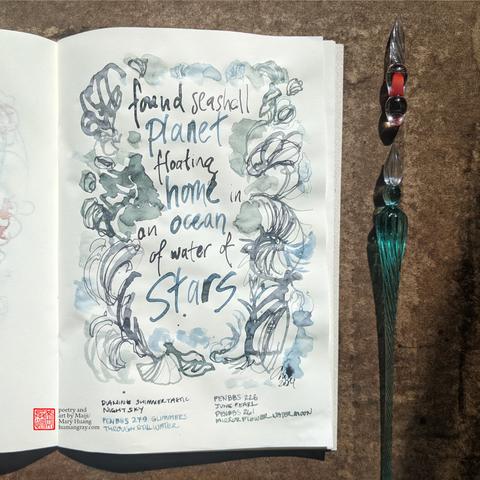
šŸ’§ Haiku Ink series: https://humangray.com/haiku-ink-series

#haiku #ink #poetry #FountainPenInk #nature #moon #autumn #Buddhism #Daoism #Taoism

maiji: autumn moon

[image set: 1) Photo of notebook next to two glass dip pens, one of which is just a tip. The page shows a handwritten haiku surrounded by ink lines and splotches suggesting a scene with a warm orange moon over a blue-purple lake with branches of red and glittering purple peeking in at the edges and being reflected in the water. 2) Eight swatches laid out in diagonal 4x2 rows next to a mini flashcard set being used as an ink colour swatchbook. 3) An open note book surrounded by sample vials and boxes of ink. The work-in-progress page shows only the text and red ink blobs of foliage shapes around the bottom with a bit of a splotch at the side. A waterbrush peeks out of the bottom left.]sometimes it’s enoughto reflect another’s light—unresisting moon- Poetry and art by Maiji/Mary Huang, humangray.comAs Tricycle explains, "moon" in traditional haiku always represents the autumn moon when there's no other modifier to indicate a different season.This kigo came during the month of Mid-Autumn Moon Festival, and there are so many associations that easily emerge from that alone. So I started thinking of what's changed and what's stayed the same in how I celebrate the festival today, compared to what a large, ultra-special family gathering it would have been for my grandparents and my ancestors decades and centuries ago.As I was reflecting, it occurred to me that, you know... moonlight technically doesn't exist. The moon itself does not emanate any light. Moonlight is, of course, reflected sunlight. That led me reflect on a lot of other things. Like where value comes from, what acknowledgement and worth means. Or the small self versus a bigger purpose, what legacies result in. I don't think there are straightforward or ultimate answers to many, or maybe even any, of these things, even if there are common answers. And a lot of them are things we might understand in the abstract, or as theory, but need to experience ourselves to find our own deep appreciation of them.For example, I care a lot about what other people think of me, as much as I wish I didn't sometimes. I want my efforts and hard work to be recognized. I think that's true for a lot of people. At the same time, I'm not really someone who relishes the spotlight. I also dislike the idea of climbing ladders (social, corporate, whatever) brainlessly; I think it's one of those things that society has conditioned us to automatically think of as "normal" without question, resulting in the misconception that progress somehow always means something going up, even at the expense of sustainability and so many other things.I'm sometimes much happier, much more effective, at supporting others I respect, whose work I believe in. There are so many people doing amazing things out there, and often that support can be so meaningful and invaluable to bolster their spirit, their efforts. A hundred years later, five hundred years later, a thousand years later... what's the real legacy of our actions? What are the things we really must do?Buddhism and Daoism would say...  nothing. There's nothing you must do. But, it's helpful to understand that certain things can cause certain outcomes.Inks used Vinta Sikatuna Sandugo 1565 Gourmet Pens x Ink Institute Puffin's Beak J. Herbin Amethyste de l'Oural Ink Institute Cat at Dawn

Pillowfort

walking with the wind
as it scatters vivid gems
from its red leaf cloak

šŸ Commentary, wip photos, and ink palette used: https://www.pillowfort.social/posts/5646468
šŸ’§ Haiku Ink series: https://humangray.com/haiku-ink-series

#haiku #ink #FountainPenInk #poetry #nature #autumn #leaves #MixedMedia

maiji: red leaves

[image set: 1) Photo of notebook next to two glass dip pens, one of which is just a tip, the other clear with pale aqua-white swirls running throughout its body that look like smoke or an ink drops in water. The page shows a handwritten haiku surrounded by ink lines, splatters and colourful maple leaf shapes reminiscent of a surrounded by dancing leaves. 2) Eight swatches laid out in diagonal 4x2 rows next to a mini flashcard set being used as an ink colour swatchbook. 3) A closeup shot of the centre of the piece, showing the handwritten script with dots of spleckled ink and tiny orange and red maple leaves sitting on top of the paper, casting faint dimensional shadows on the paper.]walking with the windas it scatters vivid gemsfrom its red leaf cloak- Poetry and art by Maiji/Mary Huang, humangray.comI was really struggling with this fall kigo, as simple and obvious as it is for the season—and perhaps that’s exactly why it was a struggle. So I started going on more walks early in the morning and in the early evenings. Just to spend more time around the trees and the leaves and take everything in, see what I notice. Near the end of the October, I went out for a walk on a wonderfully windy day, and came out with this haiku. I really like the end result; it feels light, whimsical and magical which captures my memory of that walk. A downside is that red leaves may not be as much the focus so much as the motion of the wind, but I do see the splotches of colour in my mind when I read it...You may have noticed I've changed to a new glass dip pen. The other one isn't broken, but the tip seems to be chipped in a way where it's difficult for the ink to sit on it, so it's extremely scratchy and sometimes doesn't write at all. This new one is a Teranishi Glass Dip pen with a screw-on lid. It's more expensive than my other dip pens, as well as more portable (neither here nor there since I don't travel with glass dip pens) and super pretty (the big appeal).This haiku ink is also different from all the other haiku ink works I've made so far because it's dimensional! More WIP photos and details below the cut. [READ-MORE]Art-wise, this was a fun experiment! There’s a local miniatures show every fall, and I picked up these little maple-leaf punches which crafters can use to make teeny tiny plants. I had a lot of scrap label paper sitting around in a drawer, off-cuts from cutting out homemade stickers, so I took a strip and punched a bunch of maple leaves out of it. I wasn't entirely sure how I would use these, so there was lots of trying different things, like scattering the leaves on the paper and spilling ink all over them to see if I could get colour wrapping around blank maple leaf silhouettes (no I couldn't, the ink is too waterly and the leaves are too small and light and keep floating around); tracing the punched-out holes; punching out other kinds of paper, and so on. It was a nice change from what I normally do, and also required I do the art in stages and wait for the ink to dry so that I don’t turn everything into a big mess. I’m pretty impatient when it comes to making stuff normally and usually prefer finishing things in one sitting, so that was another nice change.I kept adjusting what I was doing based on whether something seemed to be working, or not. I considered, but ultimately didn't use, the label stock as stickers in this case, as I wasn't sure what the archival standards of its glue were. Not that I expect this notebook to last forever, but... just a habit of mine to think about things like that. In the end I let the thickness of the multiple layers (backing paper with the label stock) make the leaves a bit sturdier, sealed them with a mix of bookbinder's white PVA glue and water, and glued them on by brushing them with more bookbinder's glue.Photos below of various stages of progress, with some detail shots at the end.[Photo of an open notebook showing the poem written out, with blobs of yellow ink around it and tiny white leaf shapes scattered in them, soaking up the ink.][Photo of closeup where orangey brown ink has blobbed on top of the yellow splotches, and the leaf shapes now soaking up that colour. Lots of dots of ink have also been speckled across the page.][Photo of piles of tiny dried paper-leaves in a small cap and next to a golf pencil for size reference. They do look like tiny autumn leaves of various shades of yellow, orange and red, slightly darker at the edges and have a layer of faint clear material - the glue+water mixture - extending past the borders.][Photo of the open notebook with splotches of colour layered with speckles and maple leaf outlines. A pair of tweezers sits next to a round cap full of leaves, ready to help pick them up and position them onto the page.][Photo of closeup of page showing the layers of mini maple leaves with ink splotches, creating a vibrant textured autumn pattern.][/READ-MORE]Inks used Vinta Sikatuna Sandugo 1565 Ink Institute Wenhu Line Kyo no Oto Yamabukiiro Pilot Iroshizuku Kirisame

Pillowfort

in a wide open
hydro field, the autumn wind
caresses my head

šŸ—¼ Commentary, wip photos, and ink palette used: https://www.pillowfort.social/posts/5731894
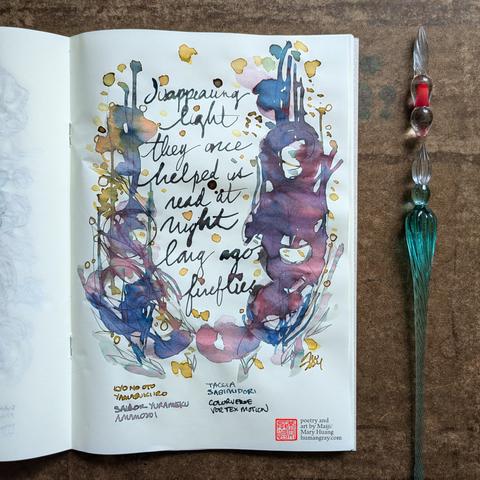
šŸ’§ Haiku Ink series: https://humangray.com/haiku-ink-series

#FountainPenInk #haiku #ink #poetry

maiji: autumn wind

[image set: 1) Photo of notebook next to two glass dip pens, one of which is just a tip, the other clear with pale aqua-white swirls running throughout its body that look like smoke or an ink drops in water. The page shows a handwritten haiku surrounded by ink lines, splatters and swirls depicting a wide open field lined with hydro towers. 2) Eight swatches laid out in diagonal 4x2 rows next to a mini flashcard set being used as an ink colour swatchbook. 3) A work-in-progress shot of the open notebook with scratchy lines rendering hydro towers flanking the text in grey-green-brown ink. A hand holding the tip of a glass dip pen hovers over the page. An open glass ink bottle, papers and tissues surround the notebook.]in a wide openhydro field, the autumn windcaresses my head- Poetry and art by Maiji/Mary Huang, humangray.comIt feels like I made this a lifetime ago, but it's only been two months. This past October-November, I was hit with an out-of-nowhere craving for Coffee Crisp after not having any for years, and ended up eating a lot of Halloween candy. Following that, I decided to build in more regular walks into my routine alongside my daily stretches/exercises. I was already going on more walks over the course of working on the haiku ink series, so it wasn't terribly difficult to expand on it. It helped me get out more, and it was lovely to have more opportunities to quietly observe the day-to-day changes as the weather transitioned from what we humans arbitrarily consider one season to the next.I already did a wind-themed haiku the previous month, not knowing that "autumn wind" would be November's kigo, so I wanted to be very conscious about a different perspective. On one of my walks, I passed through a hydro (transmission) tower corridor, a rare part of the city with nearly completely unobstructed sky. It's a fairly popular trail in the area, frequented by runners, cyclists, and pet walkers, but that day there was no one else. Perhaps because it was a cloudy and hazy-dreamy grey, with the potential of rain. I distinctly remember passing between several towers, and feeling the wind very gently buffet the space there, ruffling all around my head.Maybe this ended up too simple, but it has the things I most wanted to capture (the open hydro field, the sensation of the wind), and when I look at it I remember that walk, so that's good enough. I debated between the words "face", "cheek" and "head", and went with the latter since it gives me a more child-like feeling, as opposed to an intimacy you might associate with lovers.Part of me feels like I overdid the splatters, especially since it wasn't actually raining, but I've been having lots of fun with splatters. And it does capture the misty vibes.Inks used Pennonia Zuzmó Lichen Kyo no Oto Hisoku Dominant Industry Autumn Forest Kyo no Oto Ochiguriiro

Pillowfort

night comes early and
the city glitters with lights—
our brief human lives

✨ Commentary, wip photos, and ink palette used: https://www.pillowfort.social/posts/5875220
šŸ’§ Haiku Ink series: https://humangray.com/haiku-ink-series

#FountainPenInk #haiku #ink #poetry

maiji: night comes early

[image set: 1) Photo of notebook next to two glass dip pens, one of which is just a tip. The page shows a handwritten haiku surrounded by vertical strokes of purple-grey ink bleeding into abstract teal and green-gold clouds, rings, small squares and speckles to create the sketchy impression of a dense city. 2) Eight swatches laid out in diagonal 4x2 rows next to a mini flashcard set being used as an ink colour swatchbook. 3) A waterbrush and glass dip pen rest against tissue over an open notebook with the piece in progress. Only the text of the haiku and several vertical lines/strokes and speckling of the purple-grey ink are present at this stage. 4) Closeup of the ink splotches and abstract rings and squares, showing the speckling and a hint of glitter in the ink.]night comes early andthe city glitters with lights—our brief human lives- Poetry and art by Maiji/Mary Huang, humangray.comThis was the last haiku ink of 2024. I found this December kigo in English very interesting, being an entire phrase: "night comes early".One of my favourite meditation practices is as follows: Wait til evening, as the sun is starting to set. Turn all the lights off. Sit facing a window. (Please be careful to take any appropriate precautions you need to transition safely from 2 to 3, if you're going to be stumbling around in a nearly pitch-black room...) Breathe.  Observe all the minute changes as day turns into night. In my case, I do this in my bedroom, and sit on my bed, facing a window through which I can see many tall city buildings and slivers of sky (as I mention in winter horizon). It's a quietly magical experience. Clouds drift slowly or quickly across the sky—it's especially magical when they are moving almost imperceptibly slowly, and I can focus on them and slow my focus enough to detect their movement. Birds circle the air repeatedly. The sky shifts in amazing vertical gradients as the earth turns and the sun descends and withdraws its rays. Streetlights start to turn on. In the tall building across the way, windows begin to light up in subtly different shades of room lighting, warm and cool, turning the tower into a glittering jewel. I really have the sense of so many lives existing in tandem with mine.I was thinking about how that experience fits into those images many of us have likely seen: of the surface of the planet at night, showing large swaths of darkness, and then sparkling, glowing trails and clusters around the most densely-populated modern cities.We think we're so important. We as an individual are the entire world we know, that we perceive on a daily basis. When you pause and take a step back, you can see that we're really so, so tiny. The understanding and insight of this can be underwhelming, overwhelming, scary, calming, boring and beautiful all at the same time.Inks used Lennon Toolbar Muzha Tieguanyin Kyo no Oto Ryokyuiro Diamine Shimmertastic Night Sky Ink Institute Cat at Midnight It’s hard to believe I’ve been working on this series since 2023. Nearly two years of haiku ink, and all started on a lark! Based on the number of pages left in this notebook, the last haiku ink will likely be in September/posted in October. Assuming I don’t get inspired to double-up again, which I did once. I’m thinking once I finish the series, it’d be fun to do a flip through video of the entire book to see the entire collection at once!

Pillowfort

cold fingers aware
of where there's still heat: furnace
of belly and heart

ā¤ļø Commentary, wip photos, and ink palette used: https://www.pillowfort.social/posts/5940868
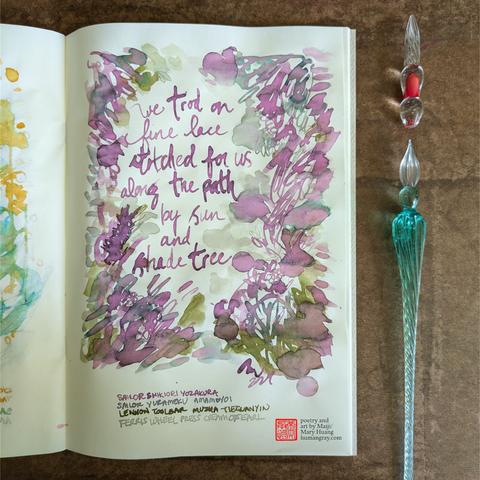
šŸ’§ Haiku Ink series: https://humangray.com/haiku-ink-series

#FountainPenInk #haiku #ink #poetry

maiji: furnace

[image set: 1) Photo of notebook next to three writing instruments: the remnant tip of a glass dip pen, a transparent Pilot Prera, and a Teranishi portable glass dip pen. The page shows a handwritten haiku with an ink illustration of a pair of hands clasping or resting with overlapping fingers, surrounded by warm orange-yellow-red-brown glow bleeding to blue and grey shades at the edges. The text also transitions from cooler colours to warmer colours. 2) Twelve swatches laid out in diagonal 6x2 rows next to a mini flashcard set being used as an ink colour swatchbook. 3) A waterbrush, glass dip pen and capped fountain pen rest over an open notebook and sketchbook with rough sketches and the piece in progress, surrounded by open bottles of ink and a ceramic waterpot. The beginning of the haiku with the largest words "cold" and "heat" are visible alongside red lines of the hands.]cold fingers awareof where there's still heat: furnaceof belly and heart- Poetry and art by Maiji/Mary Huang, humangray.comThe kigo for January was ā€œfurnaceā€ or ā€œheaterā€. My extremities get cold very easily, and when walking and meditating I was often reminded that my body itself is also a source of heat, so I followed that feeling. Conventional sitting meditation posture suggests folding your hands in your lap or resting them on your knees. When I facilitate I often include a third option, which I personally enjoy: placing my hands on my belly to hold that warmth and feel my belly rise and fall with my breathing. I find it helps me be much more aware of the physical existence of my body, and get less lost in my floating headspace.I went a little overboard on the colour selection for this one, and probably could have had the same effect with fewer colours… but it was fun. I wanted to capture a lively feeling, energetic feeling like excited atoms.Since we're talking about furnaces, heaters, heat... I wanted to take the opportunity to talk about heat pumps!! Did you know!! (as the bellmaster at my sangha, who is a climate activist, says:) Heat pumps are one of the most effective single things an individual can do in the face of the climate crisis! And depending on where you live there are often incentives for buying/switching to heat pumps. Here’s some info on them and how they work as a starting point to learning more. David Suzuki Foundation (Canadian source): Get a Heat Pump. Save money, help the climate! The Atlantic (US source): You're thinking about home heating wrong - Getting a heat pump is one of the easiest ways for homeowners to fight climate change The Guardian (British source): A fridge but in reverse? The fascinating science of heat pumps - visualized Inks used Gourmet Pens x Ink Institute Puffin's Beak Pilot Iroshizuku Benzaiten J. Herbin Rouille d'Encre Ink Institute Wenhu Line Taccia Sunao-Iro Jeans Aqua Blue Pilot Iroshizuku Fuyusyogun

Pillowfort

given a new life
the warmth of an old blanket
filling the sock hole

(February's kigo, "blanket", is a 2-for-1. Here's the first...)

🧦 Commentary, wip photos, and ink palette used: https://www.pillowfort.social/posts/6085164
šŸ’§ Haiku Ink series: https://humangray.com/haiku-ink-series

#FountainPenInk #Ink #haiku #poetry #socks #darning #mending #cozy

maiji: blanket

[image set: Two photos, each showing a haiku illustrated with ink in an open notebook next to two glass dip pens. 1) Portrait orientation depicting a pair of warm, colourful socks with a patchwork feel. 2) Landscape orientation of a scene with boot prints walking into a wintry cemetery with snowy hills dotted with gravestones.]given a new lifethe warmth of an old blanketfilling the sock holethick blanket coverssigns of those who came before—cemetery snow- Poetry and art by Maiji/Mary Huang, humangray.comFebruary is a double feature! Two different takes on the kigo "blanket". More photos and wips below the cut. [READ-MORE][Two photos showing early stages of the illustrations, where it is just the lines of poetry with some lines and ink washes. In both, the notebook is surrounded with bottles of ink and a hand holding a waterbrush hovers over the page.][Two photos showing ink swatches for each piece laid out in neat rows next to a mini flashcard set being used as an swatchbook. 1) A vivid/vibrant grey, green, yellow pink palette. 2) A washed-out pale cool grey, warm grey, grey and pale blue palette.][/READ-MORE]The first one is obviously based on my darning adventures. The second is from a daytime walk through the cemetery where my grandparents are buried. One of my few resolutions this year was to visit their graves more frequently. The place is very beautiful, practically a park. February also saw the city's heaviest volumes of snow in years, and it was very fresh that day, thick layers of snow all over the grounds. It reminded me very much of the giant fluffy marshmallow snow mounds I remember from childhood that feels quintessentially Canadian. An illusion, but that's how it felt. As I trudged along, sinking with every step, I was aware of how the snow easily buried the footprints of anyone who might have been walking around before I got there... and acting as a blanket for all those at rest here, as well.Inks usedblanket (socks) Diamine Earl Grey Sailor Wakauguisu Kyo no Oto Yamabukiiro J. Herbin Rouille d'Ancre blanket (cemetery) Pilot Iroshizuku Fuyusyogun Pilot Iroshizuku Kirisame Ink Institute Cat at Dusk Taccia Sunao-iro Jeans Aqua Blue

Pillowfort

(...and this is the second.)

thick blanket covers
signs of those who came before—
cemetery snow

ā„ļø Commentary, wip photos, and ink palette used: https://www.pillowfort.social/posts/6085164
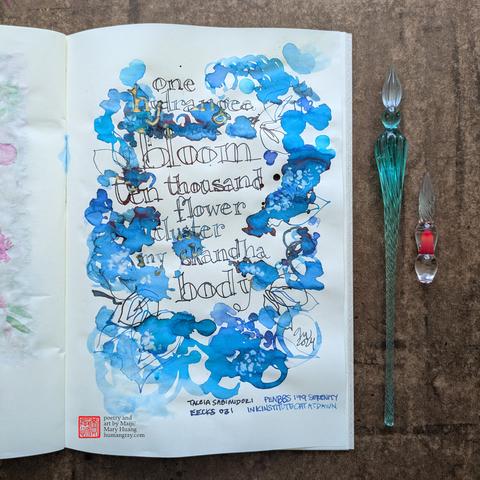
šŸ’§ Haiku Ink series: https://humangray.com/haiku-ink-series

#FountainPenInk #ink #haiku #poetry

maiji: blanket

[image set: Two photos, each showing a haiku illustrated with ink in an open notebook next to two glass dip pens. 1) Portrait orientation depicting a pair of warm, colourful socks with a patchwork feel. 2) Landscape orientation of a scene with boot prints walking into a wintry cemetery with snowy hills dotted with gravestones.]given a new lifethe warmth of an old blanketfilling the sock holethick blanket coverssigns of those who came before—cemetery snow- Poetry and art by Maiji/Mary Huang, humangray.comFebruary is a double feature! Two different takes on the kigo "blanket". More photos and wips below the cut. [READ-MORE][Two photos showing early stages of the illustrations, where it is just the lines of poetry with some lines and ink washes. In both, the notebook is surrounded with bottles of ink and a hand holding a waterbrush hovers over the page.][Two photos showing ink swatches for each piece laid out in neat rows next to a mini flashcard set being used as an swatchbook. 1) A vivid/vibrant grey, green, yellow pink palette. 2) A washed-out pale cool grey, warm grey, grey and pale blue palette.][/READ-MORE]The first one is obviously based on my darning adventures. The second is from a daytime walk through the cemetery where my grandparents are buried. One of my few resolutions this year was to visit their graves more frequently. The place is very beautiful, practically a park. February also saw the city's heaviest volumes of snow in years, and it was very fresh that day, thick layers of snow all over the grounds. It reminded me very much of the giant fluffy marshmallow snow mounds I remember from childhood that feels quintessentially Canadian. An illusion, but that's how it felt. As I trudged along, sinking with every step, I was aware of how the snow easily buried the footprints of anyone who might have been walking around before I got there... and acting as a blanket for all those at rest here, as well.Inks usedblanket (socks) Diamine Earl Grey Sailor Wakauguisu Kyo no Oto Yamabukiiro J. Herbin Rouille d'Ancre blanket (cemetery) Pilot Iroshizuku Fuyusyogun Pilot Iroshizuku Kirisame Ink Institute Cat at Dusk Taccia Sunao-iro Jeans Aqua Blue

Pillowfort

the endless cycle
of all things: but I did this
last year... spring cleaning

🧹 Commentary, wip photos, and ink palette used: https://www.pillowfort.social/posts/6195518
šŸ’§ Haiku Ink series: https://humangray.com/haiku-ink-series

#FountainPenInk #MastoArt #ink #CreativeToots #haiku #poetry #SpringCleaning

maiji: spring cleaning

[images: 1) Photo of a haiku illustrated with ink in an open notebook next to two glass dip pens, one of which is just a tip. The illustration depicts vertical bands of ink hanging like curtains and a broom or mop bleeding out into motion lines of colourful inks. 2) ink swatches for each piece laid out in two diagonal rows next to a mini flashcard set being used as an swatchbook. 3) Work in progress photo of the open notebook with the text of the haiku and vertical ink lines running down the top right, surrounded by a bottle of ink, an open sketchbook with sketches and thumbnails for the laout, and a handmade ceramic water jar with the glass dip pen tip resting in it. 4) Angled shot showing the silver glitter in the ink used for the text of the poem.]the endless cycleof all things: but I did thislast year... spring cleaning- Poetry and art by Maiji/Mary Huang, humangray.comDoing deeper spring cleaning in March always makes me feel this way. Especially when I’m under the bed trying to hunt down dust bunnies.Inks used PenBBS #226 June Pearl Kingdom Note Genji Monogatari Asahanada no Orimono Pilot Iroshizuku Benzaiten Gourmet Pens x Ink Institute Puffin's Beak

Pillowfort

becoming a bus
picking up pilgrims along
the way—spring rain drops

🚌 Commentary, wip photos, and ink palette used: https://www.pillowfort.social/posts/6304912
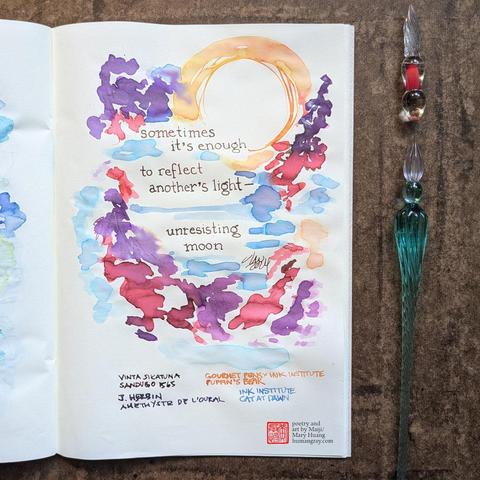
šŸ’§ Haiku Ink series: https://humangray.com/haiku-ink-series

#FountainPenInk #ink #MastoArt #CreativeToots #haiku #poetry

traffic rushes by
the tiny lilac floret’s
unhurried fragrance

🌼 Commentary, wip photos, and ink palette used: https://www.pillowfort.social/posts/6401451
šŸ’§ Haiku Ink series: https://humangray.com/haiku-ink-series

#FountainPenInk #ink #haiku #MastoArt #CreativeToots #poetry #Florespondence #FlowersOfMastodon #lilac

my mind is as still
as the summer lake's surface
joyful cannonball

🌊 Commentary, wip photos, and ink palette used: https://www.pillowfort.social/posts/6499086
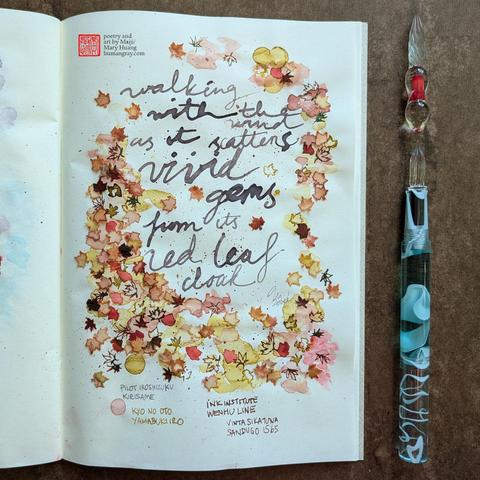
šŸ’§ Haiku Ink series: https://humangray.com/haiku-ink-series

#FountainPenInk #ink #haiku #MastoArt #CreativeToots #poetry #summer

approaching even
unmoving sticks and stones in
full armor, crabwise

šŸ¦€ Commentary, wip photos, and ink palette used: https://www.pillowfort.social/posts/6555935
šŸ’§ Haiku Ink series: https://humangray.com/haiku-ink-series

#FountainPenInk #ink #haiku #MastoArt #CreativeToots #poetry #crab

Perseid shower
we admire them from the trail
where they can't be seen

🌃 Commentary, wip photos, and ink palette used: https://www.pillowfort.social/posts/6671348
šŸ’§ Haiku Ink series: https://humangray.com/haiku-ink-series
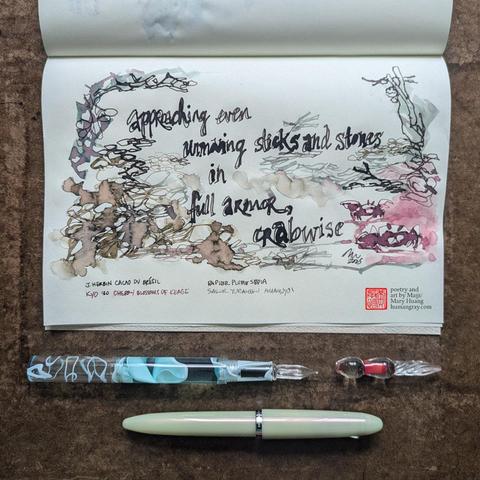
#FountainPenInk #ink #haiku #MastoArt #CreativeToots #poetry #perseids #stars