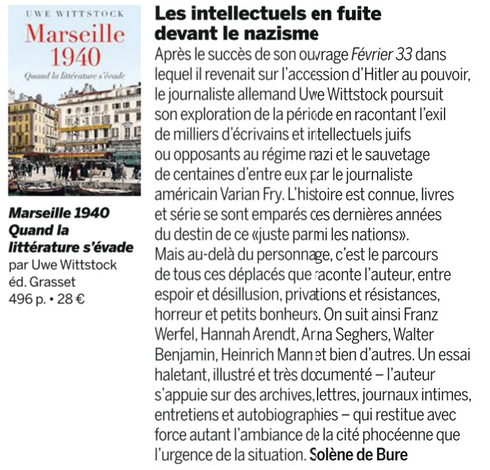
"In #Marseille 1940: The Flight of #Literature, the #German #literary critic #UweWittstock traces the anguished itineraries of more than a dozen #refugee #writers and #artists and the efforts by a group of courageous #Americans—along with many anonymous but no less courageous #French people—to rescue them. Told in a series of short, suspenseful #vignettes, it is a #sequel to his book February 1933: The Winter of Literature, which followed a group of German intellectuals in the days after #Hitler came to power. Some of those whose hasty escape from #Germany #Wittstock #narrated in the first #book reappear in the second in even more dire straits. February 1933 struck a chord by charting the shift from denial to panic when #Germans suddenly found themselves living in a #fascist country, and Marseille 1940 makes another timely intervention: as governments once again shut borders and attempt to turn us against the #foreigners in our midst..."

https://www.nybooks.com/articles/2026/02/26/rescuing-the-refugees-marseille-1940-wittstock/

Rescuing the Refugees

After the fall of France many writers and artists fleeing the Nazis ended up in Marseille, desperately seeking a way out of occupied Europe.

The New York Review of Books

Februar 33. Der Winter der Literatur – Uwe Wittstock

https://www.youtube.com/watch?v=OB2oELCNuP0

Es ging rasend schnell. Der Februar 1933 war der Monat, in dem sich auch für die Schriftsteller in Deutschland alles entschied. Uwe Wittstock erzählt die Chronik eines angekündigten und doch nicht für möglich gehaltenen Todes. Von Tag zu Tag verfolgt er, wie das glanzvolle literarische Leben der Weimarer Zeit in wenigen Wochen einem langen Winter wich und sich das Netz für Thomas Mann und Bertolt Brecht, für Else Lasker-Schüler, Alfred Döblin und viele andere immer fester zuzog,

#Februar1933 #Geschichte #Gespräch #Lesung #Literatur #Nazis #Politik #UweWittstock #Wissen

Februar 33. Der Winter der #Literatur - Uwe Wittstock, 08.03.22

YouTube
Zum Welttag des Tagebuches am 12. Juni 2025

Am Morgen, des Donnerstag 12 Juni erfahre ich im Radio, dass es einen Welttag des Tagebuches gibt (Kurzform Tag des Tagebuchs)[1]. Also zwei Tage nach meinem 61. Geburtstag. Tagebuch schreibe ich s…

paysages

1940 -> 2022 -> 2025 ...

#UweWittstock #marseille #art #science

#UweWittstock's book "February 1933: The Winter of Literature" and #RobertMusil's "Literature and Politics" illustrate how many #WeimarRepublic writers compromised or fled to survive the rise of #fascism. Few actively resisted #Nazism, with most opting for silence or collaboration to avoid persecution. #BertoltBrecht and #JosephRoth are exceptions who recognized and opposed the threat early, while figures like #ErichKästner remained to document the era.

https://jacobin.com/2024/05/weimar-writers-fascism-book-review

How Writers Survived Fascism

The last years of the Weimar Republic are often thought to have witnessed an outpouring of politically engaged literature. But the history is more complicated. Writers more often avoided antagonizing a resurgent right to protect their lives and careers.

H. Mann, Hannah Arendt und Lion Feuchtwanger müssen sich im Juni 1940 in Sicherheit bringen. Die Wehrmacht hat Frankreich besiegt, die Gestapo fahndet nach jenen, die in Frankreich Asyl gefunden hatten.

Uwe Wittstock: Marseille 1940
https://www.findosbuecher.com/?p=7926

#buchtipp #lesetipp #sachbuch #chbeck #literatur #lesen #iamreading #history #geschichte #frankreich #deutschland #paris #marseille #uwewittstock #rezension

Uwe Wittstock: Marseille 1940 – Die große Flucht der Literatur – findos buecher