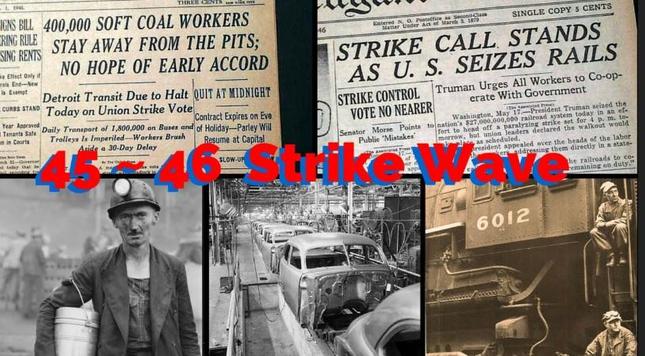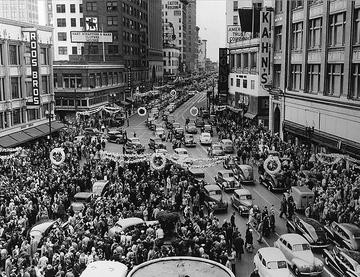
Today in Labor History January 15, 1946: 260,000 U.S. electrical workers struck against General Electric, Westinghouse and General Motors. It was part of the Great Strike Wave of 1946, the largest in U.S. history. In that wave, 43,000 oil workers struck in October, 1945; 225,000 autoworkers in November, 1945; 93,000 meatpackers in January, 1946; 750,000 steel workers, in January 1946; 340,000 coal miners, in April, 1946; and 250,000 railroad workers in May 1946. There were also General Strikes in Lancaster, PA; Stamford, CT; Rochester, NY; and Oakland, CA.

#workingclass #LaborHistory #strikewave #union #generalstrike #generalmotors #generalelectric #oakland #coal #miners

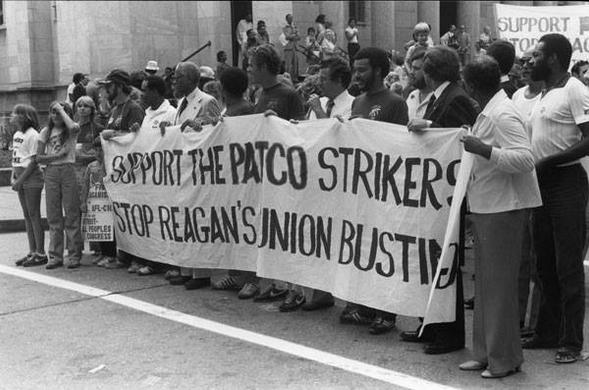
Today in Labor History October 20, 1980: As a presidential candidate, Ronald Reagan wrote a letter to PATCO President Robert Poli promising that if the air traffic controllers union endorsed him, he would “take whatever steps necessary to provide them with the most modern equipment available and to adjust staff levels and work days so that they were commensurate with achieving a maximum degree of public safety.” The union naively endorsed Reagan and, within a few short months, President Reagan fired the air traffic controllers for engaging in an “illegal walkout” over staffing levels and working conditions. Their nationwide strike began on August 3, 1981, after workers rejected the government's final contract offer. Most of the 13,000 strikers ignored orders to go back to work and were fired on August 5. The mass firing of unionized workers, and the inability of the labor movement, as a whole, to respond to the crisis, led to the rapid downhill spiral of union power and membership. For example, in the years immediately after the PACTO strike, other major employers chose to fire striking workers en masse and replace them with scabs (e.g., Phelps Dodge, 1983; Hormel, 1985-1986; and International Paper, 1987). In the 14 years leading up to the PATCO strike, an average of 2.3 million U.S. workers per year were engaging in strikes and job actions. In the 10 years immediately after the PATCO strike, there was an 80% drop in strikes, with an average of 414,000 people on strike each of those years. And from 2001-2017, the number of U.S. workers who were striking each year had declined even further to an average of only 84,000 per year. There was a slight uptick in 2018 and 2019 with over 400,000 strikers each of those years, and again in 2023, with nearly 478,000 workers on strike. (Data is still pending for 2024, which is looking like another high number). But to this day, there has not been a single year where the number of striking U.S. workers has risen above 20% of the average prior to the PATCO strike.

#workingclass #LaborHistory #union #strike #patco #AirTrafficControllers #reagan #unionbusting #phelpsdodge #hormel #solidarity #strikewave

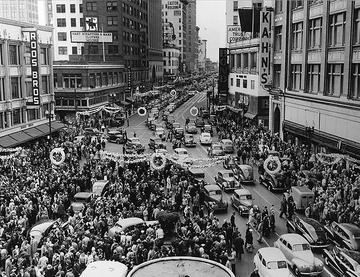
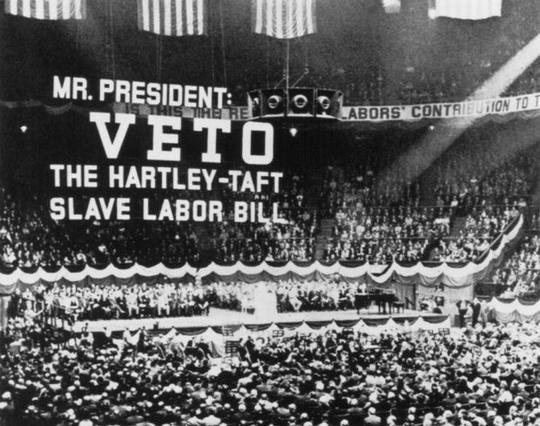
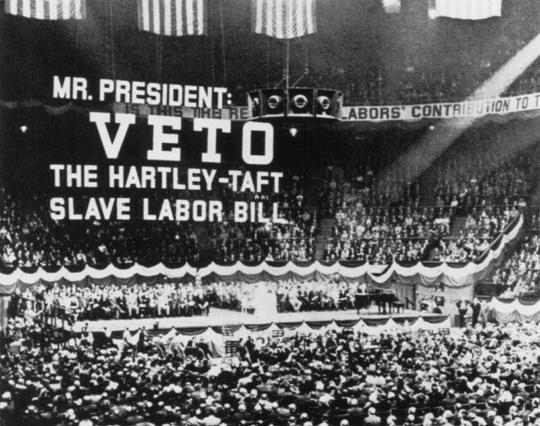
Today in Labor History September 16, 1945: 43,000 oil workers went on strike in 20 states. During WWII, most of the major unions collaborated with the U.S. war effort by enforcing labor “discipline” and preventing strikes. In exchange, the U.S. government supported closed shop policies under which employers at unionized companies agreed to hire only union members. While the closed shop gave unions more power within a particular company, the no-strike policy made that power virtually meaningless. When the war ended, inflation soared and veterans flooded the labor market. As a result, frustrated workers began a series of wildcat strikes. Many grew into national, union-supported strikes. In November 1945, 225,000 UAW members went on strike. In January 1946, 174,000 electric workers struck. That same month, 750,000 steel workers joined them. Then, in April, the coal strike began. 250,000 railroad workers struck in May. In total, 4.3 million workers went on strike. It was the closest the U.S. came to a national General Strike in the 20th century. And in December 1946, Oakland, California did have a General Strike, the last in U.S. history. Overall, it was the largest strike wave in U.S. history. In 1947, Congress responded to the strike wave by enacting the Taft-Hartley Act, restricting the powers and activities of labor unions and banning the General Strike. The act is still in force today and one the main reasons there hasn’t been a General Strike in the U.S. since 1945.

#workingclass #LaborHistory #GeneralStrike #oakland #oilworkers #union #strike #strikewave #worldwartwo #tafthartley #uaw #coal #railroads #inflation #steel #wildcat

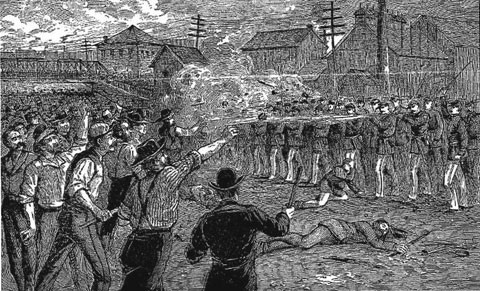
Today in Labor History July 26, 1877: Federal troops killed up to 30 workers at the "Battle of the Viaduct," Chicago, during the Great Upheaval (AKA Great Train Strike). This came after the Workingmen’s Party (affiliated with the First International), organized a rally of six thousand people. At this gathering, a former Confederate Army Officer from Waco, Texas, named Albert Parsons, gave a fiery speech. The events of the Great Upheaval radicalized Parsons and his wife Lucy. In the years following it, they became some of the nation’s leading anarchist organizers. The state executed him in 1887 as one of the Haymarket Martyrs who had been fighting for the eight-hour workday. His widow, Lucy, an African American woman, went on to cofound the radical Industrial Workers of the World, in 1905, along with Mother Jones, Eugene Debs, Big Bill Haywood, and others.

The day after Parsons’ speech, protests erupted. Police fired into the crowd, killing three men. The next day, an armed demonstration of 5,000 workers fought the police and soldiers in the Battle of the Viaduct, when they killed as many as 30 more workers and injured over one hundred. One journalist wrote, “The sound of clubs falling on skulls was sickening for the first minute, until one grew accustomed to it. A rioter dropped at every whack, it seemed, for the ground was covered with them.” A judge later found the police guilty of preventing the workers from exercising their right to freedom of speech and assembly

The Great Upheaval was a national strike wave involving major uprisings in Martinsburg, WV, Baltimore, Pittsburgh, Saint Louis, San Francisco, Boston, Reading, PA, New York and many other cities. I write about it in my historical “Great Upheaval Trilogy.” My first book, “Anywhere But Schuylkill,” takes place in the years immediately preceding the Great Upheaval. Book II, “Red Hot Summer in the Smoky City,” my current WIP, takes place in Pittsburgh, at the height of the Great Upheaval.

You can read my complete article about the Great Upheaval here: https://michaeldunnauthor.com/2024/03/31/the-great-upheaval/

You can read my biography of Lucy Parsons here: https://michaeldunnauthor.com/2024/03/24/lucy-parsons/

And you can get my book ANYWHERE BUT SCHUYLKILL from these indie book sellers:
https://www.keplers.com/
https://www.greenapplebooks.com/

Or send me $25 via Venmo (@Michael-Dunn-565) and your mailing address, and I will send you a signed copy!

#workingclass #LaborHistory #chicago #massacre #railroad #GeneralStrike #wildcat #strikewave #IWW #socialism #haymarket #anarchism #lucyparsons #policebrutality #policemurder #fiction #novel #historicalfiction #writer #author #books @bookstadon

Rep Jim McGovern calls for a nationwide General Strike. This a mainstream Democrat, asking the public to break the law. Yes, General Strikes have been illegal in the U.S. since the 1947 Taft-Hartley bill, written in the wake of the 1945-1946 strike wave, the largest strike wave in the history of the U.S., when literally millions of workers went on strike, from steel, electricity, automotive, to coal, electricity and numerous other industries. This strike wave included General Strikes in Lancaster, Pennsylvania; Stamford, Connecticut; Rochester, New York; and Oakland, California. In total, 4.3 million workers participated in the strikes. It was the closest things we've ever had to a nationwide General Strike since the Great Upheaval, 1877.

Also, remember that the 1968 upheaval in Paris, which spread throughout France, was students AND workers, included a General Strike, and forced Charles de Gaulle to flee the country as his government collapsed

https://portside.org/2025-03-15/rep-mcgovern-and-national-strike

#generalstrike #oakland #Democracts #strikewave #nationalstrike #TaftHartley #paris

Rep. McGovern and a National Strike

It’s not a lot of laughs being a Congressional Democrat these days. Their party is a mess. Partisan loathing is on high boil. If you’re a veteran liberal like Rep. Jim McGovern (D-Second District), every day brings the dismantling of something you spent years building.

Portside

Today in Labor History January 15, 1946: 260,000 U.S. electrical workers struck against General Electric, Westinghouse and General Motors. It was part of the Great Strike Wave of 1946, the largest in U.S. history. In that wave, 43,000 oil workers struck in October, 1945; 225,000 autoworkers in November, 1945; 93,000 meatpackers in January, 1946; 750,000 steel workers, in January 1946; 340,000 coal miners, in April, 1946; and 250,000 railroad workers in May 1946. There were also General Strikes in Lancaster, PA; Stamford, CT; Rochester, NY; and Oakland, CA.

#workingclass #LaborHistory #strikewave #union #generalstrike #generalmotors #generalelectric #oakland #coal #miners

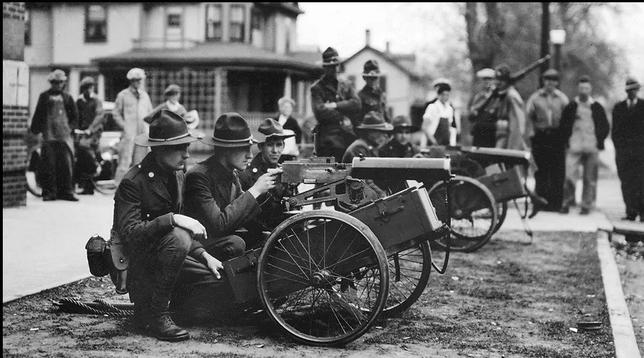
Today in Labor History January 4, 1933: Angered by increasing farm foreclosures, members of Iowa's Farmers Holiday Association threatened to lynch banking representatives and law officials who instituted foreclosure proceedings for the duration of the Depression. In April, 600 farmers battled the sheriff and his deputies to prevent a foreclosure. A group of farmers dragged a district judge from his chair, put a rope around his neck, and threatened to hang him unless he promised not to issue any more eviction notices. They stripped him naked, beat him, smeared him with grease, and jerked from the ground by the noose until he lost consciousness. Once revived, they told him to pray, and raised him again from the ground by the noose. That same month, state officers in Crawford County were beaten, prompting the Iowa governor to declare martial law in three counties and send in the National Guard. During the farmers’ strike, the refused to sell their products. “We’ll eat our wheat and ham and eggs. Let them [the bankers] eat their gold.” They called their strike the “farmers holiday” and their movement the Farmers Holiday Association. One of the leaders, Milo Reno, said they were being “robbed by a legalized system of racketeering.” He also said that the farmers might have to “join hands with those who favor the overthrow of government. . . You have the power to take the great corporations. . . shake them into submission.”

This was just one of many violent movements rebelling against capital during the Great Depression. In 1934, there were General Strikes in Toledo, Minneapolis, and San Francisco, in which workers fought back against police, vigilantes, and National Guards with sticks, clubs, bottles and rocks. Police shot and killed 2 strikers each in the San Francisco, Toledo, and Minneapolis General Strikes. There were bloody strike waves among textile workers all along the Eastern Seaboard, though the overwhelming majority of violence was perpetrated against them by cops and vigilante thugs, with at least 18 workers killed and over 160 injured. But this militancy, solidarity, and willingness of workers to confront the state’s legalized violence against them were major influences on the implementation of New Deal reforms by President Roosevelt, including the Wagner Act, which created the National Labor Relations Board.

#workingclass #LaborHistory #foreclosure #farmers #greatdepression #assassination #police #iowa #GeneralStrike #sanfrancisco #minneapolis #toledo #repression #solidarity #strike #union #strikewave #newdeal

Today in Labor History October 20, 1980: As a presidential candidate, Ronald Reagan wrote a letter to PATCO President Robert Poli promising that if the air traffic controllers union endorsed him, he would “take whatever steps necessary to provide them with the most modern equipment available and to adjust staff levels and work days so that they were commensurate with achieving a maximum degree of public safety.” The union naively endorsed Reagan and, within a few short months, President Reagan fired the air traffic controllers for engaging in an “illegal walkout” over staffing levels and working conditions. Their nationwide strike began on August 3, 1981, after workers rejected the government's final contract offer. Most of the 13,000 strikers ignored orders to go back to work and were fired on August 5. The mass firing of unionized workers, and the inability of the labor movement, as a whole, to respond to the crisis, led to the rapid downhill spiral of union power and membership. For example, in the years immediately after the PACTO strike, other major employers chose to fire striking workers en masse and replace them with scabs (e.g., Phelps Dodge, 1983; Hormel, 1985-1986; and International Paper, 1987). In the 14 years leading up to the PATCO strike, an average of 2.3 million U.S. workers per year were engaging in strikes and job actions. In the 10 years immediately after the PATCO strike, there was an 80% drop in strikes, with an average of 414,000 people on strike each of those years. And from 2001-2017, the number of U.S. workers who were striking each year had declined even further to an average of only 84,000 per year. There was a slight uptick in 2018 and 2019 with over 400,000 strikers each of those years, and again in 2023, with nearly 478,000 workers on strike. (Data is still pending for 2024, which is looking like another high number). But to this day, there has not been a single year where the number of striking U.S. workers has risen above 20% of the average prior to the PATCO strike.

#workingclass #LaborHistory #union #strike #patco #AirTrafficControllers #reagan #unionbusting #phelpsdodge #hormel #solidarity #strikewave

Today in Labor History September 16, 1945: 43,000 oil workers went on strike in 20 states. During WWII, most of the major unions collaborated with the U.S. war effort by enforcing labor “discipline” and preventing strikes. In exchange, the U.S. government supported closed shop policies under which employers at unionized companies agreed to hire only union members. While the closed shop gave unions more power within a particular company, the no-strike policy made that power virtually meaningless. When the war ended, inflation soared and veterans flooded the labor market. As a result, frustrated workers began a series of wildcat strikes. Many grew into national, union-supported strikes. In November 1945, 225,000 UAW members went on strike. In January 1946, 174,000 electric workers struck. That same month, 750,000 steel workers joined them. Then, in April, the coal strike began. 250,000 railroad workers struck in May. In total, 4.3 million workers went on strike. It was the closest the U.S. came to a national General Strike in the 20th century. And in December 1946, Oakland, California did have a General Strike, the last in U.S. history. Overall, it was the largest strike wave in U.S. history. In 1947, Congress responded to the strike wave by enacting the Taft-Hartley Act, restricting the powers and activities of labor unions and banning the General Strike. The act is still in force today and one the main reasons there hasn’t been a General Strike in the U.S. since 1945.

#workingclass #LaborHistory #GeneralStrike #oakland #oilworkers #union #strike #strikewave #worldwartwo #tafthartley #uaw #coal #railroads #inflation #steel #wildcat

Today in Labor History August 5, 1842: The "Plug Plot" riots began in England in response to high unemployment, high food prices and declining wages. There was a spontaneous strike wave of coal miners, weavers and spinners culminating in a general strike. The riot got its name when the plugs were pulled out of factory boilers. The strikers were influenced by the Chartist movement, 1838-1848. Over 500,000 workers participated. It was the single largest working class uprising in 19th century England. In the aftermath, the authorities tried over 1,500 strikers.

#workingclass #LaborHistory #riot #england #uk #generalstrike #chartism #inflation #wages #strikewave #coal #mining