 Hacker News
A Guide to CubeSat Mission and Bus Design
https://pressbooks-dev.oer.hawaii.edu/epet302/
#HackerNews #CubeSat #Mission #BusDesign #SpaceEngineering #SmallSat #Technology #SatelliteDevelopment
A Guide to CubeSat Mission and Bus Design
https://pressbooks-dev.oer.hawaii.edu/epet302/
#HackerNews #CubeSat #Mission #BusDesign #SpaceEngineering #SmallSat #Technology #SatelliteDevelopment
Analytical Mechanics of Space Systems — 5th Edition (2026)
by Hanspeter Schaub
🛰️ Master spacecraft motion.
Analytical Mechanics of Space Systems — 5th Ed.
DM for info.
#Aerospace #SpaceEngineering #Astrodynamics #StudyEngineering #DigitalLearning
Job Alert
DLR-DAAD Research Fellowship Nr. 735
Deadline: open until filled
Location: Germany - Oberpfaffenhofen
https://www.academiceurope.com/ads/dlr-daad-research-fellowship-nr-735/
#DLR #ResearchFellowship #RadarTechnology #Spaceengineering #STEM #Engineering #electricalengineering #phd #hiring



Chaque fin de semaine, une image qui a fait l’actualité ou retenu notre attention. Le 26 juin, une nouvelle version du propulseur à propergol solide équipant le lanceur lunaire SLS de la NASA a été mise à feu pour un essai statique dans l’Utah.
Sorry for the delay in replying! Let’s be clear upfront: we can’t build a fully operational space elevator with today’s technology.
But history shows us that what seems impossible today can become reality tomorrow. When President John F. Kennedy set the goal of landing a man on the Moon in 1961, many thought it was a pipe dream. Yet less than a decade later, the Apollo program succeeded, proving that with determination, innovation, and investment, the impossible can be achieved. So, while ambitious, a space elevator is a plausible future project.
Trying to be as objective as I can, here’s a more nuanced take on feasibility — starting with economics. A space elevator would be expensive; estimates vary, but it’s safe to say it would be a multi-billion-dollar project. To put that in perspective: SoFi Stadium cost $4.9 billion, and the Apollo program cost about $203 billion (adjusted to 2015 dollars). Expert analyses estimate the cost of the first space elevator between $6 billion and $100 billion depending on design and infrastructure included. So financially, it’s ambitious but plausible, especially as a long-term infrastructure investment with transformative potential for space access and sustainable resource use.
The technical challenges are immense, but so are those of every large, unprecedented undertaking. Picture a tether anchored to a mobile ocean platform, gently swaying with the waves, while robotic climbers ascend and descend, carrying cargo and passengers to the stars.
Several organizations, including the International Space Elevator Consortium, are actively developing the technologies and infrastructure needed. While we’re far from the finish line, the potential benefits—significantly reduced launch costs, increased space access, and large-scale space-based solar power—are exciting.
A key technical hurdle is finding a material with sufficient tensile strength. Though it might sound counterintuitive, a space elevator is more like a suspension bridge to space than a giant tower. The concept evolved from building “bottom-up” to a “top-down” approach, where a geostationary satellite deploys a cable down to Earth. Currently, carbon nanotubes (CNTs) and ultra-high molecular weight polyethylene (UHMWPE) are leading candidates for tether materials. For example, Shizuoka University in Japan is prototyping and testing high-tensile-strength materials in space. The key issues remain: producing suitable materials like carbon nanotubes at scale.
In conclusion, while we can’t build a fully operational space elevator today, overcoming the technical difficulties in the near future is possible. With continued advances in materials science, engineering, and technology, we may soon see the space elevator shift from futuristic fantasy to game-changing reality.
I’m no space engineering expert, so I welcome corrections and insights.
---
References & Further Reading
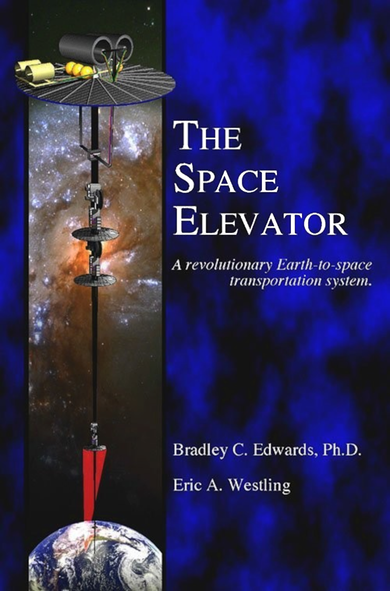
- Edwards, Bradley C. “The Space Elevator.” https://nss.org/wp-content/uploads/2017/07/2000-Space-Elevator-NIAC-phase1.pdf
- Gao, Tianrui. “The Feasibility Analysis of a Space Elevator.” https://ijetch.org/2024/IJET-V16N4-1290.pdf
- International Space Elevator Consortium — Annual Studies https://www.isec.org/studies/#ApexAnchor
Recommended Videos
- Space Elevators: Strategies & Status — https://youtu.be/V0ju74IqW0A
- Clean Energy From Space? — https://youtu.be/iNqCAvL1T1Y
- Asteroid Mining — https://youtu.be/3-3DjxhGaUg
- Everyone is Wrong About Asteroid Mining — https://youtu.be/p3hlnL2JN8E
CC: @cy @isecdotorg @sorceressofmathematics @goodmirek @tiotasram @Ifrauding @Elrick_Winter @tiotasram @davidtheeviloverlord
#SpaceElevator #FutureTech #SpaceExploration #Innovation #ScienceFiction #Engineering #SpaceTravel #CarbonNanotubes #UHMWPE #FeasibilityStudy #SpaceAccess #SustainableTech #SpaceResearch #SpaceEngineering
#SpaceTechnology #SpaceEconomics #SpaceInnovation #SpaceDevelopment
#megaprojects #SpaceTower #Megastructure
🚀 What is Astronautical Engineering?
Explore the specialized field focused on the design, development, and deployment of spacecraft and systems that operate outside Earth's atmosphere.
👉 Click here: https://www.engineersheaven.org/forum/topic/12
to visit our website and read the full article.
#AstronauticalEngineering #SpaceEngineering #SpaceExploration #RocketScience #SatelliteEngineering #SpacecraftDesign #AerospaceTechnology #EngineersHeaven #SpaceInnovation #OuterSpaceResearch
🛰️ What is the average thrust of a microsatellite?
Explore the engineering behind compact space missions.
👉 Click here: https://www.engineersheaven.org/forum/topic/94
to visit our website and read the full article.
#Microsatellite #SatelliteThrust #SpaceEngineering #OrbitalTech
Good luck to them, tho the UK's track record on bringing innovation to fruition is not encouraging (thinking HOTOL and Skylon, etc.).
#Space #RocketScience #Fusion
#SpaceEngineering #FusionMotors
https://www.europesays.com/uk/5582/

 DIGIBOKA
 Academic Europe
 Headlines Africa
 andrea_ferrero
 AlcorNews
 Debby ⁂📎🐧

 Philip C James