"The FoSci Report 2026: Understanding, Detecting, and Documenting Manipulation in the Research Ecosystem"

In this report, 17 authors – among them scholarly sleuths and investigators of science, from academia and industry – come together to present a primer on the field of forensic scientometrics.

https://figshare.com/articles/online_resource/_b_Forensic_Scientometrics_FoSci_Report_2026_b_Understanding_Detecting_and_Documenting_Manipulation_in_the_Research_Ecosystem/32178456?file=64280955

#research #science #scientometrics #forensics #researchFraud

China, India, and Iran Among the Fastest-Rising Scientific Nations According to 2025 ScholarGPS Rankings

New 2025 country rankings released by ScholarGPS reveal a significant shift in global scientific power, with several emerging nations gaining ground on

EIN Presswire

This paper explores the fascinating phenomenon of “zombie journals” – journals that continue to exist after their editorial boards resign and launch rival “breakaway journals.”

 https://doi.org/10.1016/j.respol.2026.105519

Using cases from linguistics and bibliometrics, the study shows that journal brands can survive institutional crises, but often with dramatically changed author communities, citation patterns, and academic identities.

#AcademicPublishing #OpenScience #Scientometrics #JournalMetrics

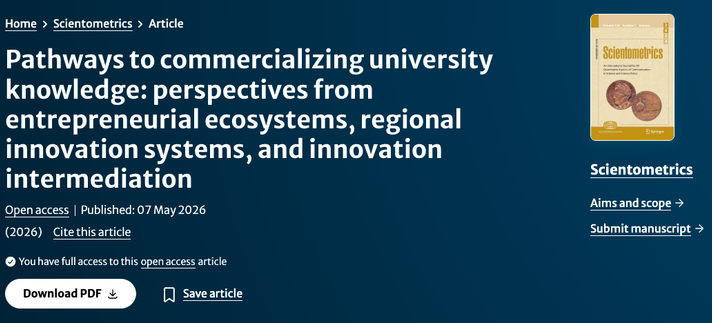
Almost skipped a new paper in #Scientometrics - glad I didn’t. A key point: fundamental research is often too uncertain for the market, so universities become crucial for helping ideas survive through startups, accelerators, and entrepreneurial networks. #Patent licensing, meanwhile, depends more on real long-term collaboration with industry than on fancy “technology transfer offices”.

 https://doi.org/10.1007/s11192-026-05648-4

#HigherEducation #Innovation #Startups #Technology #Transfer

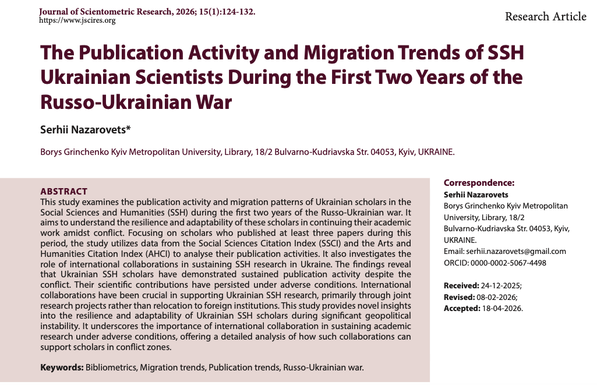
I’m glad to share my paper on publication activity and migration trends of Ukrainian SSH scholars during the first two years of the full-scale war.

👉 https://www.jscires.org/article/15/1/124

The key finding: the most productive researchers have largely remained in #Ukraine and many have maintained or even increased their publication activity, despite the challenges.

#Science #OpenScience #Bibliometrics #HigherEducation #Scientometrics #Research #Academia

Today I gave a talk on @OpenAlex — the largest open database of scholarly metadata. #OpenAlex offers a broader and more inclusive view of science, making previously “invisible” research more visible.

At the same time, it raises important questions about metadata quality, data completeness, and how we interpret metrics.

👉 https://doi.org/10.13140/RG.2.2.31061.79847

A key takeaway: research evaluation can vary significantly depending on the data source and analytical choices.

#OpenScience #Scientometrics

China proposes a departure from impact factor to measure academic influence

Chinese researcher says traditional measure of a paper’s citations is susceptible to manipulation and lacks Chinese perspective.

South China Morning Post

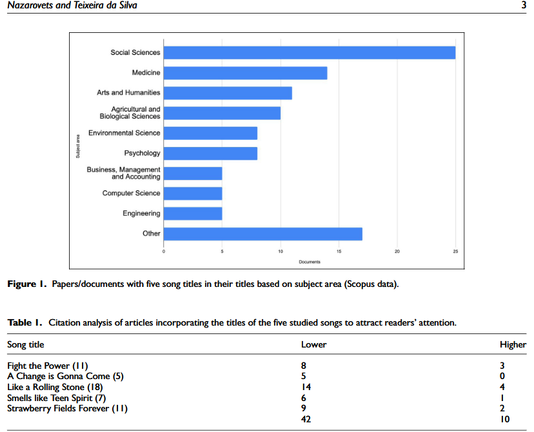
Can a great song title make your paper more visible? In our new study, we explored how famous song titles appear in Scopus-indexed article titles.

🎧 https://doi.org/10.1177/01655515261437409

We found that in most cases, these titles are used as catchy rhetorical signals to attract readers. But here’s the catch: they don’t necessarily lead to higher citations. So yes, your title can sound like a rock hit… but impact still depends on more than style.

#Scientometrics #AcademicWriting #Bibliometrics

Gave a short online lecture on altmetrics today. Main point: altmetrics measure attention, not quality. Sometimes they capture real interest - sometimes just noise. Attention ≠ impact.

👉 https://doi.org/10.13140/RG.2.2.30154.12488

#Altmetrics #ResearchImpact #OpenScience #ScholarlyCommunication #Scientometrics

A recent Journal of Informetrics study shows – There is no universal number of “too many authors.”

In some fields, 3–6 may already be unusual.
In medicine – dozens are common.
In physics – large teams are often the norm.

 https://doi.org/10.1016/j.joi.2026.101803

Yes, #hyperauthorship can signal problems (e.g., honorary authorship, metric inflation). But the key question is not “how many authors?” 👉 it is: Is this abnormal for this field and time?

#Scientometrics #ResearchEvaluation #Bibliometrics