Team is coding around the increasingly problematic citations from CERN:
6000 co-authors.
Librarians around the world must be forming support groups?
Team is coding around the increasingly problematic citations from CERN:
6000 co-authors.
Librarians around the world must be forming support groups?
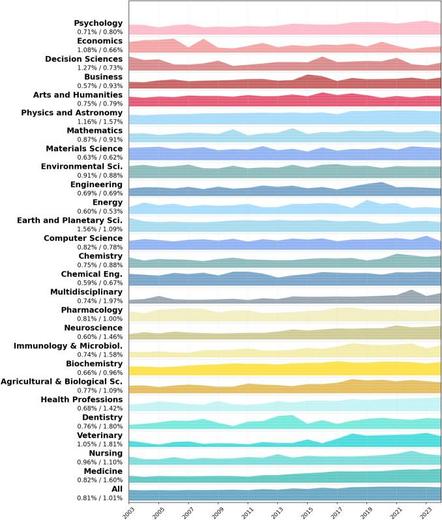
Mega-authorship implications: How many scientists can fit into one cell?
#authorship #DanielSDotson #Hyperauthorship #Megaauthorship #Physics #ScholarlyPublishing #ScientificCommunication
How many authors are (too) many? A retrospective, descriptive analysis of authorship in biomedical publications
#authorship #BiomedicalResearch #EvaKittl #Hyperauthorship #MartinJakab #Multiauthorship #ScholarlyPublishing #ScientificCommunication #TobiasKiesslich
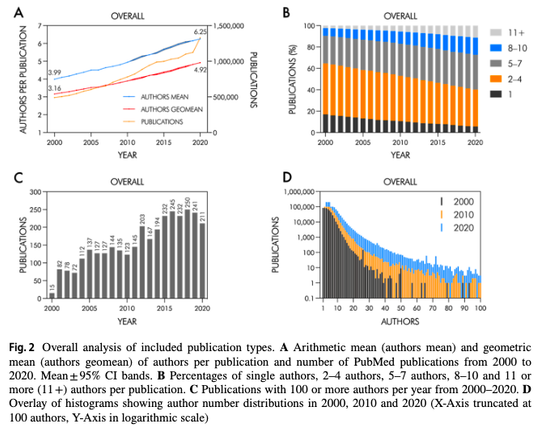
The results of the analysis of biomedical papers in 2000-2020 show that over the past two decades, the average number of authors ✍️ per publication has increased significantly - from 3.99 to 6.25!
https://doi.org/10.1007/s11192-024-04928-1
#authorship #hyperauthorship #multiauthorship #Scientometrics
Publishing in academic journals is primary to disseminate research findings, with authorship reflecting a scientist’s contribution, yielding academic recognition, and carrying significant financial implications. Author numbers per article have consistently risen in recent decades, as demonstrated in various journals and fields. This study is a comprehensive analysis of authorship trends in biomedical papers from the NCBI PubMed database between 2000 and 2020, utilizing the Entrez Direct (EDirect) E-utilities to retrieve bibliometric data from a dataset of 17,015,001 articles. For all publication types, the mean author number per publication significantly increased over the last two decades from 3.99 to 6.25 (+ 57%, p < 0.0001) following a linear trend (r2 = 0.99) with an average relative increase of 2.28% per year. This increase was highest for clinical trials (+ 5.67 authors per publication, + 97%), the smallest for case reports (+ 1.01 authors, + 24%). The proportion of single/solo authorships dropped by a factor of about 3 from 17.03% in 2000 to 5.69% in 2020. The percentage of eleven or more authors per publication increased ~ sevenfold, ~ 11-fold and ~ 12-fold for reviews, editorials, and systematic reviews, respectively. Confirming prior findings, this study highlights the escalating authorship in biomedical publications. Given potential unethical practices, preserving authorship as a trustable indicator of scientific performance is critical. Understanding and curbing questionable authorship practices and inflation are imperative, as discussed through relevant literature to tackle this issue.
Hyperauthorship - a new trend in academia for papers with hundred of authors. It seems a good thing for supporting equity and diversity, but also has new challenges.
https://www.nature.com/articles/d41586-023-00575-3
#academia #publishing #science #scicomm #hyperauthorship #authorship #authorshipanalysis