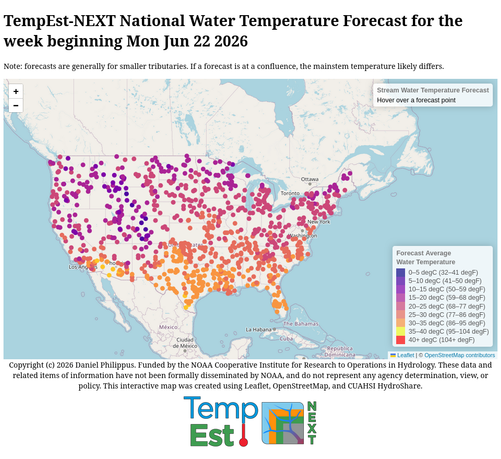
Big update to the stream temperature forecasts I've periodically shared here: they're now available through an interactive map, updated daily(ish). The current forecast can be found at https://dash.rivertempest.org. I was pleasantly surprised at how straightforward this was using Leaflet and automatically retrieving the forecasts from CUAHSI's #HydroShare platform.

Next step: more forecast points.

#hydrology #rivertemperature #forecasting

Following up on my recent post about command-line use of TempEst-NEXT, there's now a graphical user interface in version 0.2.2, allowing users to easily generate river temperature predictions anywhere. After installing through the Python package index (pip install --upgrade tempest-next), just run `NEXTapp` or `NEXT --gui` to launch the interface. (Desktop background not included.) #forecasting #rivertemperature #hydrology

TempEst-NEXT v0.2.1 (the model for #forecasting #rivertemperature anywhere in the contiguous US without local observations) is out, now with support for interactive and command-line use. Here's all it takes to estimate the last five years of water temperature for Geneva Creek, an unmonitored stream in southern Guanella Pass, Colorado:

NEXT --site_type coordinates --lat 39.51129 --lon -105.71680 --start 2021-01-01 --end 2025-12-31 --output geneva.csv

(After installing via pip install --upgrade tempest-next, of course.)

See full documentation at https://rivertempest.org/.

TempEst Modeling — RiverTempest.org

I decided it was time to put together a single documentation website for all my #RiverTemperature software (https://www.rivertempest.org/) and I would just like to say that #sphinxdoc is a wonderful tool. Super straightforward to get everything up and running, looks good, has working search, etc. Not to mention automatically generating HTML documentation from the comments in my code.
TempEst Modeling — RiverTempest.org

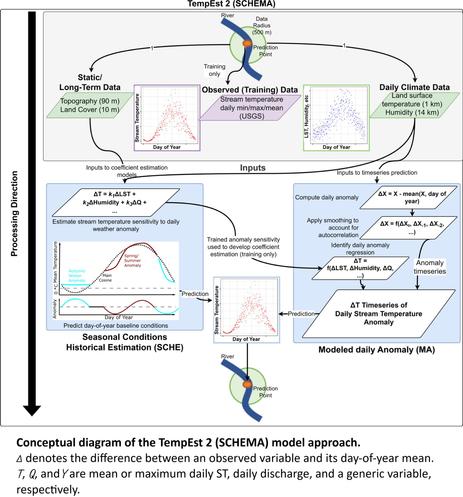
For the last few years, I've been working on making it possible to estimate high-resolution (daily, 1-km) river temperatures anywhere in the contiguous US. I'm delighted to announce that the paper introducing TempEst 2, the first high-resolution, ungaged river temperature model for the CONUS, has just been published in the Journal of Hydrology. TempEst 2 comes with a data retrieval script (Google Earth Engine) and a pretrained model, so you just provide the coordinates for your points of interest - on any stream, any size, urban or less-disturbed, etc - and get estimates with a typical RMSE of 2.0 C. I've found that it's practical to use for up to 10,000 sites or so for a given analysis (though you do need to split the data retrieval into blocks of <1500 sites). The paper also introduces a modeling framework for ungaged rivers called SCHEMA, which takes advantage of highly seasonal conditions to build well-performing models with few coefficients suitable for ungaged coefficient estimation.

Open-access paper (with Claudia R. Corona, Katie Schneider, Ashley Rust, and Terri S. Hogue): https://doi.org/10.1016/j.jhydrol.2025.133321

Model source code and usage information: https://github.com/mines-ciroh/tempest2

Open data: https://doi.org/10.4211/hs.a8b243957f7946e388d10ab206990675

TempEst 2 builds on our work with river temperature seasonality (https://doi.org/10.1111/1752-1688.13228).

#RiverTemperature #hydrology #modeling