 Erratic Attempts
#341: How Radical Should You Be In Your Belief?
How radical should you be in your belief? If you believe in something, shouldn’t you aim to believe in it more? So, let’s discuss.
All of us have our ideas that we prefer over others. All of us may have our political, religious, cultural preferences. There’s nothing wrong with that. That’s what we do. That’s what makes us human.
If we believe deeply that something is correct, that something is good, should we not think also that more of that is better? It’s a seductive idea and it seems logical initially. If you are X, if you believe in X, shouldn’t you believe in it more so? That seems to be the case because otherwise why would you believe in it? Is your belief really that weak that you can’t strengthen it?
So that’s the idea. And if you for some reason don’t want to fully commit, maybe you really never believed it completely. Maybe you’re not really a true believer. That’s the other part of the idea.
However, I would say this ignores certain facts about ideas, because every idea — whether it’s a religion, a philosophy, a cultural preference — typically has safeguards. When you look at all the big religions, they have some sort of clause, some sort of warning against taking it too far. Because that’s what the very idea of divinity is. That’s what the very idea of God is: that which we as human beings cannot completely understand. God is that which we cannot even approach so much that we can be certain of what God is. Because if we could, wouldn’t that mean in some way that we could become God? And that’s the very warning that most religions promote.
Believe, but don’t assume for a moment that you have all the answers.
There’s this joke that camels always look at humans in a specific way. The joke is that God has 100 names. We know 99 of them. But the camel knows all 100. And that’s why the camel looks so superior.
But that is the idea of religion. The idea of religion is a combination — as strange as this may sound — of belief and humility. We are not God. We are not everything in the universe. We are not all-knowing. We are not omnipotent. And we will never get there. So whatever you think of as God — whether you think that’s a religious idea, whether you think that’s nature, whether you think that’s the universe, whether you think that’s just the ultimate good — this idea is clear: do not pretend to be all-knowing yourself. Have some sense of humility.
Now that also goes for philosophy. You may say, I follow philosopher so-and-so. But philosophy is an ongoing conversation about wisdom — the love of wisdom; that’s what philosophia means. Each idea in philosophy lives in interaction with other ideas. Philosophy is more than just footnotes to Plato. Plato can be footnotes to Plato — if you look at the Laws and the Republic, there are two very different ideas there, and more than two.
Philosophers are typically smarter than those who follow a specific philosophy. Because every philosopher knows that in order to put out the strongest version of their idea, they have to leave some of the complications out. But there are always complications. And philosophy X always lives in some form of exchange with philosophy Y or Z or however many there are. Every idea lives in an ecosystem of ideas. It lives in relation with others.
Philosophy X may be good or better in certain respects than philosophy Y. Maybe philosophy Y is good in other aspects. But the truth emerges in the interaction between the two.
So you may believe that the individual is the source of all morality. But how far do you want to take this? Do you believe this to the complete abdication of responsibility for others? Do you believe this to the complete rejection of the state? Similarly, if you believe the state is the authority over everything else, at which point does this have to stop? At which point does the state have to even question itself as to how far it should go?
Everything costs money. Does this mean that everything should be judged by its price tag? Even though price is not a static thing — it depends on a lot of factors. Is the price tag always the value of something, or is it just our momentary expression of our social and cultural priorities? Of course there’s supply and demand which regulate that. But is that still everything? Aren’t there things where we should find some difficulty putting a price on? Aren’t there some things that we can’t really measure very well? So isn’t there a limit to this kind of positivist, materialist way of looking at things?
Equally, if we say the materialistic world doesn’t matter and we need to live in a more spiritual, contemplative state of mind — that may be true to a point, but eventually bills will have to be paid. You do live in some form of reality, and that reality means that resources typically are limited and there needs to be a prioritizing. How do you organize that?
The material and the spiritual belong together. They will always have friction between each other, but they will always complement each other. If you’re too materialistic — if you believe that only that which can be measured, only that which can be owned, only that which can have a price tag matters — you should maybe think about some more spiritual components of life. If you’re too spiritual, maybe you need to be rooted more in the fact that there’s also a materialist component of life.
If X drowns out Y, sides of X may appear that make it wrong, because you need that balance. And there are more than just two — X and Y is easier, but you could say XYZ or whatever.
So in fact the saying may be true that too much of a good thing is indeed not good. It distorts what it is.
This is why you see me frequently call for moderation. You could argue that too much moderation is also wrong — you need some passion and some intensity and some belief. Well, yes. But moderation can also be just a middle ground between these different poles. All these different ideas around us lead us to negotiate our space within them. Moderation does not mean you don’t have convictions. It means that you question at which point your convictions turn into such a radicality, into such an extreme version, that they become wrong — that they are undermined by their own conviction.
Is radicality the truest expression of an idea? No. It may be the most flamboyant, the most interesting. But it can’t survive well. If you turn too radical, too extremist, your idea may be more attractive to people who really think like you. But then look at history. Every time an idea became too radical, it fails. It has failed. No matter what the idea — because in its radicality, in its extremism, it loses its power of conviction towards those who don’t agree with you. And the number of people in the world who agree with you is always going to be punctuated by the number of people who disagree with you.
If you want to build a successful movement, if you want to build a successful approach to politics, to religion, to whatever your cultural or social idea may be, you need to convince others. You need to find ways of integrating aspects of the other into your own.
Which is why this very familiar symbol of yin and yang — masculine, feminine, black, white, dark, light — shows you these two parts, but there’s always something of the other in the bigger part. You know the symbol.
If we don’t find a way to integrate that with which we disagree — as some sense of doubt, as some sense of humility within our convictions — then our convictions will be nothing but arrogance, nothing but self-congratulatory pose, and turn out to be nothing else than solipsism: centering on yourself and that which you think defines you as the only thing that matters.
[This was originally posted to YouTube as a video. This post is a slightly abbreviated transcript, preserving the oral style of the video.]
#2026 #balance #beliefAndHumility #camelJoke #conviction #convictionVsArrogance #criticalThinking #culturalCommentary #divinity #doubt #ecosystemOfIdeas #extremism #God #humility #ideas #ideology #individualVsState #integration #Laws #loveOfWisdom #materialism #moderation #moderationVsExtremism #philosophia #Philosophy #Plato #politicalCommentary #politicalPhilosophy #politicalTheory #positivism #priceAndValue #publicPhilosophy #radicalism #radicality #religionAndReason #Republic #selfCongratulation #solipsism #spirituality #successfulMovements #tooMuchOfAGoodThing #trueBeliever #wisdom #yinAndYang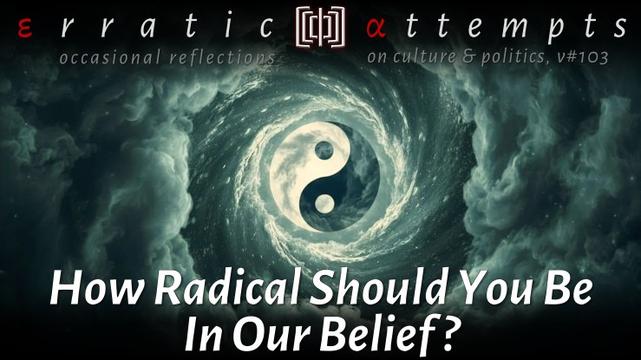
 Judith Zoë


 Keith Wilson
 Gregory B Sadler

 Samantha Brennan
 Philosophy_Mark


 Jack Manzi