What is the Effective Altruism Movement?

Most people want to do some good in the world. They donate to causes that feel meaningful, volunteer when they can, or try to live in ways that align with their values. But a growing movement called effective altruism takes a different approach, starting with a question that sounds simple but turns out to be surprisingly difficult: what is actually the best way to help?

The Core Idea

Effective altruism is a philosophy and social movement built on the premise that doing good is not enough on its own. The goal is to do the most good possible, using evidence and reason to figure out where resources, time, and effort will have the greatest positive impact.

At its core, the movement treats altruism like an optimization problem. If some charities help 10 times more people per dollar than others, and you give to the less effective one out of habit or emotional connection, you are leaving enormous potential impact on the table. Effective altruists argue that this kind of tradeoff deserves serious attention.

The term itself was coined in 2011 when Giving What We Can and 80,000 Hours merged under the umbrella of the newly formed Centre for Effective Altruism at Oxford University. Since then, the movement has spread to tens of thousands of participants across more than 70 countries.

Where It Came From

The philosophical roots of effective altruism trace back to the Australian moral philosopher Peter Singer, whose 1972 essay “Famine, Affluence, and Morality” laid out the argument that wealthy people in developed countries have a moral obligation to help those in extreme poverty, and that geographical distance does not diminish that obligation. Singer later expanded these ideas in books including The Life You Can Save (2009) and The Most Good You Can Do (2015).

The movement was formalized largely through the work of William MacAskill, a Scottish philosopher who co-founded Giving What We Can in 2009 with fellow Oxford graduate student Toby Ord. The organization encourages members to pledge at least 10% of their income to the most effective charities. MacAskill also co-founded 80,000 Hours, a research organization that helps people figure out which career paths will allow them to do the most good over the course of their working lives.

MacAskill’s 2015 book Doing Good Better became one of the defining texts of the movement, arguing that applying data and scientific reasoning to charitable giving can make a dramatically larger difference than giving based on emotional appeal or brand recognition.

Best selling money books on Amazon

How It Works in Practice

Effective altruism encourages people to evaluate their giving across several dimensions. Is the cause large in scale? Is it neglected relative to its importance? And is it tractable, meaning that additional resources and effort can actually move the needle?

Using these filters, the movement has tended to prioritize a handful of cause areas: global health and poverty, animal welfare, pandemic preparedness, and reducing risks that could threaten humanity’s long-term future.

One of the most influential institutions to emerge from this movement is GiveWell, a nonprofit charity evaluator founded in 2007. GiveWell reviews hundreds of charities and publishes detailed analyses of which ones save the most lives per dollar donated. Its top charities have historically focused on global health interventions like distributing malaria-prevention bed nets through the Against Malaria Foundation or providing seasonal malaria treatments to children in sub-Saharan Africa. GiveWell estimates that it has guided more than $2.6 billion in donations and helped avert over 340,000 deaths through these recommendations.

Another concept central to the movement is “earning to give,” the idea that some people can do more good by pursuing high-income careers and donating a significant portion of their earnings than they could by working directly for a charity. A software engineer who donates $100,000 a year to highly effective causes may ultimately help more people than someone working full time for a nonprofit that struggles with funding.

80,000 Hours takes a similar evidence-based approach to career choice, helping people think through which paths are likely to have the greatest positive impact given their skills, circumstances, and interests.

The Books That Define the Movement

If you want to understand effective altruism more deeply, a few books are worth your time.

Doing Good Better by William MacAskill is probably the best starting point. It walks through the logic of effective giving in accessible terms, punctures common assumptions about charitable impact, and provides a practical framework for making better decisions about where to direct your giving.

The Most Good You Can Do by Peter Singer covers similar ground with more philosophical depth, grounding the movement’s arguments in ethics and exploring what it really means to live a fully ethical life.

MacAskill’s 2022 book What We Owe the Future extends these ideas toward what the movement calls longtermism, the argument that protecting the long-term future of humanity may be one of the most important things we can do, given how many people could exist in the centuries ahead.

Criticisms Worth Knowing

No movement this ambitious goes without criticism, and effective altruism has attracted plenty of it. Some critics argue that the movement’s emphasis on quantifiable impact leads it to neglect causes that are harder to measure but no less important, like systemic inequality or community-level change. Others argue that the focus on impartial global benefit can feel cold and philosophically extreme in ways that conflict with ordinary human intuitions about loyalty, relationships, and local responsibility.

The movement also faced serious reputational damage following the 2022 bankruptcy of the cryptocurrency exchange FTX and the fraud conviction of its founder Sam Bankman-Fried, who had been one of the largest donors to effective altruism causes. The episode raised hard questions about how the movement had handled scrutiny of one of its most prominent members and whether its ethical framework had been applied consistently.

What It Has to Do with Your Finances

You do not have to be a philosopher or donate half your income to engage with effective altruism’s ideas. The movement’s most useful contribution may simply be its insistence on asking “what actually works?” before opening your wallet.

If charitable giving is part of your financial plan, the same discipline you apply to investing, keeping expenses low, avoiding fees, and letting compounding do its work, can be applied to giving. Tools like GiveWell make it easier than ever to verify that the dollars you set aside for charity are doing something real.

The broader lesson is one that good financial thinking and good altruistic thinking share: good intentions are not enough. What matters is whether your resources are actually going where they will do the most good.

#Charity #DoingGoodBetter #EffectiveAltruism #PeterSinger #TheMostGoodYouCanDo #TobyOrd #WhatWeOweTheFuture #WilliamMacAskill


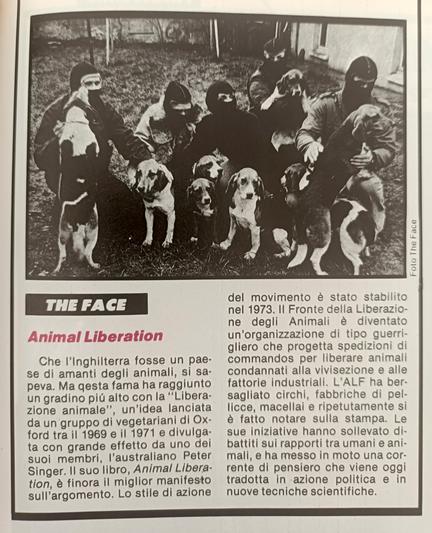
Un articolo di "The Face" ripreso da #Frigidaire , 1983

#alf #petersinger #vegan

Peter Singer is a Consequentialist Hedonic Utilitarian Ethicist.

It's his professional job to be good at ethics and teach others about ethics.

He thinks the best ethics are judged by the consequences, and that good is the best for the most people.

He has a podcast. It's probably great. He is cool. I only just heard about it.

But this is his website.

The podcast is offered on Spotify and Apple.

It has an AI chat bot that isn't even prompted well to sound like Peter for no reason at all.

It has a embed for a substack.

That embed for a substack is expired because it's run by a thing called Supascribe that is presumably some software as a service scam.

Below that is a cookie permissions banner which is asking for permission to spy on you for advertisers even though there are no actual adverts on the site.

There are links at the top and bottom to Facebook and Instagram.

There is no RSS feed embedded in the page.

I repeat: Peter Singer is actually pretty cool, and he thinks about ethics sanely.

This is the web we have built. Where a professional Consequentialist Hedonic Utilitarian Ethicist does all this.

#web #ethics #peterSinger

𝑳𝒊𝒕𝒆𝒓𝒂𝒓𝒚 𝑵𝒐𝒎𝒂𝒅𝒔 - 𝑻𝒉𝒆 𝑶𝒓𝒊𝒈𝒊𝒏𝒂𝒍 𝑶𝒎𝒆𝒍𝒂𝒔: 𝑻𝒉𝒆 𝑪𝒂𝒔𝒆 𝒐𝒇 𝒕𝒉𝒆 𝑨𝒏𝒊𝒎𝒂𝒍𝒔 𝒗𝒔. 𝑴𝒂𝒏

And when the child cannot speak for itself?

Humanity's first global lawsuit! In this 10th-century Islamic fable, animals put mankind on trial for the crimes of the extraction economy.

https://waywordsstudio.com/podcasts/waywords_podcast/original-omelas-case-animals-versus-man/

#podcast #literature #arabicliterature #medievalliterature #petersinger #ursulakleguin #donnaharaway #aristotle #francisbacon #jacquesderrida #speciesism

Famine, Affluence, and Morality - Wikipedia

Peter Singer – Wikipedia

@max_muehsal

Obgleich und weil ich mich sehr für die Bewahrung der Mitwelt engagiere, betone ich die Bedeutung der Menschenwürde.

Diese wird nach meiner Auffassung durch die ethische Gleichsetzung von Menschen mit Tieren, wie sie auch Peter Singer vertritt, leider relativiert.

Und, nein, da gehe ich nicht mit.

@Teh_Doc_Inan @Sabine1963

#Mitwelt #Menschenwürde #Mensch #Tier #PeterSinger

Infanticide? We're Not Talking Abortion.

When the ethicist Peter Singer proposed in 1993 that a newborn cannot be a "person" until 30 days old, it did so only as a rule. This unseemly plan involved granting doctors the power to euthanize disabled infants at the moment – a declaration that horrified people and shocked moral circles. Five years later, Singer had been made the Decamp Professor of Bio-Ethics at Princeton University, which made him credible in the eyes of the academy.

Get Informed
Spirus Gay, l’acrobate anarchiste qui a fait de sa vie et de son corps une œuvre politique - RTBF Actus

Par Sylvain Wagnon, professeur des universités en sciences de l’éducation, Université de Montpellier. Comment définir...

RTBF.be

Stop Gambling Our Future for Meat Deforestation

Renowned animal rights ethicist philosopher Peter Singer asserts that our dietary choices, particularly our consumption of meat and dairy, are jeopardising the Earth’s future. These industries contribute significantly to environmental degradation, deforestation, and greenhouse gas emissions, intensifying the impacts of climate change. By indulging in hamburgers and other meat-based products, we are not only compromising our health but also the wellbeing of our planet. For a more sustainable and compassionate future, consider boycotting meat and dairy. Choose to be vegan for the animals and to save our planet #Boycottmeat be #vegan #Boycott4Wildlife

https://youtu.be/ge4S2oHF5oY

Originally published by The Conversation June 15, 2023 and republished here under the Creative Commons Licence, read original.

Peter Singer, Princeton University

I wasn’t aware of climate change until the 1980s — hardly anyone was — and even when we recognised the dire threat that burning fossil fuels posed, it took time for the role of animal production in warming the planet to be understood.

Today, though, the fact that eating plants will reduce your greenhouse gas emissions is one of the most important and influential reasons for cutting down on animal products and, for those willing to go all the way, becoming vegan.

A few years ago, eating locally — eating only food produced within a defined radius of your home — became the thing for environmentally conscious people to do, to such an extent that “locavore” became the Oxford English Dictionary’s “word of the year” for 2007.

If you enjoy getting to know and support your local farmers, of course, eating locally makes sense. But if your aim is, as many local eaters said, to reduce greenhouse gas emissions, you would do much better by thinking about what you are eating, rather than where it comes from. That’s because transport makes up only a tiny share of the greenhouse gas emissions from the production and distribution of food.

With beef, for example, transport is only 0.5% of total emissions. So if you eat local beef you will still be responsible for 99.5% of the greenhouse gas emissions your food would have caused if you had eaten beef transported a long distance. On the other hand, if you choose peas you will be responsible for only about 2% of the greenhouse gas emissions from producing a similar quantity of local beef.

And although beef is the worst food for emitting greenhouse gases, a broader study of the carbon footprints of food across the European Union showed that meat, dairy and eggs accounted for 83% of emissions, and transport for only 6%.

More generally, plant foods typically have far lower greenhouse gas emissions than any animal foods, whether we are comparing equivalent quantities of calories or of protein. Beef, for example, emits 192 times as much carbon dioxide equivalent per gram of protein as nuts, and while these are at the extremes of the protein foods, eggs, the animal food with the lowest emissions per gram of protein, still has, per gram of protein, more than twice the emissions of tofu.

Animal foods do even more poorly when compared with plant foods in terms of calories produced. Beef emits 520 times as much per calorie as nuts, and eggs, again the best-performing animal product, emit five times as much per calorie as potatoes.

Favourable as these figures are to plant foods, they leave out something that tilts the balance even more strongly against animal foods in the effort to avoid catastrophic climate change: the “carbon opportunity cost” of the vast area of land used for grazing animals and the smaller, but still very large, area used to grow crops that are then fed — wastefully, as we have seen — to confined animals.

Because we use this land for animals we eat, it cannot be used to restore native ecosystems, including forests, which would safely remove huge amounts of carbon from the atmosphere. One study has found that a shift to plant-based eating would free up so much land for this purpose that seizing the opportunity would give us a 66% probability of achieving something that most observers believe we have missed our chance of achieving: limiting warming to 1.5℃.

Another study has suggested that a rapid phaseout of animal agriculture would enable us to stabilise greenhouse gases for the next 30 years and offset more than two-thirds of all carbon dioxide emissions this century. According to the authors of this study:

The magnitude and rapidity of these potential effects should place the reduction or elimination of animal agriculture at the forefront of strategies for averting disastrous climate change.

Climate change is undoubtedly the biggest environmental issue facing us today, but it is not the only one. If we look at environmental issues more broadly, we find further reasons for preferring a plant-based diet.

Fires in the Amazon and linked to cattle ranching. Andre Penner/AP Photo

The clearing and burning of the Amazon rainforest means not only the release of carbon from the trees and other vegetation into the atmosphere, but also the likely extinction of many plant and animal species that are still unrecorded.

This destruction is driven largely by the prodigious appetite of the affluent nations for meat, which makes it more profitable to clear the forest than to preserve it for the indigenous people living there, establish an ecotourism industry, protect the area’s biodiversity, or keep the carbon locked up in the forest. We are, quite literally, gambling with the future of our planet for the sake of hamburgers.

Joseph Poore, of the University of Oxford, led a study that consolidated a huge amount of environmental data on 38,700 farms and 1,600 food processors in 119 countries and covered 40 different food products. Poore summarised the upshot of all this research thus:

A vegan diet is probably the single biggest way to reduce your impact on planet Earth, not just greenhouse gases, but global acidification, eutrophication, land use and water use. It is far bigger than cutting down on your flights or buying an electric car, as these only cut greenhouse gas emissions.

Poore doesn’t see “sustainable” animal agriculture as the solution:

Really it is animal products that are responsible for so much of this. Avoiding consumption of animal products delivers far better environmental benefits than trying to purchase sustainable meat and dairy.

Those who claim to care about the wellbeing of human beings and the preservation of our climate and our environment should become vegans for those reasons alone.

Doing so would reduce greenhouse gas emissions and other forms of pollution, save water and energy, free vast tracts of land for reforestation, and eliminate the most significant incentive for clearing the Amazon and other forests.

This is an edited extract from Animal Liberation Now by Peter Singer (Penguin Random House).

Peter Singer, Professor of Bioethics in the Center for Human Values, Princeton University

This article is republished from The Conversation under a Creative Commons license. Read the original article.

Originally published by The Conversation June 15, 2023 and republished here under the Creative Commons Licence, read original.

ENDS

Read more about human health, veganism, nutrition and why you should #Boycottpalmoil, #Boycottmeat for your own and the planet’s health

Ecuadorean Viscacha Lagidium ahuacaense

High in the remote granite outcrops of Cerro El Ahuaca, #Ecuador the Ecuadorean #Viscacha Lagidium ahuacaense is plump and fluffy #rodent sporting sage-like long whiskers. From their high perch they look down upon…

Read more

Climate Change Driving Mass Bird Deaths in the Amazon

A recent #study has revealed that even in the most isolated parts of the #Amazon, bird #populations are collapsing due to #climatechange. Research published in Science Advances found that a 1°C increase in…

Read more

Declining primate numbers are threatening Brazil’s Atlantic forest

#Brazil’s Atlantic Forest, one of the most biodiverse ecosystems in the world, is facing severe threats due to deforestation and habitat fragmentation. This has led to a sharp decline in primate species, including…

Read more

Blue-streaked Lory Eos reticulata

Brilliantly coloured and full of energy, the Blue-streaked Lory (Eos reticulata) is a striking and unique #parrot living in the forests of the Banda Sea Islands, #Indonesia. Their scarlet plumage is decorated with…

Read more

Blonde Capuchin Sapajus flavius

The blonde #capuchin (Sapajus flavius) is an enigmatic and critically endangered #primate found in the northeastern forests of Brazil. With their striking golden-yellow fur and intelligent, expressive faces, these capuchins are among the…

Read more

Load more posts

Something went wrong. Please refresh the page and/or try again.

Take Action in Five Ways

1. Join the #Boycott4Wildlife on social media and subscribe to stay in the loop: Share posts from this website to your own network on Twitter, Mastadon, Instagram, Facebook and Youtube using the hashtags #Boycottpalmoil #Boycott4Wildlife.

✓ Subscribed

2. Contribute stories: Academics, conservationists, scientists, indigenous rights advocates and animal rights advocates working to expose the corruption of the palm oil industry or to save animals can contribute stories to the website.

Wildlife Artist Juanchi Pérez

Read more

Mel Lumby: Dedicated Devotee to Borneo’s Living Beings

Read more

Anthropologist and Author Dr Sophie Chao

Read more

Health Physician Dr Evan Allen

Read more

The World’s Most Loved Cup: A Social, Ethical & Environmental History of Coffee by Aviary Doert

Read more

How do we stop the world’s ecosystems from going into a death spiral? A #SteadyState Economy

Read more

3. Supermarket sleuthing: Next time you’re in the supermarket, take photos of products containing palm oil. Share these to social media along with the hashtags to call out the greenwashing and ecocide of the brands who use palm oil. You can also take photos of palm oil free products and congratulate brands when they go palm oil free.

https://twitter.com/CuriousApe4/status/1526136783557529600?s=20

https://twitter.com/PhillDixon1/status/1749010345555788144?s=20

https://twitter.com/mugabe139/status/1678027567977078784?s=20

4. Take to the streets: Get in touch with Palm Oil Detectives to find out more.

5. Donate: Make a one-off or monthly donation to Palm Oil Detectives as a way of saying thank you and to help pay for ongoing running costs of the website and social media campaigns. Donate here

Pledge your support

#animalRights #animalrights #animals #BoycottMeat #BoycottPalmOil #Boycott4wildlife #BoycottMeat #BoycottPalmOil #climateChange #climatechange #dairy #deforestation #diet #ethics #meat #nutrition #PalmOil #palmOilDeforestation #PeterSinger #plantBasedDiet #saturatedFats #vegan #veganism