Leith’s first streetlamps: the thread about that time the Russian Navy made the town dark for a week

This thread was originally written and published in August 2019

I spent the evening trawling through old engravings of Leith, and think I’ve found what I was looking for. The oldest picture (that I can find) showing street lamps in Leith! These five oil lamps are shown in the vicinity of the King’s Wark on the Shore, in a 1790 print by Dominic Serres.

Leith Pier and Harbour, Dominic Serres, 1790 © Edinburgh City Libraries

This search was stimulated by a conversation which enlightened me with a curious tale that involved the Leith streetlamps in days of yore. It got me thinking, what were the earliest streetlamps? According to “Leith Through Time” by Jack Gillon and Fraser Parkinson, there is a description of Leith Walk having 40 lamps in 1799 after its upgrade to a road for carriages following the North Bridge being opened and the primary horse and carriage route moving from the Easter Road to Leith Walk.

The Edinburgh World Heritage foundation commissioned an excellent report on the old Edinburgh streetlamps. Although it is principally concerned with the World Heritage area of the Old and New Towns, we can at least get the an idea of the particulars of what early lamps in Leith would have been like from it. A contemporary colour image of a London lamp lighter is shown with his assistant in 1808. The lamp is a glass globe, with a ventilated, wind-proofed cowl. Suspended in the globe is the lamp itself, a small glass dish of oil with a floating disc, with basic lenses from crown glass “bullseyes”. The lamplighter is passing the assistant the oil dish to refill from his jug.

Lamplighter and assistant, 1808, from “Costume of Great Britain” by W. H. Pyne. © The Board of Trustees of the Science Museum

Here’s a similar Georgian lamp frame on Leith Walk today, the crosspiece under the holder for the globe was for the leerie (lamplighter) to prop his ladder up on. When you see these old lamp frames with a ring to hold a glass lamp globe and no source up the centre for gas or electricity, you can be sure these are for old oil lamps. These lamps burned oil, specifically what was known as “train oil”. Which is odd as trains as we think of them now weren’t a thing in the late 18th century; that’s because it’s a corruption of the Dutch traan, a word for fish oil (levertraan in Dutch is cod liver oil, in German it is lebertran). However this is no oil from a fish, specifically it’s oil from a whale!

Leith walk oil lamp frame

Leerie, leerie, light the lamps, Lang legs and short shanks. Tak’ a stick and break his back, And send him through the Nor’gate!

An old Scottish childrens’ rhyme, recorded by Robert Chambers in 1826

An 1820 minute of Edinburgh’s lighting committee explains; “…the Contractor shall furnish the lamps with a sufficient quantity of the best Greenland whale oil and two wicks of sixteen threads of the best Oxford cotton“. The best oil was Grade 1, from the top of the cask. Edinburgh and Leith had a ready local source of such oil from the Leith whale fleet, which was active around the late 18th and early 19th century, but apparently the city sourced it’s municipal lighting oil from Hull.

The city’s lamp contractor was Smith & Company on George Street. The lamps were to be “trimmed daily and the globes to be cleaned at least three times in the week.” Even the finest train oil gave off soot; one of the early lighthouse keepers’ tasks was to polish the soot off of the reflector of the oil lamp (see below). The lamps were to be filled to burn until 3AM, at which point they would burn out and extinguish themselves, although the commission recognised “let the same quantity of oil be put into 2 two lamps and both equally trimmed by the most expert and experienced lamplighters, the one will continue burning from half an hour to an hour longer than the other

If the name Smith and the association with Georgian lamps is ringing a little bell, that is because Smith was Thomas Smith, the adoptive father of Robert Stevenson – the patriarch of that great Lighthouse-building and lamp and lens-making dynasty. Smith himself was also a builder of some of the first Scottish lighthouses as the chief engineer to the Northern Lighthouse Board and was an early pioneer of lighthouse lamp and lens improvements.

Coincidentally, the Smiths and Stevensons lived at 15 Baxter’s Place, which is the top of the route of Leith Walk, with their works a short walk away at Greenside. So it is perhaps no coincidence this fashionable new stretch of the city got some of his finest street lamps so early. But the reason for this entire thread is less about the lamps themselves, but more because of the curious tale of the week in the winter of 1799 when the Leith street lamps kept going out and leaving the Walk “ever and anon into a more or less eclipsed condition“.

In 1799, Russian warships anchored in Leith Roads off of Inchkeith, part of a squadron from the Baltic Fleet under Vice Admiral Pyotr Khanykov. Britain and Russia were at this time allies in the War of the Second Coalition against revolutionary France and Spain, and the Royal Navy’s North Sea Squadron under Admiral Duncan was co-operating with the Russians on escorting convoys in the North Sea.

The Russian fleet was in a poor state compared to the Royal Navy, and frequently put in to port to repair and seek medical attention; there was an agreement at the time that sick sailors could be brought into Edinburgh for treatment by the Royal Infirmary. The Russian 66 gun man-of-war Iona* under Captain Piavzov arrived in Leith Roads on 19th November from Texel following the failed Anglo-Russian invasion of the Frissian Islands. The newspapers noted she was not fit for sea and she proceeded to put a significant part of her crew ashore with fever and other ailments and buried her dead on Inchkeith.

(* = the contemporary newspaper reference says Jonas, but I am going to assume this was a typo or translation error, as no such ship existed in Russian service, and in Russian I am told that Iona and Jonah are one and the same)

Anglo-Russian naval cooperation, 1799-1807, a painting by Thomas Buttersworth, 1799. © National Maritime Museum

There appears to have been little in the way of contact or hospitality between the Russians and locals; a contemporary account describes a party rowing out from Leith to the Iona only to be completely ignored by the officers and men of the ship and coming away with a very negative opinion about Russian naval efficiency, decorum and cleanliness. The Anglo-Russian naval cooperation agreement was faltering at this time and Russia would shortly quit the alliance, but before leaving, the Iona allowed parties of men ashore into Edinburgh on the pretext of sight-seeing. Possibly they had more carnal reasons for wanting to be on land…

For the better part of a week that December, the street lamps of Leith Walk would mysteriously go out each night, even though they were cleaned, checked and the oil levels trimmed daily sufficient that they should burn until dawn. It was finally discovered by a night watchman that the Russian sailors staggering home down the Walk from the drinking dens of Edinburgh were climbing the lamp posts, removing and extinguishing lamps and drinking the contents of train oil. Why they should go to this effort is potentially revealed by the reference of a late-Georgian cookbook which tells us that the sailors in question were Kamtschadales. What we would now refer to as Kamchadals; these are the inhabitants of Kamchatka in the far east of Russia, descendants of the indigenous peoples of those parts. To them the train oil was a home comfort; just imagine these sailors, some 10,000 miles sailing from home, utterly homesick, in poor health and morale coming ashore and finding that the street lamps of Leith Walk were full of what they considered to be a fine delicacy. Of course they couldn’t but help themselves!

The thing about unpressurised oil lamps though is that they are a rubbish source of light. The Commissioners, on inspecting their lights, found “the great proportion giving light so very feebly“, so it was hardly surprising that when gas lamps came along there was a rapid switch. Gas (town gas, from coal) arrived in Edinburgh in 1818 when the New Street gas works was opened by the Edinburgh Gas Light Company. You can still find some of their covers embedded in Edinburgh pavements. Leith got its gasworks in 1837, on the corner of Baltic and Constitution Streets. Like New Street, it was the arrival of the railway bringing in coal straight from the Lothian coalfield that had made this possible and not just economical but profitable

Edinburgh Gas Light Co. road cover. A version exists with the letters re-arranged for the later Edinburgh & Leith Gas Commissioners.

So next time you’re strolling along some of the Georgian bits of Leith, like Ferry Road, you might look up and think of the time the Russian sailors drank all the lamp oil and left the place in darkness.

Ferry Road oil lamp holder

And if you’re wanting to go and find even more Georgian oil lamp holders in Leith (and who wouldn’t?) someone’s already identified and catalogued the remaining lot of them in this handy Flickr album.

https://www.flickr.com/photos/historic_streetlights_leith/albums/72157629667895362

If you have found this useful, informative or amusing, perhaps you would like to help contribute towards the running costs of this site – including keeping it ad-free and my book-buying budget to find further stories to bring you – by supporting me on ko-fi. Or please do just share this post on social media or amongst friends.

Explore Threadinburgh by map:

Travelers' Map is loading...
If you see this after your page is loaded completely, leafletJS files are missing.

These threads © 2017-2026, Andy Arthur.

NO AI TRAINING: Any use of the contents of this website to “train” generative artificial intelligence (AI) technologies to generate text is expressly prohibited. The author reserves all rights to license uses of this work for generative AI training and development of machine learning language models.

#Lochend #Logan #Restalrig #StMargaret

Gibsons of Leith: the thread about the enterprising fish smokers who became pioneers of Scottish aviation

This thread was originally written and published in February 2023.

In a previous thread, we looked at the Edinburgh Aviation Craze of 1910, when a few local citizens dared to dream that they might fly in machines they had crafted from their own hands. One of those men was John Gibson, and this is his story. John was born in September 1856, the first child of Margaret Forrest and John Gibson of New Street, Fisherrow, the small harbour village just to the west of Musselburgh. John (senior) was a fish curer and town councillor, like his father before him, and the family lived in a house by the name of Gibson’s Land. The family moved to Liverpool in the 1860s, business at Fisherrow having been disrupted by the coming of the railways. John Junior went to sea as an apprentice aged 14, learning that trade across the globe on oceanic sailing ships.

In August 1875, when aged just 18, he found himself wrecked off Cape Horn after the on which he was serving had to be abandoned. The Albert Gallatin of Liverpool became uncontrollable after losing her rudder and was in danger of being wrecked on the rocky shore of the Ildefenso Islands to the south of Chile. The ship’s complement of 30 took to the boats; the first mate and 20 seamen in the larger and Captain Groves, his wife and two children, and five seamen including John in the smaller. The latter boat made it safely to Islas Hermite, where they spent 9 days, before setting off again in search of something from which to construct a sail. After 2 days fruitless rowing they landed on another island, where they were reduced to a diet of half a cracker and 3½ ounces of salt beef each per day and suffered badly from exposure. They were fortuitously rescued by the ship Syren of Boston after 18 days. The other 21 men were never seen again.

Islas Hermite, CC-by-SA 3.0, Jerzy Strzelecki

John Senior moved the family back to Scotland around this time, re-establishing his fish curing business in Leith, but his son fancied his chances and headed to Australia to prospect for Gold. Not striking it rich, he soon returned home and joined the family trade, dealing in smoked fish in Newhaven. In 1897 he set himself up as a dealer of machinery and soon took to repair work and it was not long before this extended to bicycles. He entered the cycle trade at 109 Leith Walk around 1905, this business soon took the name of the Caledonian Cycle Works. These premises had substantial workshops to the rear, under the Manderston Street railway arches, perfect space for Gibson to indulge in tinkering with bikes, cars and engines.

Plaque dedicated to John Gibson adjacent to his “Caledonian Cycle Works” at 109 Leith Walk, which now houses a Salvation Army shop. The date given for his birth does not match his birth certificate and as nice as it is to imagine the fact, he did not build Scotland’s first aircraft (although he did claim to!).Local newspaper adverts for the Caledonian Cycle Works in 1907

It’s not exactly clear why, but in early 1909 John Gibson decided to get himself into the aircraft industry by building his own machines. Perhaps he was inspired by those two other bicycle repair shop proprietors; Orville and Wilbur Wright. Or perhaps it was the contemporary adventures of Scotland’s other aviation pioneers, which had been plastered all over the newspapers. The Barnwell brothers of Stirling – Frank and Harold – had been experimenting with gliders and had even tried to fit an internal combustion engine to one in 1905. In 1908, Lt. Laurence D. L. Gibbs made short, powered hops in a curious, swept-wing, “automatic stability” biplane called the Dunne D.4 in much secrecy in Glen Tilt near Blair Atholl. In July 1909, the Barnwells made the first powered flight in Scotland. Closer to home for Gibson there was a financial incentive to budding aviators too; in September 1909, the directors of the Marine Gardens amusement park in Portobello had offered a £500 prize, good for 1 year, for the first flight across the Firth of Forth by a Briton in a British-built plane, so long as it started from Marine Gardens. It was noted in April 1910 that Mr Charles Hubbard, an engineer living at Viewforth, was experimenting with a Bleriot-type monoplane of his own construction on Portobello Golf Course and had made a number of powered hops before it crashed.

Suitably inspired, Gibson’s first forays into aeroplanes were quarter-scale models, c. 10 feet long and certainly showing the influence of the Wright Brothers: being biplanes controlled by warping the wings and by a canard (a leading control surface rather than a tail), being powered by two propellers driven by chains from a single engine and by landing on skis. They were built both to hone and refine Gibson’s techniques and design, but also as demonstration pieces to be put on public show. In total he built nineteen different models, and the design of his craft evolved over this time.

An early variant Gibson aeroplane, before the Farman type. This one may be that described as being shown at the Leith Flower Show in Victoria Park in August 1910A subsequent model, from a photo submitted to Flight magazine by John Gibson in February 1912. It is beginning to look more like a Farman-type, but still retains features of the earlier craft above such as the chain-driven propellers

The definitive model moved up to half-scale, 15½ feet long and 12 feet in span, and adopted the layout of Henry Farman, a French aviation pioneer and a type which was very popular in the UK at that time. Again a canard biplane, it had movable ailerons on the wing-tips for control, a single, 7-cylinder rotary engine and the refinement of wheels with rubber suspension added to the landing skis. This was built specifically to exhibit in London and Berlin in March and April of 1910 respectively and was sponsored by the North British Rubber Company to exhibit their rubberised aircraft fabric. The structure was of ash wood, braced by piano wires.

The Gibson Farman-type half-scale biplane, at the company’s workshops in Manderston Street

Even before half-sized Farman model was completed, Gibson had already moved on to the construction of a full-sized version of it – Caledonia No. 1. In July 1910 it was ready and The Scotsman reported it to be 30 feet long and 28 feet in span, with a loaded weight of 700 lbs. It was powered by a 3-cylinder, water-cooled engine of 30 hp, driving a 2-bladed propeller of 6 feet 8 inches at 1,100 rpm. The pilot sat on the lower wing, with the engine to his back and the radiators on either side. In contrast to the model, the vertical tails were mounted one above the other, rather than side-by-side. Construction was of silver spruce, with elm skids, and again it was covered in North British rubberised fabric. The aircraft could be disassembled for transport, and a photo of it exists in a field outside Edinburgh being put back together again. Gibson told the press that the only part of his machine that was not built in Scotland was its engine. He had intended to enter the machine into the Royal Aero Club’s inaugural Scottish flying meeting at Lanark Racecourse in August of that year, but the proprietors were wary of the public relations disasters experienced by other events as a result of amateur flyers who could not convince their homespun machines to take off and barred all but experienced pilots in proven aircraft. Gibson was disappointed to be excluded from the Lanark meet, but this was probably for the best as No. 1 refused to take off.

Gibson’s Caledonia No. 1, probably at Balerno. Photograph donated by John Gibson’s son G. T. Gibson to the National Museums of Scotland and on display at the East Fortune Museum of Flight

Undeterred, the machine was rebuilt as Caledonia No. 2, and in August it is reputed to have managed to make some short, controlled hops at Buteland Farm, outside Balerno, with Gibson’s 30 year old son – John G. Gibson (the G was for Gibson!) – at the controls. The main visual changes to No. 2 were the twin canards at the front and the curved supporting skids between them and the wheels (which protected the plane in the event of it nosing-over on take off and landing).

Caledonia No. 2, from photos submitted by John Gibson in August 1910, before it had managed a controlled flight. His son, John G., is at the controls.

Gibson undertook some of the flying himself, but as injured in a crash and broke his leg. Thereafter he deferred most of the flight testing to his son – John G. There are mentions online of testing being undertaken on Leith Links, but I can find no references to substantiate this, and as far as I’m aware Buteland Farm was used as their test ground. The Gibsons now had a working aircraft and began soliciting for orders, charging £450 for a complete machine. Full-page spread adverts were placed in the Edinburgh and Leith post office directories:

Gibson’s Aeroplanes advert from 1910-11, from the Edinburgh & Leith Post Office Directory.

Planes, Tails, Ailerons, supplied on receipt of measurements and other details on very short notice.
Best materials only used. Your orders solicited for Scottish-built Planes.
Spare parts or complete machines.
Wood Spars cut any length, straight-grained and free from knots.
Aeroplane Fabric, all grades, at factory prices.
We make Aluminium castings from customer’s patterns or drawings. Wood patterns made to order.
We undertake Aeroplane repairs.

Advert for Gibson’s Aeroplanes, 1910-11

Nine more machines were built by the company in the next few years, most for sale to private customers. In September 1911, Gibson reported to the press that one of his machines – Caledonia No. 11 – had accidentally but successfully performed a “somersault” in the air when being flown at Cramond by Gordon T. Cooper, the son of the secretary of the Edinburgh Aeronautical Association. In November of that year, one of the Gibson machines was included in the display of the Scottish Aeronautical Society at the National Exhibition, at Kelvingrove in Glasgow.

An American Farman biplane in flight in 1910, with a passenger clinging on to a strut next to the pilot.

Of the 11 full-size machines built by the Gibsons, four were written off in crashes, one was destroyed in a fire when on display at an exhibition in Brussels and another met the same fate in the Manderston Street workshop. Progress seems then to have stalled, this is perhaps because John G. had graduated from Edinburgh University as a prize-winner and passed an entry exam to the Indian Civil Service, which gained him a prestigious appointment in London with the HM Office of Works. A larger machine was designed in 1913 and was said to be under construction the following year when the outbreak of war saw it being cancelled. This event saw John G. join the Royal Engineers, and he was twice wounded during the conflict. Post-war he took a civil service job attached to the Air Ministry.

Wooden propeller from a Gibson aeroplane at the National Museums of Scotland Museum of Flight at East Fortune. Given the date, and the size, this may have been fitted to the Farman-type half scale model.

During the war, the Caledonian Cycles business was relocated to Dalry Road and the Leith Walk premises and its workshops became the Caledonian Motor Works, with additional workshop premises being taken on Sloan Street and Jameson Place nearby. Business became focussed on providing bodies for lorries and post-war the company would become a principal agent in Scotland for Leyland lorries and buses, with premises taken in King Street, Aberdeen to serve the north-east of Scotland. Later they would become an agent for Morris Commercial Vehicles.

John Gibson (senior) died aged 79, at his home at 19 Pilrig Street in Leith on August 7th 1935. The Scottish newspapers mourned his passing and noted a surprising further string to his bow; he was an acknowledged authority on Egyptology and a Fellow of the Society of Antiquities. John G.’s younger brother – George Thomson Gibson – seems to have largely taken over the running of the company. George was a capable engineer – taking out his first patent for improvements to motorcycle frame joints in 1918. In the 1950s he took out a series of patents for improvements to refuse vehicles and these would become something of a company speciality.

1957 patent by George T. Gibson for a tipping refuse lorry

Another line of business was “Gibson Towers”, which they designed and built for themselves; mobile platforms for working at height. Still based in Leith, a pleasing throwback to their aviation heritage was the continued use of “Aero, Edinburgh” as the telegram address.

A 1956 advert for Gibson Towers

George T. died in Edinburgh in 1960 aged 69. John G. died in 1970, aged 80. The company continued for a while after the death of the Gibson brothers, being closed and wound-up in 1975.

If you have found this useful, informative or amusing, perhaps you would like to help contribute towards the running costs of this site – including keeping it ad-free and my book-buying budget to find further stories to bring you – by supporting me on ko-fi. Or please do just share this post on social media or amongst friends.

Explore Threadinburgh by map:

Travelers' Map is loading...
If you see this after your page is loaded completely, leafletJS files are missing.

These threads © 2017-2026, Andy Arthur.

NO AI TRAINING: Any use of the contents of this website to “train” generative artificial intelligence (AI) technologies to generate text is expressly prohibited. The author reserves all rights to license uses of this work for generative AI training and development of machine learning language models.

#Lochend #Logan #Restalrig #StMargaret

Review: Ella – Taste of Greece on Leith Walk

My first visit to Ella – Taste of Greece coincided with a trip to the nearby Leith Arches market. Situated conveniently on Leith Walk, this Greek bistro immediately catches the eye. It presents a facade of artistic dilapidation …
#dining #cooking #diet #food #mediterranean #MediterraneanDiet #MediterraneanFood #Greek #leith #leithwalk #Mediterranean #mediterraneanfood
https://www.diningandcooking.com/2420439/review-ella-taste-of-greece-on-leith-walk/

Signal boosting a message from our fellow Indie Bookshop, the excellent Argonaut Books on Leith Walk:

"We need your help. Waterstone's, without any direct communication with us, will be opening their 6th Edinburgh branch less than 100 metres from our front door at the Foot of the Walk in Leith.

Please read on for more information: https://www.heraldscotland.com/news/25629089.waterstones-open-prime-site-beside-independent-shop/ "

This has happened before when the large chain, which *promised* not to open a smaller branch near an existing Indie Bookshop, tried to do so in Edinburgh's Stockbridge, only to face a barrage of criticism as it was close to the excellent Golden Hare Bookshop (they claimed they hadn't realised this and did eventually withdraw plans). Now this.

Sharing this for fellow #Edinburgh bookshop lovers as Argonaut is a fabulous Indie, and also a number of our local authors often do their writing right there in their coffee shop, next to the books.

#books #livres #Bookshops #Librairies #Edinburgh #Edimbourg #ArgonautBooks #Waterstones #CorporateCulture #LeithWalk #IndependentBookshops #IndieBookshops #bookst

Waterstones to open on prime site beside independent shop

UK's biggest bookselling chain under fire over plans for new store beside Edinburgh tram line.

The Herald

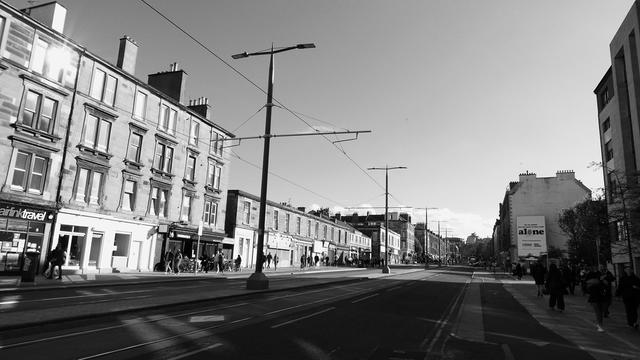
Low winter sunlight, making an almost perfect angled wedge of shadow and light across Leith Walk.

.

.

#Edinburgh #Edimbourg #photography #photographie #architecture #Shadows #ombres #LeithWalk #Ecosse #Scotland

Chum and I paid a visit to the vintage clothing fair at Out of the Blue Drill Hall. She got some nice pieces, I didn't find any clobber (the bulk of the offerings were for women), but did treat myself to a couple of nice rings from a craft stall.

As a bonus we ran into some other friends, then coffee in a nearby cafe that also sold #vinyl

#Edinburgh #Edimbourg #photography #photographie #OutOfTheBlueDrillHall #Vintage #fashion #LeithWalk

Review: La Casa, Leith Walk

La Casa is a well-established Mediterranean restaurant on the bustling stretch of Leith Walk. With a sister restaurant in Dalry, this Leith location has become a reliable fixture for those seeking a casual, lively tapas meal. It’s a spot I was fir…
#dining #cooking #diet #food #mediterranean #MediterraneanDiet #MediterraneanFood #lacasa #leith #leithwalk #Mediterranean #mediterraneanfood #solo #tapas
https://www.diningandcooking.com/2363340/review-la-casa-leith-walk/

Review: La Casa, Leith Walk

La Casa is a well-established Mediterranean restaurant on the bustling stretch of Leith Walk. With a sister restaurant in Dalry, this Leith location has become a reliable fixture for those seeking a casual, lively tapas meal. It’s a spot I was first introduced to via an Itison vou…
#dining #cooking #diet #food #MediterraneanFood #lacasa #leith #leithwalk #Mediterranean #mediterraneanfood #solo #tapas
https://www.diningandcooking.com/2363340/review-la-casa-leith-walk/