@celineh2ooo.bsky.social and @stevensalzberg.bsky.social compared 3,493 vertebrate genomes to identify 342 gains of introns in human genes, tracing their origins and identifying cases of intronization as a mechanism of intron emergence.

🔗 doi.org/10.1093/gbe/evaf091

#genome #evolution #introns

Double-stranded DNA viruses may serve as vectors for horizontal transfer of intron-generating transposons.
#Transposons #Introners #Introns #dsDNAviruses #HorizontalGeneTransfer #Dinoflagellates #Preprint
https://www.biorxiv.org/content/10.1101/2025.03.18.643946v1
Double-stranded DNA viruses may serve as vectors for horizontal transfer of intron-generating transposons

Specialized transposable elements capable of generating introns, termed introners, are one of the major drivers of intron gain in eukaryotes. Horizontal gene transfer (HGT) is thought to play an important role in shaping introner distributions. Viruses could function as vehicles of introner HGT since they often integrate into host genomes and have been implicated in widespread HGT in eukaryotes. We annotated integrated viral elements in diverse dinoflagellate genomes with active introners and queried viral elements for introner sequences. We find that 25% of viral elements contain introners. The vast majority of viral elements represent maverick-polinton-like double-stranded DNA (dsDNA) viruses as well as giant dsDNA viruses. By querying a previously annotated set of maverick-polinton-like proviruses, we show that introners populate full-length elements with machinery required for transposition as well as viral infection. Introners in the vast majority of viral elements are younger than or similar in age to others in their host genome, suggesting that most viral elements acquired introners after integration. However, a subset of viral elements show the opposite pattern wherein viral introners are significantly older than other introners, possibly consistent with virus-to-host horizontal transfer. Together, our results suggest that dsDNA viruses may serve as vectors for HGT of introners between individuals and species, resulting in the introduction of intron-generating transposons to new lineages. ### Competing Interest Statement R.C.-D. was supported by R35GM128932.

bioRxiv

When your body turns your DNA into one of many alternate protein forms, it uses this finely tuned biomachinery for a rope dance with the mRNA strand to carry out very coordinated cuts and joins.

https://youtu.be/OuAGeQYjfus

Absolutely incredible to see it animated with this level of detail :0

#RNA #spliceosome #structuralbiology #animation #exons #introns #alessoninthelariat

- YouTube

Enjoy the videos and music you love, upload original content, and share it all with friends, family, and the world on YouTube.

"Most importantly, by proving that the evolutionarily-conserved RNA core of splicing machines can recognize small molecules specifically, our work provides a solid basis for the rational design of splicing modulators not only against bacterial and organellar introns, but also against the human spliceosome, which is a validated drug target for the treatment of congenital diseases and cancers." #spliceosome #splicing #intron #introns #transcription #ribonucleicAcid #RNA

https://www.nature.com/articles/s41467-024-48697-0

Targeting the conserved active site of splicing machines with specific and selective small molecule modulators - Nature Communications

Splicing is a vital biological reaction and a druggable pathway to treat infection, genetic diseases and cancer. Here, the authors describe how splicing is modulated by small molecules that target the conserved splicing active site in the group II introns.

Nature
Scientists reveal how RNA gets spliced correctly

To carry out all of life's functions, proteins must be produced from instructions carried by genes within DNA and delivered to the cell's protein-making machinery by messenger RNA.

Phys.org
Heat stress? More like hot new #PlantScience !
💥🌡️🌱
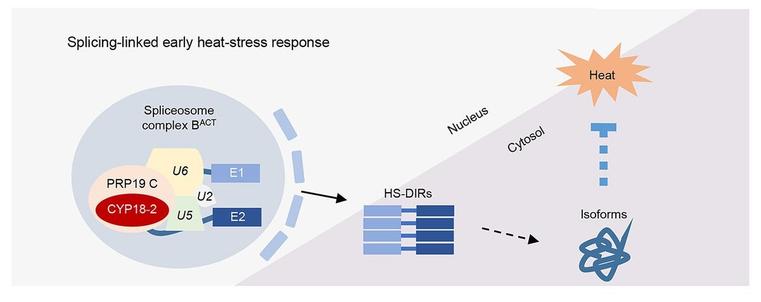
Spend the weekend with #JIPB and find out how #spliceophilin CYP18‐2 is involved in the splicing of retained #introns under heat stress in #Arabidopsis.
https://jipb.net/EN/10.1111/jipb.13450
@wileyplantsci
#AbioticStress #thermotolerance

Pictures Considered #58: Visualizing Introns

by Christoph
By reading sequences we easily detect stretches that code for pro­teins. We detect promoters, transcription factor binding motifs, start/stop signals for tran­scription, signals where introns are removed by splicing from primary transcripts (pre‑mRNA) to yield mature messenger RNA (mRNA), and much more. It wasn't always so easy.

Read more → https://tinyurl.com/4s5zebxr

#microbiology #introns #molbio #molecularBiology

Researchers reveal structural mechanism of Tetrahymena ribozyme self-splicing reaction

A team led by Prof. Zhang Kaiming from the University of Science and Technology (USTC) solved six conformations in the second-step self-splicing of Tetrahymena ribozyme using cryogenic electron microscopy (cryo-EM), revealing the mechanism of group 1 introns coordinating self-splicing reactions. Their work was published in Nature Communications.

Phys.org

A New Model Offers an Explanation For The Huge Variety of Sizes of DNA in Nature:
A new model offers a possible solution to the scientific question of why neutral sequences, sometimes referred to as 'junk DNA', are not eliminated from the genome of living creatures in nature and continue to exist within it even millions of years later

https://royalsocietypublishing.org/doi/10.1098/rsob.220223

#genetics #genetic #molecularbiology #cellbiology #introns #dna

🌡️When things get hot, we're not just splicin'...we're *#spliceophilin*🎤
Lee et al. report on the role of spliceophilin CYP18-2 in the splicing of retained #introns under #HeatStress in #Arabidopsis. https://doi.org/10.1111/jipb.13450
@wileyplantsci
#PlantScience #JIPB #GeneEditing