#AlanWarburton ’s 2020 video essay 𝑅𝐺𝐵𝐹𝐴𝑄 traces a recent history of what he terms the #hyperimage, drafting a trajectory from computer graphics to synthetic data and examining how images have become increasingly unmoored from photographic #indexicality.
Full video essay awaits you on 𝟯𝟭 𝗠𝗮𝗿𝗰𝗵 at the #BecomingImage: 𝑺𝒚𝒎𝒑𝒐𝒔𝒊𝒖𝒎 in Kino Šiška 🧩 🖼️
> https://aksioma.org/becomingimage/symposium/rgbfaq/
TIL:
en.wikipedia.org/wiki/Indexic...
In
#semiotics,
#linguistics,
#anthropology, and
#philosophy of language
#indexicality is the phenomenon of a sign pointing to some element in the context in which it occurs. A sign that signifies
#indexically is called an index or, in philosophy an
#indexical.
Indexicality - WikipediaTIL »We have to talk about the concept of #indexicality.«
Finally I have a word for what is so irritating for me in #AI #slop – it is something that is utterly missing, not something that is there.
Invidious
YouTube

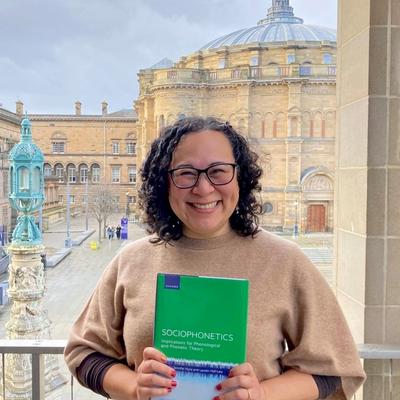
Professor Lauren Hall-Lew Inaugural Lecture
Professor Lauren Hall-Lew's Inaugural Lecture from 25th September 2024. Sociophonetic indexicality as a window onto language and society.
I am so hot and bothered by this writing from 1990.
Inductive indexicality! WHEW!
#Indexicality #Pronouns
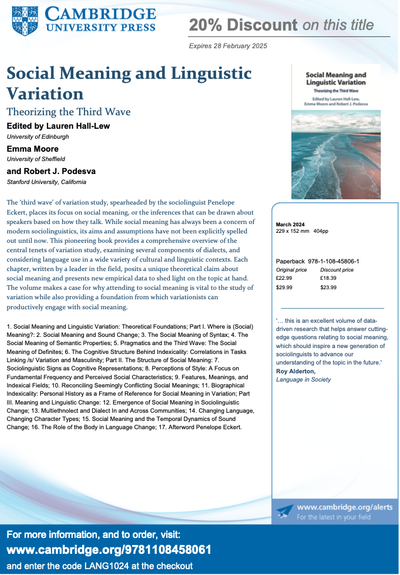
We're in paperback!!! And we're 20% off!!! 🎉🎉🎉
Hall-Lew, Lauren, Emma Moore, & Robert J. Podesva (eds.) 2021. Social Meaning and Linguistic Variation: Theorizing the Third Wave. Cambridge: Cambridge University Press.
https://www.cambridge.org/gb/universitypress/subjects/languages-linguistics/sociolinguistics/social-meaning-and-linguistic-variation-theorizing-third-wave
#sociolinguistics #variation #indexicality #books
Boosting this study simply because I love it!!
Morán Panero, Sonia. (2019).
“It’s more fashionable to speak it badly”: indexicality and metasemiotic awareness among users of English from the Spanish-speaking world
/
“Se lleva más hablarlo mal”: indicialidad y conciencia metasemiótica entre hablantes de inglés del mundo hispano.
https://doi.org/10.1515/jelf-2019-2021
#sociolinguistics #ESL #EFL #socialmeaning #indexicality #recommended #read

“It’s more fashionable to speak it badly”: indexicality and metasemiotic awareness among users of English from the Spanish-speaking world
As ELF scholars warn us against treating linguistic productions of “non-native” English speakers as “errors” when they are sociolinguistically driven variation, it is necessary to investigate how speakers in Expanding Circle settings conceptualise, label and experience such uses themselves. This paper reports a qualitative study of the metalinguistic and evaluative practices of university students in Chile, Mexico and Spain. It explores how they ascribe (un)desirable meanings to different ways of speaking English as an additional language (i. e. indexical relations), whether these symbolic associations are seen to influence students’ own linguistic use, and the extent to which such indexical relations are theorised as inherent in language form or as symbolic and negotiable (i. e. metasemiotic awareness). The analysis of more than 53 hours of elicited interview talk reveals a complex web of available social meaning relations and multidirectional accounts of the effects that such meanings have on students’ linguistic and semiotic practices. Although many students display awareness of the contextual variability of social meaning-making processes (Coupland. 2007. Style: Language variation and identity . Cambridge: Cambridge University Press), only a minority were able to directly challenge dominant indexical associations and stereotypical trait attributions. The findings underscore the need for English language teachers to understand their students’ semiotic goals and interpretative repertoires, firstly to avoid discriminating against sociolinguistically motivated variation in students’ English use and secondly, to provide them with additional tools to negotiate their position as speakers of English as an additional language. The paper also reflects on the implications that these findings have for how we explain variation and attitudinal ambivalence in ELF research.
Do LLMs consider heteroglossia in their models? If so, how they deal with that? And how they revolve around indexical expressions?
#gptchat #LLM #indexicality #heteroglossia Aksioma
 MathiasTCK.bsky.social
 katzenberger
 Lauren Hall-Lew
 T. T. Perry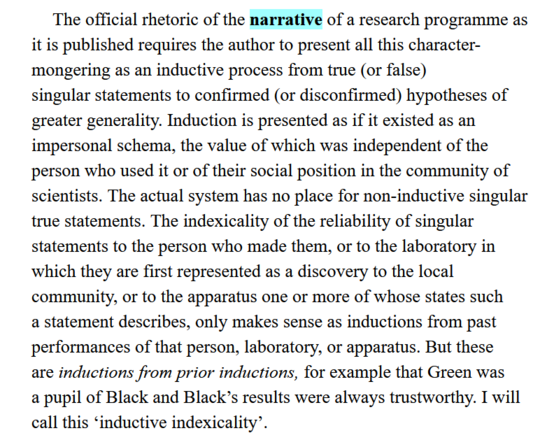
 André Vereta-Nahoum