 Hotznplotzn
Report: U.N. “experts” accepted funding from China, Russia, Qatar, pushed their interests
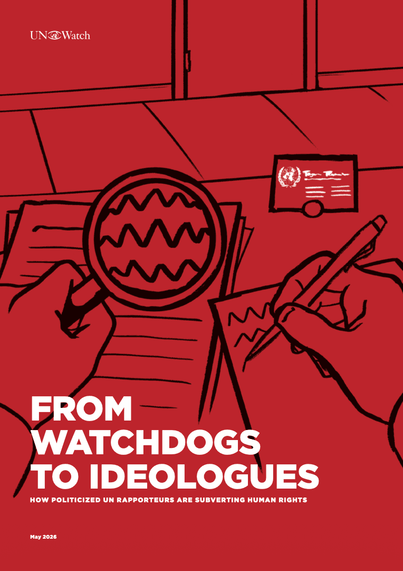
Report: U.N. “experts” accepted funding from China, Russia, Qatar, pushed their interests - SDF Chatter
cross-posted from: https://lemmy.sdf.org/post/53805497 [https://lemmy.sdf.org/post/53805497] > Archived [https://web.archive.org/web/20260527050052/https://unwatch.org/report-u-n-experts-accepted-funding-from-china-russia-qatar-pushed-their-interests/] > > Here is the report: From Watchdogs to Ideologues - How Politicized UN Rapporteurs Are Subverting Human Rights (pdf) > [https://web.archive.org/web/20260526164432/https://unwatch.org/wp-content/uploads/From-Watchdogs-to-Ideologues.pdf] > > In November 2006, UN Secretary-General Kofi Annan described the system of Special Procedures as “the crown jewel of the UN human rights system.” Nearly two decades later, that jewel has lost much of its luster—tarnished by politicization, disregard for impartiality, and a complete failure of accountability to minimal norms and professional standards. > > The Human Rights Council today maintains 59 Special Procedures mandates—46 dealing with global themes, and 13 addressing specific countries—an increase of nearly 30% from when the Council was created in 2006. Although Special Procedures are unsalaried, they receive certain financial support when carrying out official duties, including UN funding for country visits, as well as training, staffing support, and other institutional resources. > > […] > > Yet, like the body that appoints them—the 47-member Human Rights Council, a majority of whose members are non-democracies—the Special Procedures have become politicized. The mechanism increasingly functions not as an independent human rights safeguard, but as a vehicle for ideological advocacy, selective targeting, and the laundering of unverified and even spurious allegations through the authority of the United Nations. > > […] > > [According to a new report], the reality of the Special Procedures system increasingly diverges from the admiring scholarly assessments. Rather than operating as independent and impartial experts, many mandate-holders now use country visits and thematic reports to advance politicized narratives, disproportionately target democratic states, and shield authoritarian regimes from scrutiny. As detailed below, structural deficiencies—including politicized appointments, proliferation of mandates, weakened evidentiary standards, lack of transparency, and the absence of accountability—have eroded the credibility and integrity of the system in practice.
 Demokritus Jorik

 Adam Isacson
 Palm Oil Detectives
 Bombo Radyo News [Unofficial]
 Voteinorout 🇺🇸
 Miguel Afonso Caetano
 NYT > Home Page
 The Japan Times
 (Older) RJT