“The enclosure of the commons inaugurates a new ecological order. Enclosure did not just physically transfer the control over grasslands from the peasants to the lord. It marked a radical change in the attitudes of society toward the environment.”*…

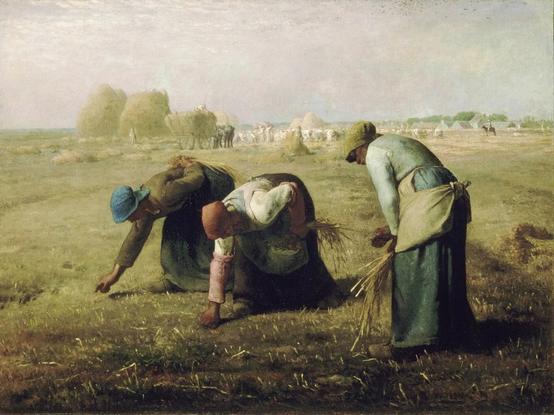
The Gleaners by Jean-Francois Millet (1857)

Several days ago, juries in New Mexico and California found Facebook/Meta (and in California, also YouTube/Google) guilty of knowingly employing algorithms to serve content to minors that caused depression, anxiety, and other mental health harms… behavior par for the course of the (massive, “mechanical”) extractive behavior that is their business model. As NPR reports (on the California verdict):

While the financial punishment is miniscule for companies each worth trillions of dollars, the decision is still consequential. It represents the first time a jury has found that social media apps should be treated as defective products for being engineered to exploit the developing brains of kids and teenagers… The outcome of this case could influence thousands of other consolidated cases against the social media companies. The litigation has drawn comparisons to the legal crusade in the 1990s against Big Tobacco, which forced the industry to to stop targeting minors with advertising…

L. M. Sacasas draws on a comparison to the English “enclosure movement” (and here) to put the stakes of this battle against algorithmic extraction into historical context…

If you were to ask me something like “What’s the most urgent task before us?” or “What counsel do you have to offer in this cultural moment?” I would say this:

Resist the enclosure of the human psyche.

Don’t misunderstand me. I’m sure there are other necessary and urgent tasks. But this would be my contribution to the conversation. I would be offering not only an imperative to pursue, but also, and perhaps more importantly, an analogy to clarify and interpret the techno-economic forces at play in a digitized society. Such analogies or concepts can be useful. They can crystalize a certain understanding of the world and catalyze action and resolve. They can be a rallying cry.

In any case, I’ll say it again: resist the enclosure of the human psyche.

Some of you may immediately intuit the force of the analogy, but I suspect it needs a little unpacking.

Here’s the short version: I’m drawing an analogy between a historical development known as the enclosure of the commons and the condition of the human psyche in the context of a digitized society. The enclosure of the commons is the name given to the centuries-long process by which lands available to the many were turned into a resource to be managed and extracted by the few. My claim is that structurally similar processes are unfolding with the aim of enclosing the human psyche and transforming it into a resource to be managed and extracted…

The longer version, which follows, unpacks that analogy and explains what the impact of “enclosing the human psyche” could– would likely– be. Sacasas concludes…

… The individual human psyche does not seem like a thing held in common. But, in fact, that presumption may itself be a symptom of the enclosure of the psyche, although there are certainly many other forces leading toward that same conclusion. What if the psyche were a thing held in common? That is to say, what if our purchase on reality and the emergence of the self depended on human relationships and communities? From this perspective, the enclosure of the human psyche deprives us of a common world, which yields an experience of solidarity and belonging.

I’ve elsewhere developed this point at greater length, but here I’ll only note Hannah Arendt’s warning that we are deprived of a “truly human life” when we are “deprived of the reality that comes from being seen and heard by others, to be deprived of an ‘objective’ relationship with them that comes from being related to and separated from them through the intermediary of a common world of things.”

That last bit about a common world of things, a material, not only virtual world, is key. The logic of enclosure seeks to lock us into a private virtual world of “bespoke realities,” thus excluding us from the common world of things that yields as well a public consciousness. As Arendt put it, “Only the experience of sharing a common human world with others who look at it from different perspectives can enable us to see reality in the round and to develop a shared common sense.”…

Eminently worth reading in full: “The Enclosure of the Human Psyche

* Ivan Illich, “Silence is a commons” in In the Mirror of the Past (to which Sacasas alludes in the essay linked above)

###

As we cosset commons, we might recall that it was on this date in 1867 that a bilateral treaty was signed effecting the sale of Alaska by Russia to the United States. It was ratified on May15 and American sovereignty took effect on October 18 of that year. The price for the 586,412 square miles that changed hands was $7.2 million in 1867 (equivalent to about $132 million in 2024), or about $0.02 per acre ($0.37 per acre in 2024).

Relevantly to the piece above, the land was and is largely commonly held, by the federal government, by the state, and by Native American tribes. Only roughly 1% of Alaska is in private hands. But that sliver is growing as the Trump Administration moves to “liquidate” federal real estate holdings (sell them to private owners) and in the meantime, licenses huge swathes of Alaska for oil and gas development, mineral extraction, and the infrastrucutre (roads, pipelines) needed to service them. Alaskans are worried.

The $7.2 million check used to pay for Alaska (source) #access #Alaska #AlaskaPurchase #commons #culture #enclosure #enclosureMovement #history #humanPsyche #LMSacasas #land #landAccess #landOwnership #landUse #ownership #politics #psyche #Russia

What Are You Really Chasing? - Zsolt Zsemba

Explore the core psychological needs that quietly drive your decisions, relationships, and reactions, and learn how to recognize which one is shaping your life.

Zsolt Zsemba

What Are You Really Chasing?

Psychological Needs You May Not Even Realize

The hidden needs shaping your behaviour. Explore the core psychological needs that quietly drive your decisions, relationships, and reactions, and learn how to recognize which one is shaping your life.

Let me ask you something simple and uncomfortable.

If you stripped away your job title, your relationships, your social media, and your opinions, what would you still need to feel okay with yourself?

Most people answer too fast.

And most people answer wrong.

Behind almost every reaction, argument, and life choice sits a psychological need you may not even realize you are feeding. You are not chasing happiness. You are chasing relief. Relief from feeling small, unseen, unwanted, or unsure of your place.

Here are six of the most common drivers. As you read, notice which one tightens your chest. That is usually the one that owns you.

Pity

Pity shows up when your identity stays attached to what hurt you. You talk about what happened, who wronged you, and how unfair life has been. At first, people listen. Over time, they pull away.

Pity gives attention without requiring growth. It feels safer than risk. If you notice that sympathy feels better than respect, or that being helped feels easier than standing on your own, pity may be the currency you learned to trade in early.

Power

Power is not always loud. Sometimes it looks calm, organized, and responsible. You plan everything. You lead every conversation. You struggle when someone else takes charge.

This need often comes from a time when you felt helpless. Control became protection. If you feel anxious when outcomes depend on others, or if you only relax when you are in charge, power is likely the need you keep feeding.

Approval

Approval is one of the most exhausting needs to live with. You edit yourself in real time. You read rooms constantly. You replay conversations after they end.

You may call it being nice or flexible, but the cost is high. When approval runs your life, you abandon your own instincts to keep the peace. If you say yes when you mean no and feel guilty for having boundaries, this is your driver.

Significance

Significance is the need to matter in a visible way. You want your presence to be felt. You want recognition. You want proof that you count.

This can look like ambition, but underneath it often hides fear of being forgettable. If being ignored hurts more than being wrong, or if quiet rooms make you uneasy, significance may be what you are chasing through success, attention, or status.

Acceptance

Acceptance is the need to belong without conditions. You want to be chosen as you are, not because of what you offer.

When this need goes unmet, you tolerate things you should not. You stay silent to avoid exclusion. You keep relationships that drain you because loneliness feels worse than compromise. If you shrink yourself to stay connected, acceptance may be running your choices.

Intelligence

Intelligence as a psychological need is about safety through competence. You rely on logic. You explain. You correct. You prepare.

This often forms when being smart earned you protection or praise. The risk comes when your worth depends on being right. If you feel threatened when corrected or dismissed when your ideas are ignored, intelligence may be the shield you use to stay secure.

Why This Matters

None of these needs make you weak. They make you human. The problem starts when one need takes control without your awareness.

When you name the need, you loosen its grip. You stop reacting and start choosing. You stop proving and start deciding. That is where real confidence comes from.

You do not need to remove these needs. You need to stop letting them drive blind.

Ask yourself one final question.

If nobody noticed, praised, followed, or approved, what would you still choose to do?

Your answer tells you everything.

#HumanPsyche #InnerWork #mentalclarity #PersonalGrowth #personalitytraits #PsychologyInsights #SelfAwareness #ZsoltZsemba
When Survival Becomes Your Personality - Zsolt Zsemba

What the maladaptive self is, how it forms, and how survival habits can slowly turn into an identity that blocks growth, connection, clarity.

Zsolt Zsemba

When Survival Becomes Your Personality

Most People Think Their Personality is Fixed.

It is not. Much of what you call your personality is a collection of habits you picked up to survive earlier versions of your life. Some of those habits helped you get through hard moments. Others quietly stayed long after they were needed. When those survival patterns turn into identity, you are no longer adapting. You are repeating. This is where the maladaptive self forms.

The maladaptive self is not about weakness or failure. It is about outdated protection. These patterns once gave you relief, control, or safety. Over time, they start costing you relationships, momentum, and peace of mind.

What the Maladaptive Self Really Is

Maladaptive behaviour is easy to spot from the outside. Avoidance, aggression, perfectionism, and emotional shutdown. The maladaptive self goes deeper. It is when those behaviours become part of how you see yourself.

You stop saying I avoid conflict.

You start saying I am just not confrontational.

You stop saying I overwork when I feel insecure.

You start saying I am just driven.

The behaviour hardens into identity. Once that happens, change feels like a threat instead of progress.

How It Forms

The maladaptive self usually develops during periods when choice feels limited. Childhood. High stress environments. Unstable relationships. You did what worked. Avoidance kept you safe. Perfectionism earned approval. Emotional distance prevented disappointment. None of these are mistake. They are responses. The problem comes when life changes, but the response does not.

Key Characteristics to Watch For

Rigid coping. You rely on the same reaction regardless of context. You avoid, control, withdraw, or overperform even when it hurts you. Identity tied to struggle. You define yourself by the problem. The anxious one. The responsible one. The tough one. Letting go feels like losing yourself.

Short-term relief

The pattern works briefly. You feel calm. You feel in control. Then the consequences show up later in the form of stress, conflict, or burnout. Resistance to change: You defend the behaviour because it feels familiar. Even when it fails, it feels safer than trying something new.

Adaptive Self Versus Maladaptive Self

An adaptive self adjusts based on reality.

A maladaptive self protects based on memory.

Adaptive coping allows flexibility.

Maladaptive coping locks you into one lane.

Adaptive identity grows from strengths and learning.

Maladaptive identity grows from fear and avoidance.

One leads forward.

The other keeps you busy but stuck.

The Cost of Staying There

Left unchecked, the maladaptive self slowly shrinks your life. Relationships feel strained. Opportunities feel risky. Emotional reactions feel automatic instead of chosen.

Anxiety increases because the world keeps changing, and your strategy does not. Depression can settle in because effort no longer leads to reward. Life becomes maintenance instead of movement.

None of this happens overnight. It happens quietly, one repeated pattern at a time.

The Way Out

Change does not start with fixing behaviour. It starts with seeing it clearly.

Awareness

Notice the pattern without defending it. Ask when it first helped you. That question alone creates distance.

Support

Therapeutic approaches like cognitive behavioural work help separate who you are from what you learned to do.

Replacement

You cannot remove a coping strategy without building another. Emotional regulation, boundary setting, and honest self-reflection fill the gap. This is not about becoming someone new. It is about updating your operating system.

Final Thought

You are not broken.

You are patterned.

The maladaptive self is simply a version of you that stayed too long in the same role. Once you see it as learned behaviour instead of identity, it loses authority.

Growth begins when survival stops running the show.

#clarity #connection #growth #HumanPsyche #InnerWork #MaladaptiveSelf #mentalclarity #PersonalGrowth #PsychologyInDailyLife #SelfAwareness #ZsoltZsemba

“My knowledge of the human psyche is as yet imperfect. Certain areas won't yield to computation.” — Poul Anderson, Homeward and Beyond
#BOTD #PoulAnderson #QOTD #HumanPsyche #Quotation #Rationality #Quote

https://yahooeysblog.wordpress.com/2025/11/25/quote-of-the-day-5350/

Quote of the Day

“My knowledge of the human psyche is as yet imperfect. Certain areas won’t yield to computation.” — Poul Anderson, Homeward and Beyond

Yahooey's Blog
The idea of the #soul is obviously a nonsense, yet its immaterial mysterious nature has deep hooks in the #humanpsyche
https://aeon.co/essays/why-are-most-of-us-stuck-with-a-belief-in-the-soul
Why are most of us stuck with a belief in the soul? | Aeon Essays

The idea of the soul is obviously a nonsense, yet its immaterial mysterious nature has deep hooks in the human psyche

Aeon
Make ice cream. It’s where morale comes from. #humanpsyche

#RobSapolsky. 2012
Why #hierarchy creates a
#destructiveforce within the
#humanpsyche (by dr. #RobertSapolsky)

Scenes from the Symposion Nights:In the Symposion Nights we invite participants to share their ideas about reality and, at the same time, practise critical t...

https://www.youtube.com/watch?v=A4UMyTnlaMY

Why hierarchy creates a destructive force within the human psyche (by dr. Robert Sapolsky)

YouTube