 Tempo on the Pulse
 SPARC Europe
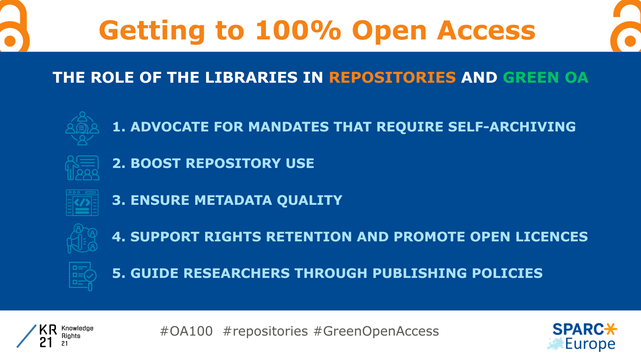
To achieve 100% #OpenAccess, you need to engage with issues on repositories and #GreenOpenAccess route. This is where libraries can support #OA100. 👇
@karlcx I had about 10 years at the helm of a research journal. Quite a time. The first "biggie" I had was making the editorial board realise they actually had an online journal that printed bound volumes, that were only being subscribed to by libraries and dinosaurs, and it was costing us big bucks.
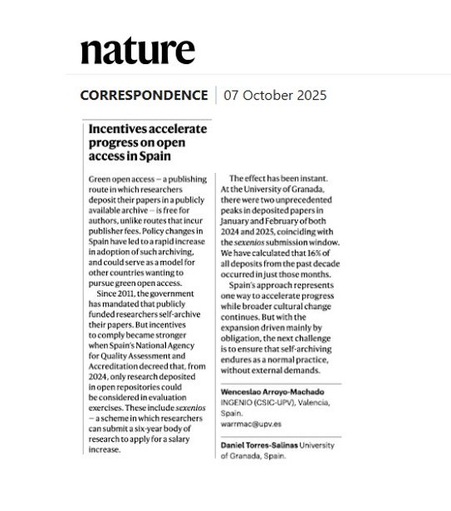
A quick look at how European countries include their #repositories as critical infrastructure in national regulations. This is key to achieving 100% #GreenOpenAccess and ensuring long-term preservation.
🇮🇪 To get #OA100, Ireland's plan makes repositories a central infrastructure. This requires an interoperable network with standardised metadata (like OpenAIRE v.4) for all Irish research outputs to ensure maximum visibility and access. 👉National Plan: https://repository.dri.ie/catalog/ff36jz222
🧵👇 1/2
When should I preprint my work?
People often come up to me and say, “Dermot, do you have the money now?”* But other times they will come up to me and ask “Dermot, when should I preprint my work?” This is a great question, and the general answer is, “whenever it suits you best”. The important thing is that your work is out there, unpaywalled, and accessible to the world. So the specific timing might be more down to individual preferences, journal policies (like time-limited embargos), or some other factors.
But, by and large, there is nothing to stop you preprinting your own work, and at a time of your choosing. There may be exceptions, but they will represent a tiny minority of cases. Here’s a nice introduction to preprinting – that covers motivations and advice for how to get started with preprinting your work.
So when and why do people decide to preprint? Let’s look briefly at different stages of the publication cycle and think why you might want to preprint your work at each point.
At the draft stage?
You can preprint your work before or after your first submission to a journal to get your fully-formed ideas out in the world as soon as possible, with a DOI, and time-stamped confirmation! It provides opportunities for early feedback, increased exposure, and let’s you claim precedence for your ideas.
After a round of reviews?
When you’ve revised a paper, you can preprint what is likely to be an almost final version that you know has had peer feedback. So, it’s still being released well before it appears “in print”, but with the knowledge that you’ve had input from your peers.
When it’s been accepted for publication?
Although later in the publication process, preprinting at this point can still be months before a journal version appears online, so it’s still really worthwhile doing it. And preprinting at this stage perhaps gives authors added confidence, knowing it’s been formally accepted and having gone through a full peer-review process.
Post-publication?
Even if your paper has been published, you can still “Preprint” (or postprint) your non-formatted manuscript version. This has the advantage that your work will remain freely accessible through “green open access”, even if the journal version is behind a paywall. An added bonus is that you don’t have to pay exorbitant fees to a publisher to make your work open access.
I think that more important than when you preprint, is that you do preprint, making your work open and accessible to all. If you’re looking for a place to preprint your work, there are lots of options from very general repositories like Zenodo or OSF Preprints, discipline-specific ones like the PsyArXiv, ArXiV, BodoArXiv, or AgriArXiv (see here for lots more preprint communities), or even region-specific repositories like AfricArXiv. So, if you haven’t preprinted before, make this the year that you do!
Dermot Lynott is an Associate Professor at Maynooth University, and the current chair of the PsyArXiv Scientific Advisory Board.
* I think I originally heard Dylan Moran make this joke, so thank you Dylan!
#greenOpenAccess #openAccess #openResearch #openScience #preprint #publishing

My latest publication, on the benefits of #openscience to researchers in the #humanities
(Ironically, I submitted this to a journal that is not #openaccess by default. LOGOS, the journal of the world publishing community does, however, authorize authors to share their papers immediately in #greenopenaccess via their institutional repository, which I did.)
eine sehr sinnvolle Fortentwicklung der 'Kleinen Schriften': Zweitveröffentlichung der Publikationen als Festgabe. Das freut den Gefeierten und nützt allen anderen.

Attached: 2 images LMU Munich: Florian #Mehltretter opening the database with Gerhard #Regn|s publications on Italian, French and other literatures. Birthday present for Regn’s 80th 🥂 https://discover.ub.uni-muenchen.de/regn
Congratulations to Thomas Beneteau for his in-depth analysis of the #incidence and #duration of #HPV infections in young women using multivariate #Cox regression models with #frailty effects.
This work based on the #PAPCLEAR #cohort in #Montpellier and the #EVOLPROOF project is now published in #InfectiousDiseases.
#DM for a #PDF version until we can opt for #GreenOpenAccess.
 Biblioteques de la UPC
 PsyArXiv Blog
 Per Pippin Aspaas
 Alexander Winkler
 Ecology & Evolution of Health