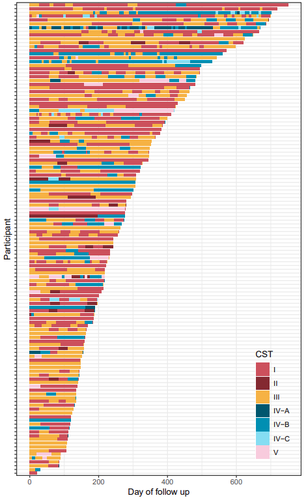
📰 Happy to announce the publication in @PeerCommunityJournal of our analysis of #VaginalMicrobiota dynamics.

🦠 This work provides unprecedented insights into the occurrence of #dysbioses.

Thanks to the #women participating in the #PAPCLEAR study at CHU Montpellier (France) 🙏

The model (all in #RStan) was built by @tsukushi_kamiya and the #16S sequencing of over 2.000 samples was done in Jacques Ravel's lab. This work stems from the @ERC_Research #EVOLPROOF project.

https://peercommunityjournal.org/articles/10.24072/pcjournal.527/

Factors shaping vaginal microbiota long-term community dynamics in young adult women

Heureux d'annoncer la publication dans @PeerCommunityJournal de notre analyse de la dynamique du #MicrobioteVaginal.

Ces travaux sont issus de l'étude #PAPCLEAR promue par le #CHU_Montpellier et financée par l' @ERC_Research, qui représente l'un des suivis les plus longs à ce jour.

Le magnifique modèle statistique (tout en #RStan) a été réalisé par @tsukushi_kamiya et le séquençage #16S de plus de 2000 échantillons réalisé dans le laboratoire de Jacques Ravel.

https://peercommunityjournal.org/articles/10.24072/pcjournal.527/

Factors shaping vaginal microbiota long-term community dynamics in young adult women

Our latest work analysing #vaginal #microbiota dynamics in young adult women in France using the #PAPCLEAR clinical study has been recommended by @rafaelmunoztamayo for @PeerCommunityIn #microbiology!

https://doi.org/10.24072/pci.microbiol.100157

Elucidating microbial community transitions within the human vag...

4 years of clinical study, 4 years of analyses: we are proud to see the results of the #PAPCLEAR study deciphering the #dynamics of #papillomavirus genital infections 🦠 in young women is published in @PLOSBiology

https://doi.org/10.1371/journal.pbio.3002949

A huge 🙏 to the study participants, the clinical staff of the CEGIDD at #CHU_Montpellier 🏥 , the @ERC_Research for funding, and all the @ete and @EcoEvoHealth team in the dry and wet labs! 🔬

@cnrs #UMontpellier #IRD #MIVEGEC #EVOLPROOF #HPV @CirbCdf

Viral and immune dynamics of genital human papillomavirus infections in young women with high temporal resolution

Human papillomavirus (HPV) infections drive one in twenty new cancer cases, with a particular burden on women. This analysis of longitudinal clinical data using kinetics models reveals that HPV infections exhibit a long plateau virus load and that their clearance is associated with specific signals in the host immune response.

Congratulations to Thomas Beneteau for his in-depth analysis of the #incidence and #duration of #HPV infections in young women using multivariate #Cox regression models with #frailty effects.

This work based on the #PAPCLEAR #cohort in #Montpellier and the #EVOLPROOF project is now published in #InfectiousDiseases.

#DM for a #PDF version until we can opt for #GreenOpenAccess.

https://doi.org/10.1080/23744235.2024.2427223

We thank all the #participants of the #PAPCLEAR study for their commitment, and all the staff of the #CEGIDD of #Montpellier for their help! 🙏

This study was supported by @[email protected] #EVOLPROOF, the #ARNS-MIE, @[email protected], and @[email protected] .

https://www.inee.cnrs.fr/fr/cnrsinfo/comparaison-des-profils-immunitaires-entre-coupes-menstruelles-et-tampons

8/N

Comparaison des profils immunitaires entre coupes menstruelles et tampons

Une récente étude clinique sur les infections sexuellement transmissibles chez les jeunes femmes a permis d’étudier des différences entre utilisat

INEE

Building on the #PAPCLEAR cohort, which was promoted by @[email protected] to study #HPV infections, we studied 138 young women and compared two groups: women using mostly #tampons (78%) vs women using mostly #menstrual_cups (22%).

https://doi.org/10.1136/bmjopen-2018-025129

Natural history, dynamics, and ecology of human papillomaviruses in genital infections of young women: protocol of the PAPCLEAR cohort study

Introduction Human papillomaviruses (HPVs) are responsible for one-third of all cancers caused by infections. Most HPV studies focus on chronic infections and cancers, and we know little about the early stages of the infection. Our main objective is to better understand the course and natural history of cervical HPV infections in healthy, unvaccinated and vaccinated, young women, by characterising the dynamics of various infection-related populations (virus, epithelial cells, vaginal microbiota and immune effectors). Another objective is to analyse HPV diversity within hosts, and in the study population, in relation to co-factors (lifestyle characteristics, vaccination status, vaginal microbiota, human genetics). Methods and analysis The PAPCLEAR study is a single center longitudinal study following 150 women, aged 18–25 years, for up to 2 years. Visits occur every 2 or 4 months (depending on HPV status) during which several variables are measured, such as behaviours (via questionnaires), vaginal pH, HPV presence and viral load (via qPCR), local concentrations of cytokines (via MesoScale Discovery technology) and immune cells (via flow cytometry). Additional analyses are outsourced, such as titration of circulating anti-HPV antibodies, vaginal microbiota sequencing (16S and ITS1 loci) and human genotyping. To increase the statistical power of the epidemiological arm of the study, an additional 150 women are screened cross-sectionally. Finally, to maximise the resolution of the time series, participants are asked to perform weekly self-samples at home. Statistical analyses will involve classical tools in epidemiology, genomics and virus kinetics, and will be performed or coordinated by the Centre National de la Recherche Scientifique (CNRS) in Montpellier. Ethics and dissemination This study has been approved by the Comité de Protection des Personnes Sud Méditerranée I (reference number 2016-A00712-49); by the Comité Consultatif sur le Traitement de l’Information en matière de Recherche dans le domaine de la Santé (reference number 16.504); by the Commission Nationale Informatique et Libertés (reference number MMS/ABD/AR1612278, decision number DR-2016–488) and by the Agence Nationale de Sécurité du Médicament et des Produits de Santé (reference 20160072000007). Results will be published in preprint servers, peer-reviewed journals and disseminated through conferences. Trial registration number [NCT02946346][1]; Pre-results. [1]: /lookup/external-ref?link_type=CLINTRIALGOV&access_num=NCT02946346&atom=%2Fbmjopen%2F9%2F6%2Fe025129.atom

BMJ Open

Nous remercions toutes les #participantes de l'étude #PAPCLEAR pour leur engagement, et tout le personnel du #CeGIDD de #Montpellier pour leur aide !

Cette étude a été soutenue par l'#ERC #EVOLPROOF, par l'#ARNS-MIE, le #CNRS et le #CHU de #Montpellier.

https://www.inee.cnrs.fr/fr/cnrsinfo/comparaison-des-profils-immunitaires-entre-coupes-menstruelles-et-tampons

8/N

Comparaison des profils immunitaires entre coupes menstruelles et tampons

Une récente étude clinique sur les infections sexuellement transmissibles chez les jeunes femmes a permis d’étudier des différences entre utilisat

INEE

Grâce à la #cohorte #PAPCLEAR, promue par le #CHU de #Montpellier et conçue pour étudier les infections #HPV, nous avons suivi 138 jeunes femmes et comparé celles utilisant principalement des #tampons (78 %) ou des #coupes menstruelles (22 %).

https://bmjopen.bmj.com/content/9/6/e025129

3/N

Natural history, dynamics, and ecology of human papillomaviruses in genital infections of young women: protocol of the PAPCLEAR cohort study

Introduction Human papillomaviruses (HPVs) are responsible for one-third of all cancers caused by infections. Most HPV studies focus on chronic infections and cancers, and we know little about the early stages of the infection. Our main objective is to better understand the course and natural history of cervical HPV infections in healthy, unvaccinated and vaccinated, young women, by characterising the dynamics of various infection-related populations (virus, epithelial cells, vaginal microbiota and immune effectors). Another objective is to analyse HPV diversity within hosts, and in the study population, in relation to co-factors (lifestyle characteristics, vaccination status, vaginal microbiota, human genetics). Methods and analysis The PAPCLEAR study is a single center longitudinal study following 150 women, aged 18–25 years, for up to 2 years. Visits occur every 2 or 4 months (depending on HPV status) during which several variables are measured, such as behaviours (via questionnaires), vaginal pH, HPV presence and viral load (via qPCR), local concentrations of cytokines (via MesoScale Discovery technology) and immune cells (via flow cytometry). Additional analyses are outsourced, such as titration of circulating anti-HPV antibodies, vaginal microbiota sequencing (16S and ITS1 loci) and human genotyping. To increase the statistical power of the epidemiological arm of the study, an additional 150 women are screened cross-sectionally. Finally, to maximise the resolution of the time series, participants are asked to perform weekly self-samples at home. Statistical analyses will involve classical tools in epidemiology, genomics and virus kinetics, and will be performed or coordinated by the Centre National de la Recherche Scientifique (CNRS) in Montpellier. Ethics and dissemination This study has been approved by the Comité de Protection des Personnes Sud Méditerranée I (reference number 2016-A00712-49); by the Comité Consultatif sur le Traitement de l’Information en matière de Recherche dans le domaine de la Santé (reference number 16.504); by the Commission Nationale Informatique et Libertés (reference number MMS/ABD/AR1612278, decision number DR-2016–488) and by the Agence Nationale de Sécurité du Médicament et des Produits de Santé (reference 20160072000007). Results will be published in preprint servers, peer-reviewed journals and disseminated through conferences. Trial registration number [NCT02946346][1]; Pre-results. [1]: /lookup/external-ref?link_type=CLINTRIALGOV&access_num=NCT02946346&atom=%2Fbmjopen%2F9%2F6%2Fe025129.atom

BMJ Open

We thank all the #participants of the #PAPCLEAR study for their commitment, and all the staff of the #CEGIDD of #Montpellier for their help!

This study was supported by the #ERC #EVOLPROOF, by the #ARNS-MIE, the #CNRS, and the #CHU of #Montpellier.

https://www.inee.cnrs.fr/fr/cnrsinfo/comparaison-des-profils-immunitaires-entre-coupes-menstruelles-et-tampons

8/N

Comparaison des profils immunitaires entre coupes menstruelles et tampons

Une récente étude clinique sur les infections sexuellement transmissibles chez les jeunes femmes a permis d’étudier des différences entre utilisat

INEE