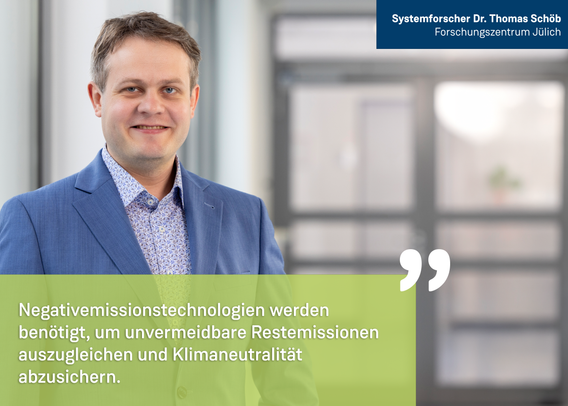
🌍 CO₂ removal must become an integral part of energy research.

Without negative emissions, #ClimateNeutrality will not be achievable. A national research team recommends better system models, clear policy frameworks, and forward-looking CO₂ infrastructure planning.

With input from Jülich researcher Dr. Thomas Schöb of Jülich Systems Analysis (ICE-2).
More: https://www.fz-juelich.de/en/news/archive/announcements/2026/negative-emission-technologies-as-part-of-energy-research

#CDR #EnergyResearch

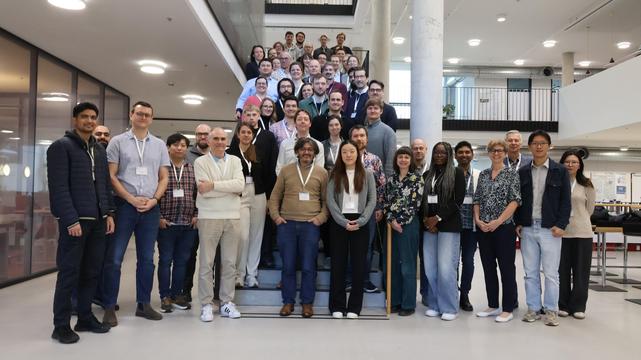
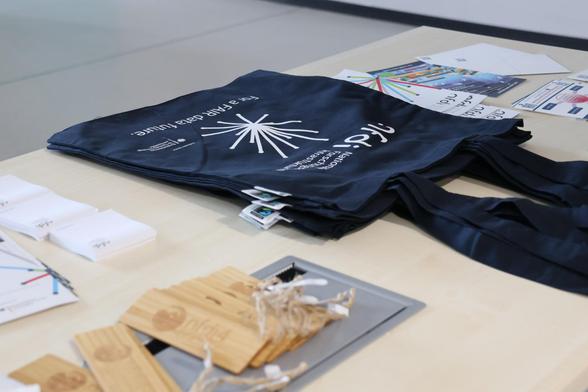
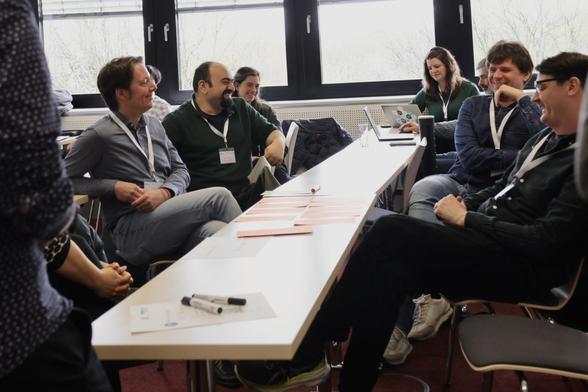
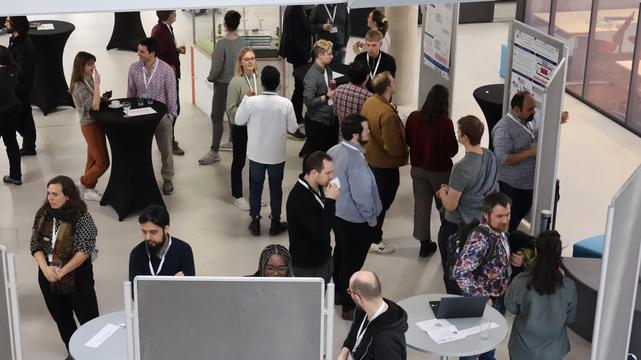
Our 3rd annual NFDI4Energy Conference took place on 24–25 March 2026 in Aachen. 🌱
Thank you to everyone who joined, presented, and contributed, and a special thank you to @rwthaachenuniversity for the wonderful collaboration in hosting the event.

Read the full conference report on our website👇
https://nfdi4energy.uol.de/updates/research-data-management-for-energy-research-in-focus-the-3rd-nfdi4energy-conference-in-aachen/

#NFDI4Energy #RDM #EnergyResearch #FAIR #OpenScience #NFDI #Aachen

447 Terabytes per Square Centimetre at Zero Retention Energy: Non-Volatile Memory at the Atomic Scale on Fluorographane

The memory wall -- the widening gap between processor throughput and memory bandwidth -- has become the defining hardware constraint of the artificial intelligence era, now compounded by a structural NAND flash supply crisis driven by AI demand. We propose a post-transistor, pre-quantum memory architecture built on single-layer fluorographane (CF), in which the bistable covalent orientation of each fluorine atom relative to the sp3-hybridized carbon scaffold constitutes an intrinsic, radiation-hard binary degree of freedom. The C-F inversion barrier of ~4.6 eV (B3LYP-D3BJ/def2-TZVP, this work; verified transition state with one imaginary frequency; confirmed at 4.8 eV by DLPNO-CCSD(T)/def2-TZVP; rigorous lower bound from the fluorophenalane molecular model) yields a thermal bit-flip rate of ~10^{-65} s^{-1} and a quantum tunneling rate of ~10^{-76} s^{-1} at 300 K, simultaneously eliminating both spontaneous bit-loss mechanisms. The barrier lies below the C-F bond dissociation energy (5.6 eV) at both levels of theory, so the covalent bond remains intact throughout the inversion. A single 1 cm^2 sheet encodes 447 TB of non-volatile information at zero retention energy. Volumetric nanotape architectures extend this to 0.4-9 ZB/cm^3. We present a tiered read-write architecture progressing from scanning-probe validation (Tier 1, achievable with existing instrumentation) through near-field mid-infrared arrays (Tier 2) to a dual-face parallel configuration governed by a central controller, with a projected aggregate throughput of 25 PB/s at full Tier 2 array scale. A scanning-probe prototype already constitutes a functional non-volatile memory device with areal density exceeding all existing technologies by more than five orders of magnitude.

Zenodo

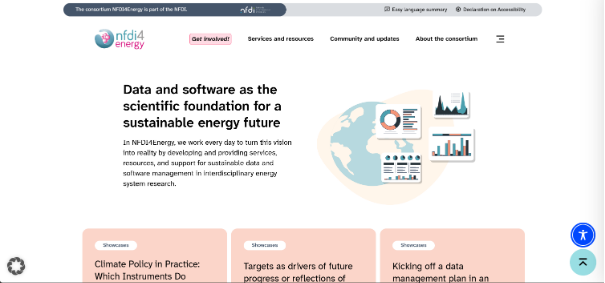
The NFDI4Energy website has been relaunched 🚀

Our website has been redesigned and restructured to provide a clearer structure, improved usability, and updated content.

Visit the website and explore involvement opportunities, our service portfolio, helpful resources, our partner network, updates from the consortium, and much more: https://nfdi4energy.uol.de/

#NFDI #NFDI4Energy #RDM #EnergyResearch

📚 Approaching ITER for the first time naturally raises substantial questions.
As a flagship fusion experiment, it challenges our assumptions about confinement, scaling and long-term feasibility. ⚡🌍
The ITER team’s FAQ provides a well-structured overview of purpose, progress and scientific context:
https://www.iter.org/faqs

#ITER #Fusion #Physics #EnergyResearch