We’re pleased to present our latest work at HICSS 58 in Waikoloa, Hawaii this January. Our study explores the use of LLMs for supporting collaborative ideation. Results from our randomized experiment suggest that LLMs can be used to strengthen anonymity by rephrasing the contributions of the users. However, AI-generated ideas suggestions did not influence significantly the innovativeness of the participants.

🔗 https://infoscience.epfl.ch/handle/20.500.14299/241341

#research #hci #cscw #cscl #ideation #design #designthinking

Fostering Innovation with Generative AI: A Study on Human-AI Collaborative Ideation and User Anonymity

Collaborative ideation is a key aspect of many innovation processes. However, a lack of proper support can hinder the process and limit the ability of participants to generate innovative ideas. Thus, we introduce AI-deation, a digital environment for collaborative ideation. At the heart of the system is an AI collaborator powered by Generative Artificial Intelligence that participates in the ideation process by automatically suggesting new ideas. Moreover, the submitted ideas are processed by a Large Language Model, acting as an idea editor. It strengthens the anonymity of the contributions to alleviate fears of judgment. We studied this system in a randomized experiment where groups solved complex problems in two conditions: humans only and humans supported by an AI collaborator. Results show that the idea editor effectively strengthened the participants' anonymity. Despite being more innovative, the AI collaborator did not significantly influence the participants' innovativeness.

New article out today! 🎉
Speech analysis of teaching assistant interventions in small group collaborative problem solving with undergraduate engineering students
It's open access! It's going to be part of a special issue on multi-modal learning analytics. Co-authored with one of my students who is about to graduate.
https://doi.org/10.1111/bjet.13449
#learninganalytics #mmla #educationresearch #collaboration #cscl

Greetings everyone,
I have been on this network for quite some time already and I would like to start taking part in the conversation.

Thus, a short #introduction is in order. I am a Ph.D. student in learning sciences @epfl. My research focuses on computer-supported collaborative learning for systems and design thinking. #cscl #designthinking #systemsthinking

I plan to use this account mainly to discuss research in these fields. Toots will be mostly in English, occasionally in French.

Learn more about our work in the paper: https://arxiv.org/abs/2306.10763 📄

#arxiv #cscl #cl #ai

Guiding Language Models of Code with Global Context using Monitors

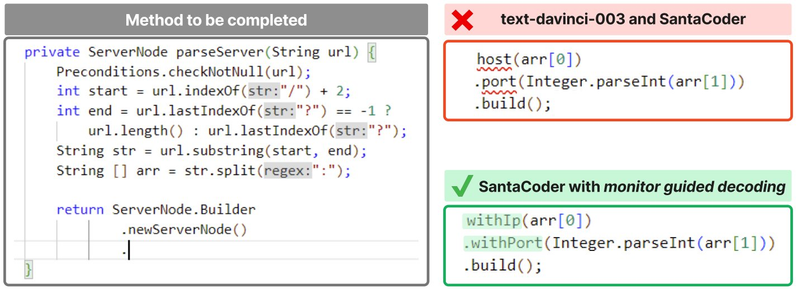
Language models of code (LMs) work well when the surrounding code provides sufficient context. This is not true when it becomes necessary to use types, functionality or APIs defined elsewhere in the repository or a linked library, especially those not seen during training. LMs suffer from limited awareness of such global context and end up hallucinating. Integrated development environments (IDEs) assist developers in understanding repository context using static analysis. We extend this assistance, enjoyed by developers, to LMs. We propose monitor-guided decoding (MGD) where a monitor uses static analysis to guide the decoding. We construct a repository-level dataset PragmaticCode for method-completion in Java and evaluate MGD on it. On models of varying parameter scale, by monitoring for type-consistent object dereferences, MGD consistently improves compilation rates and agreement with ground truth. Further, LMs with fewer parameters, when augmented with MGD, can outperform larger LMs. With MGD, SantaCoder-1.1B achieves better compilation rate and next-identifier match than the much larger text-davinci-003 model. We also conduct a generalizability study to evaluate the ability of MGD to generalize to multiple programming languages (Java, C# and Rust), coding scenarios (e.g., correct number of arguments to method calls), and to enforce richer semantic constraints (e.g., stateful API protocols). Our data and implementation are available at https://github.com/microsoft/monitors4codegen .

arXiv.org

Hey!

Happy for my first toot to be about work on combining static analysis with Language Models (LLMs) to reduce hallucinations in generated code

A thread:
LLMs often hallucinate incorrect names, especially in private codebases.
We introduce Monitor-Guided Decoding (MGD)-guide LMs to generate compilable code with correct symbol names more reliably!

Work w/ Aditya Kanade, Navin Goyal, Shuvendu Lahiri and Sriram Rajamani at Microsoft Research

Paper: https://arxiv.org/abs/2306.10763
#arxiv #cscl #cl #ai

Guiding Language Models of Code with Global Context using Monitors

Language models of code (LMs) work well when the surrounding code provides sufficient context. This is not true when it becomes necessary to use types, functionality or APIs defined elsewhere in the repository or a linked library, especially those not seen during training. LMs suffer from limited awareness of such global context and end up hallucinating. Integrated development environments (IDEs) assist developers in understanding repository context using static analysis. We extend this assistance, enjoyed by developers, to LMs. We propose monitor-guided decoding (MGD) where a monitor uses static analysis to guide the decoding. We construct a repository-level dataset PragmaticCode for method-completion in Java and evaluate MGD on it. On models of varying parameter scale, by monitoring for type-consistent object dereferences, MGD consistently improves compilation rates and agreement with ground truth. Further, LMs with fewer parameters, when augmented with MGD, can outperform larger LMs. With MGD, SantaCoder-1.1B achieves better compilation rate and next-identifier match than the much larger text-davinci-003 model. We also conduct a generalizability study to evaluate the ability of MGD to generalize to multiple programming languages (Java, C# and Rust), coding scenarios (e.g., correct number of arguments to method calls), and to enforce richer semantic constraints (e.g., stateful API protocols). Our data and implementation are available at https://github.com/microsoft/monitors4codegen .

arXiv.org

#introduction I have been wanting an alternative to Twitter for a long time, but this seems to be the time.

Live in Norway, did a PhD in computer supported collaborative learning #cscl #education, very interested in #pkm. Currently work at tana.inc.

Have done some experiments with Twitter API before, but it was very restrictive. Very curious if anyone are experimenting with ActivityPub for alternative interfaces, community sense making, integration with PKM etc. Let's chat!

Mise à jour d'un tutoriel pour analyser automatiquement les contributions de participants à des discussions (forums, focus groups, etc.) réalisé avec Nadine Mandran (#LIG-UGA) https://inspe-sciedu.gricad-pages.univ-grenoble-alpes.fr/rech-educ/tuto-rb-conpa.html #NLP #TAL #CSCL
Tutoriel – Utiliser ReaderBench pour analyser automatiquement des discussions — Recherche en éducation, Inspé, Univ. Grenoble Alpes

Games for CS Education: Computer-Supported Collaborative Learning and Multiplayer Games
(2010) : Nickel, Andrea and Barnes, Tiffany
isbn: 9781605589374
#CSCL #CSCW #education #games #multi_player #online #pair_programming #preference #programming
#my_bibtex