Strengthening open access infrastructure together: “PKP Open Journal Systems Germany 2026–2028” launched with 14 German academic institutions

diesen Beitrag auf Deutsch lesen

In January 2026, the new consortium “PKP Open Journal Systems Deutschland 2026–2028” has been launched. 14 institutions from Germany have jointly declared their support for the Public Knowledge Project (PKP) and committed to membership fees for the next three years. In this way, they are contributing to the sustainable and joint financing of relevant open-access infrastructure.

In autumn 2025, PKP and TIB called on academic organisations in Germany to join this initiative. Open Journal Systems (OJS)is the world’s most widely used software for scholarly publishing. It is an essential prerequisite for numerous academia-owned publishing services in Germany and thus enables a very large number of diamond open access publications. The consortium’s goal is to secure the development of this software and other relevant activities of PKP.

The following institutions have declared their membership at the outset:

  • BIS – Bibliotheks- und Informationssystem der Universität Oldenburg
  • Hochschulbibliothekszentrum des Landes NRW
  • Humboldt-Universität zu Berlin – Universitätsbibliothek
  • Technische Informationsbibliothek (TIB). Leibniz-Informationszentrum Technik und Naturwissenschaften und Universitätsbibliothek
  • Universität Heidelberg – Universitätsbibliothek
  • Universität Konstanz, Kommunikations-, Informations-, Medienzentrum (KIM) IT- und Bibliotheksdienste
  • Universitäts- und Stadtbibliothek Köln
  • Universitätsbibliothek Braunschweig
  • Universitätsbibliothek Clausthal
  • Universitätsbibliothek der Technischen Universität Berlin
  • Universitätsbibliothek Koblenz
  • Universitätsbibliothek Leipzig
  • Universitätsbibliothek Mannheim
  • Universitätsbibliothek Potsdam

All participating institutions become PKP members and can contribute to the PKP community and discussions. TIB organised the agreement, takes care of providing regular information to the consortium members, and enables German institutions to pay their contributions to TIB in a stable amount and in EUR.

In the current discussions about open access infrastructures, there are many calls for the operation of scholar-led, academia-owned publishing services. At the same time, there are few approaches for broadly supported and thus more secure financing of such infrastructure. With the new consortium, we are creating a good opportunity for institutions to provide support as easily as possible. It is still possible to join the consortium. We look forward to welcoming new members.

We would like to thank PKP and all members of this new consortium. Our joint efforts not only benefit our own institutions, but also help open access publishing throughout Germany and internationally. In this way, it also contributes to improving the supply of information to German academic institutions.

See PKP’s post here: https://pkp.sfu.ca/news/

#diamondOpenAccess #consortia #OJS #PKP #TIBConsortia #OpenInfrastructure #Funding #OpenAccess #LizenzCCBY40INT

Strengthening open scholarly infrastructure: PKP Open Journal Systems Deutschland 2026–2028

diesen Beitrag auf Deutsch lesen

Building on TIB’s longstanding relationship with the Public Knowledge Project (PKP), a new consortium has been established to support PKP’s mission: collaborating with a global community to develop research-informed, free and open-source software, and to enhance the quality, diversity, and accessibility of scholarly publishing. TIB and PKP are asking academic organisations from Germany to become members of this consortium.

Sustaining OJS together by becoming a PKP member

Open Journal Systems (OJS) is the most widely used open infrastructure for scholarly publishing worldwide. Its development remains core to the Public Knowledge Project’s (PKP) activities. Being a free and open source software and research project, PKP enables open-access publishing without any license costs and is not dependent on commercial publishers.

Even free software needs reliable support. With the backing of a large and active community, PKP maintains and continuously develops the software. A stable financial basis enables PKP to continue this essential work.

PKP is financially supported by institutional members–universities and other organisations that contribute an annual membership fee. A new consortium, PKP Open Journal Systems Deutschland 2026–2028, has been established to enable easier memberships for Germany’s academic institutions.

A national consortium supporting an international open infrastructure

This new initiative is now open to all publicly funded German universities and research institutions. Through the consortium, organisations can become PKP members via a German infrastructure–in Euros, with clear processes and minimal administrative effort. TIB then forwards the membership fees to PKP. Together with contributions from members around the world, this support flows into PKP’s work and enables further development of OJS and the rest of PKP’s software suite (i.e., OMP and OPS).

This consortium is a strong example of the benefits that come from PKP’s distributed yet interconnected network of journals, institutions, and communities. TIB is ideally positioned to lead this effort, not only as a longtime user of the PKP software suite, but also thanks to its extensive experience managing and coordinating consortial agreements.

Why joining the consortium makes sense

  • Ensuring long-term sustainability: Your contribution to PKP helps guarantee the ongoing development of OJS, OMP, and OPS, thus safeguarding an important open access infrastructure. More than half of all Diamond Open Access journals use OJS. By supporting PKP, you help sustain a system that provides free, high-quality scholarship to researchers.
  • Investing in cost-efficient and fiscally responsible infrastructure: Your institution already benefits from OJS being freely available. If you host OJS—e.g., for university publishing activities—you do not have to pay any license fees. Your researchers publish in OJS-driven journals across the globe, almost all of which do not charge any fees partly because they themselves do not pay any licence fees.
  • PKP membership: Your institution will become a PKP member in its own right and will have full membership benefits. Your membership will be acknowledged on the PKP website.
  • Simple route to membership: By joining the consortium, you can easily become a PKP member through a German membership model. TIB will be prepared to help with your questions.
  • Stable costs in euros: Membership fees are charged by TIB in euros, not Canadian dollars, and remain for the full duration of the agreement (2026–2028)
  • Information and networking: You will receive information about PKP activities and can participate in member and community events. TIB will organise an annual consortium meeting to coordinate community needs and provide updates on PKP developments, typically with participation of PKP representatives. Consortium members will also receive regular digital updates on current PKP activities, including software development.

Sharing responsibility

PKP software and services are a central and crucial element of the German and international open access landscape. Open Journal Systems accounts for the huge majority of all Diamond Open Access journals. Without broad participation from institutions that benefit from OJS, its continued development is unnecessarily at risk. The German consortium offers a clear and practical way to take shared responsibility—with visible benefits for all participating organisations.

Information on joining

The consortium is interested in gaining as many publicly funded academic institutions from Germany as possible as members. If you are interested in participating, please submit your details using this form:

Interest in participating in the consortium PKP Open Journal Systems Deutschland 2026–2028

#PKP #TIBConsortia #OpenInfrastructure #OpenAccess #Funding #diamondOpenAccess #consortia #OJS

Diamond Funding Navigator: A new TIB service that strengthens Diamond Open Access

diesen Beitrag auf Deutsch lesen

A new TIB service facilitates the financing of Diamond Open Access: The Diamond Funding Navigator, now available as a beta version, compiles information on offers for the consortial financing of Diamond Open Access publications worldwide. This helps improve the visibility of these offers and makes it easier for academic institutions to decide which offerings they would like to support.

Diamond Open Access collectively financed

The consortium model, which has been tried and tested in the library sector for many years, has proven to be successful for the financing of publications that appear according to the Diamond Open Access model. Here, academic institutions join forces to jointly finance the operating costs of a publication, such as a journal, over a certain period of time with comparatively small, individual contributions. The journal can thus be published without financial hurdles such as article processing charges (APC) or subscription fees. Since 2021, for example, 13 journals and two book series have already been financed using this model over a period of three years via KOALA consortia at the TIB.

Diamond Funding Navigator – a brief introduction

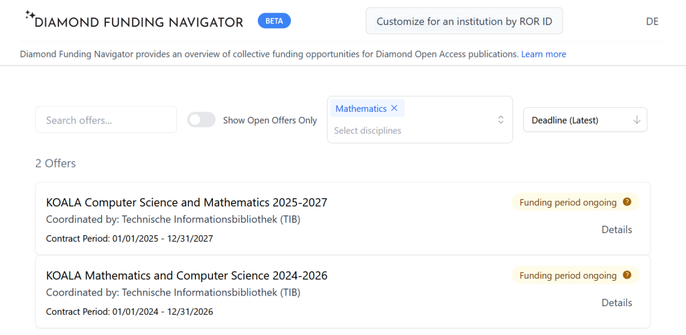
To support these initiatives, the TIB has developed the Diamond Funding Navigator, the beta version of which is now available to the public. Diamond Funding Navigator is a web service that provides a range of information on each offer: Basic information (such as name, contact information), publications included (name, ISSN, website), details on funding participation, the so-called pledging (deadlines, contract duration, institutions eligible to participate) and explanatory information (e.g. on the discplinary focus of the offer). The result is a comprehensive directory of current and past offers that can be searched, filtered and sorted. The interface is available in English and German.

Screenshot of the Diamond Funding Navigator. Overview of the offers with filtering and sorting options.

Institutional customization: Publication output via OpenAlex

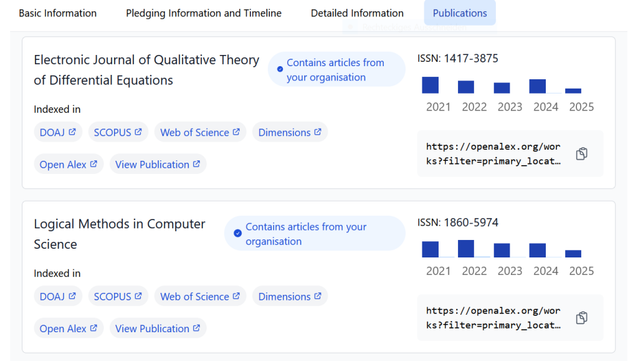
Institutions interested in learning more about funding opportunities can customize the Diamond Funding Navigator: After entering an ROR ID, institution-specific publication metrics are displayed. This provides an at-a-glance view of how many publications from a specific institution have appeared in the journals within an offer over the past five years. These figures are displayed graphically so that the ratio to the total number of articles published in the journals in this period is easily comprehensible. The publication metrics are retrieved from OpenAlex. They are available for all journals for which current publication data is available in OpenAlex.

Screenshot of the Diamond Funding Navigator. Details view of an offer with institution-specific and total publication data of the journals included.

Where does the data on the consortium offers come from?

The data on consortium offers contained in the Diamond Funding Navigator must be entered and kept up to date in the event of changes. This can be done by those responsible for the offers themselves. For this purpose, they receive access to the backend of the Diamond Funding Navigator from TIB and can then enter and save all information on their offer via a simple input mask. After a formal check of the submitted data by TIB, the entry is published. If necessary, changes can also be made in the backend after logging in, for example if the deadline of the pledging phase is extended.

A variety of offers, one point of contact

The question of financing is one of the biggest hurdles that Diamond Open Access publications have to overcome (see OA Diamond Journals Study, Part 1). While we are still a long way from a broadly effective funding mechanism for Diamond Open Access publications, it can be assumed that consortial models will become more established. Already, institutions are adopting the KOALA model (KOALA-SLUB). Third-party funded projects such as edu_consort_oa and OLEconsort are also pursuing this path. An international example is the OACIP program of the North American consortium LYRASIS. However, these offerings are decentralized and scattered; a simple overview was previously lacking – a gap that the Diamond Funding Navigator now fills.

We invite you to use the Diamond Funding Navigator: Learn about consortial offerings for Diamond Open Access publications. Send us information about consortial offerings you coordinate. Give us feedback or contact us with questions at: diafund@tib.eu

#consortia #DiamondFundingNavigator #diamondOpenAccess #financingOfOpenAccess #LizenzCCBY40INT #transitionToOpenAccess

Bon, heu, faut avouer que c'est quand même **beaucoup** plus simple chez nos voisins allemand (en tout cas, dans la présentation, l'architecture) : https://www.nfdi.de/consortia/?lang=en
#researchdata #infrastructures #consortia #RDM #data #nfdi
Consortia | NFDI

#Libraries #publishers & others in #ScholComm: We’re seeking volunteers for the third cohort of working groups for the CCLIP! This group will focus on #Consortia & consortial best practices & workflows related to cooperative collections: https://niso.org/niso-io/2024/06/call-participation-niso-cclip-consortia-working-group
Call for Participation for NISO CCLIP Consortia Working Group | NISO website

Reminder: We’re seeking volunteers for the third cohort of working groups for the CCLIP! This group will focus on #Consortia & consortial best practices & workflows related to cooperative collections. More info: https://niso.org/niso-io/2024/06/call-participation-niso-cclip-consortia-working-group #libraries #publishers #ScholComm
Call for Participation for NISO CCLIP Consortia Working Group | NISO website

🆕 Latest Policy Brief from the #PROMICON project consortium added to the #EUproject's own collection!

🧐 Note how at #PROMICON the team made use the opportunities we offer to #project #consortia to share major outputs as they are!

👉 Check out the full PolicyBrief at: https://doi.org/10.3897/arphapreprints.e121032

👉 Explore the PROMICON project outcomes collection at our journal: https://doi.org/10.3897/rio.coll.239

#openscience #horizoneu #scicomm

Strengthening the 2018 EU Bioeconomy Strategy through Microbiome Analysis and Synthetic Microbial Consortia Technologies

The 2018 EU Bioeconomy Strategy aims to create a sustainable, circular, and low-emissions economy, based on the use of renewable biological resources. The strategy focuses on the development of new biobased products and markets, the promotion of sustainable and efficient use of resources, and the support of research, innovation, and skills development in the bioeconomy sector. The main objectives of the strategy are to: - Accelerate the deployment of bio-based products and services to reduce Europe’s dependence on fossil fuels and promote the transition to a circular economy; - Optimise the use of renewable biological resources to ensure food security, while also protecting the environment and biodiversity; - Promote sustainable and efficient use of natural resources, reduce waste, and minimize greenhouse gas emissions; - Develop innovative, sustainable, and competitive bio-based industries and value chains that create jobs and support economic growth, particularly in rural areas; - Support research, innovation, and skills development in the bioeconomy sector to drive technological advancements, enhance the competitiveness of the EU’s bio-based industries, and address societal challenges such as climate change, food security, and public health. The EU Horizon 2020 PROMICON project is a pioneering initiative that directly addresses the objectives of the 2018 EU Bioeconomy Strategy. By focusing on the production of biopolymers, energy carriers, feedstocks, and antimicrobial molecules from natural microbiomes, the project is promoting the sustainable production and use of renewable biological resources while also supporting research and innovation in the bioeconomy sector.

ARPHA Preprints
How leafcutter ants cultivate a fungal garden to degrade plants could provide insights into future biofuels

Scientists have spent decades finding ways to efficiently and affordably degrade plant materials so that they can be converted into useful bioproducts that benefit everyday life.

Phys.org
DistriQ and France’s iXcampus Sign Agreement to Facilitate Quantum Talent and Entrepreneurship https://thequantuminsider.com/?p=2356107 #Quantum_Computing_Business #Canada #Clara_DolyTacconi #consortia #DistriQ #DistriQ_–_Quantum_Innovation_Zone #france #innovation #iXcampus #Quantum_Innovation_Zon #Quebec #Richard_StPierre #startups #quantumdaily Insider Brief Canadian-based DistriQ – Quantum Innovation Zone, and French-based iXcampus to collaborate on an initiatives to detect, support and nur
DistriQ and France's iXcampus Sign Agreement to Facilitate Quantum Talent and Entrepreneurship

Canadian-based DistriQ and iXcampus to collaborate on an initiatives to support and nurture talent and entrepreneurs in the quantum field.

The Quantum Insider