 Anita Eppelin
Diamond Funding Navigator: A new TIB service that strengthens Diamond Open Access
diesen Beitrag auf Deutsch lesen
A new TIB service facilitates the financing of Diamond Open Access: The Diamond Funding Navigator, now available as a beta version, compiles information on offers for the consortial financing of Diamond Open Access publications worldwide. This helps improve the visibility of these offers and makes it easier for academic institutions to decide which offerings they would like to support.
Diamond Open Access collectively financed
The consortium model, which has been tried and tested in the library sector for many years, has proven to be successful for the financing of publications that appear according to the Diamond Open Access model. Here, academic institutions join forces to jointly finance the operating costs of a publication, such as a journal, over a certain period of time with comparatively small, individual contributions. The journal can thus be published without financial hurdles such as article processing charges (APC) or subscription fees. Since 2021, for example, 13 journals and two book series have already been financed using this model over a period of three years via KOALA consortia at the TIB.
Diamond Funding Navigator – a brief introduction
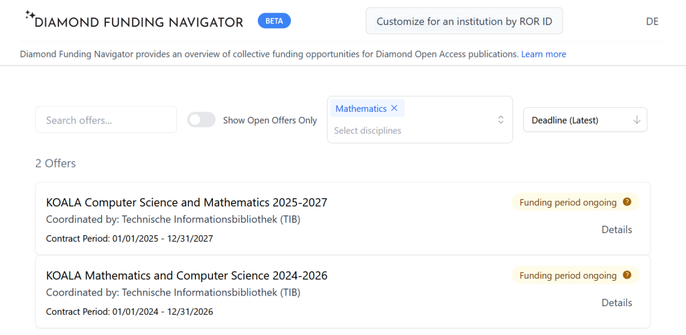
To support these initiatives, the TIB has developed the Diamond Funding Navigator, the beta version of which is now available to the public. Diamond Funding Navigator is a web service that provides a range of information on each offer: Basic information (such as name, contact information), publications included (name, ISSN, website), details on funding participation, the so-called pledging (deadlines, contract duration, institutions eligible to participate) and explanatory information (e.g. on the discplinary focus of the offer). The result is a comprehensive directory of current and past offers that can be searched, filtered and sorted. The interface is available in English and German.
Screenshot of the Diamond Funding Navigator. Overview of the offers with filtering and sorting options.Institutional customization: Publication output via OpenAlex
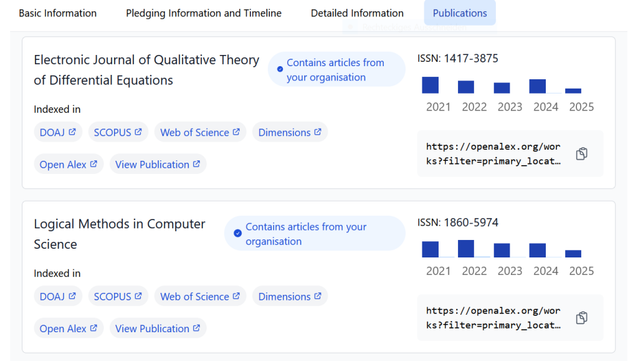
Institutions interested in learning more about funding opportunities can customize the Diamond Funding Navigator: After entering an ROR ID, institution-specific publication metrics are displayed. This provides an at-a-glance view of how many publications from a specific institution have appeared in the journals within an offer over the past five years. These figures are displayed graphically so that the ratio to the total number of articles published in the journals in this period is easily comprehensible. The publication metrics are retrieved from OpenAlex. They are available for all journals for which current publication data is available in OpenAlex.
Screenshot of the Diamond Funding Navigator. Details view of an offer with institution-specific and total publication data of the journals included.Where does the data on the consortium offers come from?
The data on consortium offers contained in the Diamond Funding Navigator must be entered and kept up to date in the event of changes. This can be done by those responsible for the offers themselves. For this purpose, they receive access to the backend of the Diamond Funding Navigator from TIB and can then enter and save all information on their offer via a simple input mask. After a formal check of the submitted data by TIB, the entry is published. If necessary, changes can also be made in the backend after logging in, for example if the deadline of the pledging phase is extended.
A variety of offers, one point of contact
The question of financing is one of the biggest hurdles that Diamond Open Access publications have to overcome (see OA Diamond Journals Study, Part 1). While we are still a long way from a broadly effective funding mechanism for Diamond Open Access publications, it can be assumed that consortial models will become more established. Already, institutions are adopting the KOALA model (KOALA-SLUB). Third-party funded projects such as edu_consort_oa and OLEconsort are also pursuing this path. An international example is the OACIP program of the North American consortium LYRASIS. However, these offerings are decentralized and scattered; a simple overview was previously lacking – a gap that the Diamond Funding Navigator now fills.
We invite you to use the Diamond Funding Navigator: Learn about consortial offerings for Diamond Open Access publications. Send us information about consortial offerings you coordinate. Give us feedback or contact us with questions at: [email protected]
#consortia #DiamondFundingNavigator #diamondOpenAccess #financingOfOpenAccess #LizenzCCBY40INT #transitionToOpenAccess