Using our #openscience #publishing solution designed for #project consortia & our integration with #ARPHA #Preprints, the #PROMICON #Horizon2020 project team added their Policy Brief to their project-branded collection!
🔗 Policy Brief: https://doi.org/10.3897/arphapreprints.e158692.
📚 Collection: https://doi.org/10.3897/rio.coll.239.

Designing Microbial Communities For Enhanced Biohydrogen Production
Phototrophic microbial communities – groups of tiny organisms whose energy for growth comes from light – play a significant role in global primary production by absorbing carbon dioxide and nitrogen gas. With the growing challenges of energy demands and environmental concerns, researchers are exploring scientifically designed (synthetic) phototrophic communities as a promising alternative to traditional energy generation methods. These consortia can efficiently convert CO₂ and N₂ gases, along with water and solar energy, into bioenergy products, offering a potential solution to today’s energy and sustainability problems.In this context, the development of synthetic phototrophic communities has attracted increased attention due to their ability to divide tasks among different species, allowing them to function more efficiently and remain stable. However, challenges remain, particularly in maintaining balance among strains and ensuring stable performance in environments that do not replicate the complex natural conditions in which these consortia typically thrive.To address these challenges, recent PROMICON studies have focused on how cyanobacteria interact with purple nonsulfur bacteria (PNSB). These bacteria, including Rhodopseudomonas palustris (R. palustris), have shown potential in producing biohydrogen and lipids by capturing nitrogen in oxygen-free environments. Nevertheless, a key limitation is that they need a carbon-based food source (e.g., acetate) to produce energy. A promising approach to overcome this issue involves growing R. palustris with cyanobacteria, which can pull carbon dioxide from the air and turn it into the organic carbon that R. palustris needs to thrive.
💡 Innovative method uses #cyanobacteria to naturally produce 100% #biodegradable #plastics overcoming issues with scalability & #microplastic residues.
📃 Policy Brief: https://doi.org/10.3897/arphapreprints.e147255, published in the #openscience project collection by the #PROMICON #Horizon2020 consortium.
👉 Explore the collection at: https://doi.org/10.3897/rio.coll.239.
👌 So far, it presents a total of 17 project outputs, i.e. 12 research papers published in different journals, project reports, policy briefs & preprints.
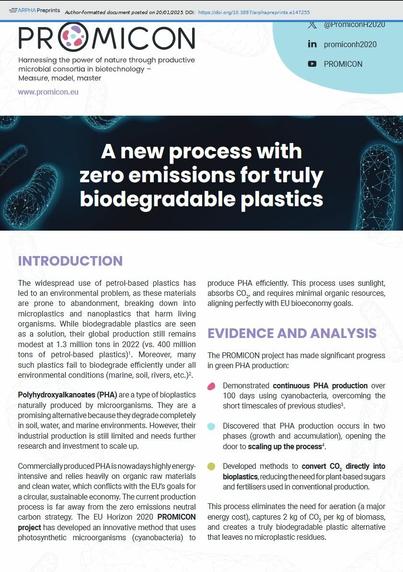
A new process with zero emissions for truly biodegradable plastics
The widespread use of petrol-based plastics has led to an environmental problem, as these materials are prone to abandonment, breaking down into microplastics and nanoplastics that harm living organisms. While biodegradable plastics are seen as a solution, their global production still remains modest at 1.3 million tons in 2022 (vs. 400 million tons of petrol-based plastics). Moreover, many such plastics fail to biodegrade efficiently under all environmental conditions (marine, soil, rivers, etc.). Polyhydroxyalkanoates (PHA) are a type of bioplastics naturally produced by microorganisms. They are a promising alternative because they degrade completely in soil, water, and marine environments. However, their industrial production is still limited and needs further research and investment to scale up.Commercially produced PHA is nowadays highly energy-intensive and relies heavily on organic raw materials and clean water, which conflicts with the EU’s goals for a circular, sustainable economy. The current production process is far away from the zero emissions neutral carbon strategy. The EU Horizon 2020 PROMICON project has developed an innovative method that uses photosynthetic microorganisms (cyanobacteria) to produce PHA efficiently. This process uses sunlight, absorbs CO2, and requires minimal organic resources, aligning perfectly with EU bioeconomy goals.
🆕 Latest Policy Brief from the #PROMICON project consortium added to the #EUproject's own collection!
🧐 Note how at #PROMICON the team made use the opportunities we offer to #project #consortia to share major outputs as they are!
👉 Check out the full PolicyBrief at: https://doi.org/10.3897/arphapreprints.e121032
👉 Explore the PROMICON project outcomes collection at our journal: https://doi.org/10.3897/rio.coll.239
#openscience #horizoneu #scicomm
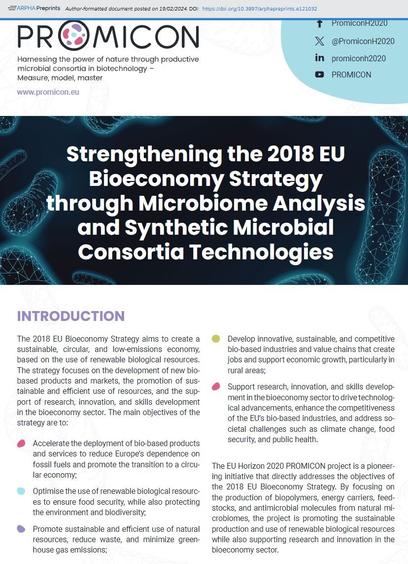
Strengthening the 2018 EU Bioeconomy Strategy through Microbiome Analysis and Synthetic Microbial Consortia Technologies
The 2018 EU Bioeconomy Strategy aims to create a sustainable, circular, and low-emissions economy, based on the use of renewable biological resources. The strategy focuses on the development of new biobased products and markets, the promotion of sustainable and efficient use of resources, and the support of research, innovation, and skills development in the bioeconomy sector. The main objectives of the strategy are to: - Accelerate the deployment of bio-based products and services to reduce Europe’s dependence on fossil fuels and promote the transition to a circular economy; - Optimise the use of renewable biological resources to ensure food security, while also protecting the environment and biodiversity; - Promote sustainable and efficient use of natural resources, reduce waste, and minimize greenhouse gas emissions; - Develop innovative, sustainable, and competitive bio-based industries and value chains that create jobs and support economic growth, particularly in rural areas; - Support research, innovation, and skills development in the bioeconomy sector to drive technological advancements, enhance the competitiveness of the EU’s bio-based industries, and address societal challenges such as climate change, food security, and public health. The EU Horizon 2020 PROMICON project is a pioneering initiative that directly addresses the objectives of the 2018 EU Bioeconomy Strategy. By focusing on the production of biopolymers, energy carriers, feedstocks, and antimicrobial molecules from natural microbiomes, the project is promoting the sustainable production and use of renewable biological resources while also supporting research and innovation in the bioeconomy sector.
 RIO Journal