@Snoro
Maybe that's what the article set out to say, and I admit I only skimmed it, but I didn't feel like either the article or the underlying research paper went to this question in any real detail.
As far as I could tell, and I might be very wrong here, but I'm saying this out loud so that someone who knows better can correct me if they want to, and maybe I'll learn something: the paper is full of stuff that sounds to me like saying we worked through a lot of differential equation modeling and it is what it is. They seem to be saying there was a diminished probability going forward, but that they weren't sure how to qualitatively assess what was causing the problem. There was a lot of general stuff about stay the course and keep working on this stuff even though we can't prove anything.
Personally, and I am neither a physicist nor mathematician, so take that into account, it seems to me that it comes down to this (which career experts are also welcome to correct if they'd like):
Global warming introduces energy into the system, but not uniformly because they are different issues of reflectivity and atmospheric composition at each point, and because albedo is causing differential buffering. So you get a lot of swirling, which is chaotic and probabilistic, but not entirely random at the macro level. Clearly the oceans are absorbing a lot of heat wear land masses are not. And so the net effect is differential heating in different places, and an overall upward global trend, but quite a lot of difference in detail. Mathematically, to have an average, you have to have a lot of stuff on one side and a lot of stuff on the other side, assuming you don't have uniform sameness, so it's mathematically impossible to see anomalies like the arctic the 20 or 30°C above normal without something being substantially below normal unless the average goes up by that same 20 or 30, which it has not.
So it seems inevitable to me that until/unless it all sames out, super high temperatures have to be matched by super low ones. And it makes sense that the division of labor is that the oceans, which have been doing us the favor of absorbing a truckload of heat, are going to have the biggest temperature anomalies, and land masses have to take up the mathematical slack. Presumably, and I'm just guessing, anything from bodies of water like lakes, to reflective surfaces like deserts or glaciers, to mountains that create deflections in wind flow, etc. create the chaotic impediments to everything just leveling out. But mostly there's going to be an excess of heat over water and statistically increasing but still less in absolute terms over land.
The heat thing seems to be accelerating so much that a differential may not matter so much going forward too far. But for now it seems unsurprising.
Anyway I could be wrong in all of this, but if so I would appreciate a climate scientist saying where. The real reason that I'm saying this, though, is to illustrate the level at which I wish climate scientists would talk. I get why mathematical modeling is complex, but regular people can't do anything with that information. It needs to be translated into something that is within reach of ordinary people to understand. So if not these specific words, words of this kind would be helpful.
At least in the form I've described it, there's no paradox at all to be resolved. It would be a paradox if (as in the opening sequence to every Prairie Home Companion, where all the kids are above average), there were gigantic upward anomalies and no gigantic downward ones. Math requires otherwise. So I don't even know what this article was trying to tell me, but I don't think it did what it said it was going to do.
#climate #ClimateReporting #ClimateJournalism
 Pitchaya Sudbanthad
 Parents For Future #EndFossilFuels 🪧🛢️❌
 The-14
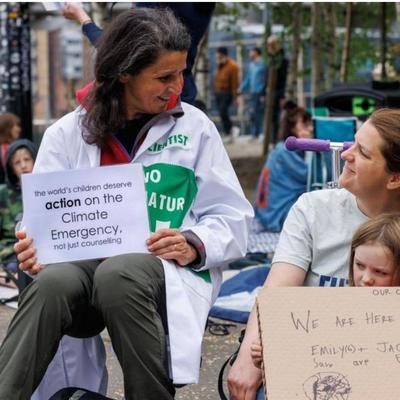 Dr Susi Arnott
 A Guy Named Brian (he/him)
 Kent Pitman
 Lotta Närhi
 EndemicEarthling
 anlomedad