"Climate action saves lives. So why do climate models ignore well-being?"

https://phys.org/news/2025-11-climate-action.html?utm_source=mastodon
#physorg #science #climate #climatemodel

Climate action saves lives. So why do climate models ignore well-being?

Climate change is already shaping our well-being. It affects mental health, spreads infectious diseases, disrupts work, damages food supplies and forces families to leave their homes because of conflict, hunger or flooding.

Phys.org

🎉 Happy 70th Birthday to our former director Prof. Martin Claussen!

🔭 Martin Claussen, a true pioneer in Earth system research, did groundbreaking work on climate-vegetation interactions. He was the first to successfully couple a #ClimateModel with a vegetation zone model, a prerequisite for modeling climate periods of the past! Learn more: https://mpimet.mpg.de/en/communication/detail-view-news-homepage/martin-claussen-celebrates-his-70th-birthday

Thank you for your dedication, leadership, & unwavering commitment to science. Wishing you the very best!✨

#climatescience #MPIM

@c_ozwei @safest_integer

https://amocscenarios.org/?lat=51&lon=11.75&model=cc_RCP45&is_amoc_on=true&is_delta=false&metric=summer_days

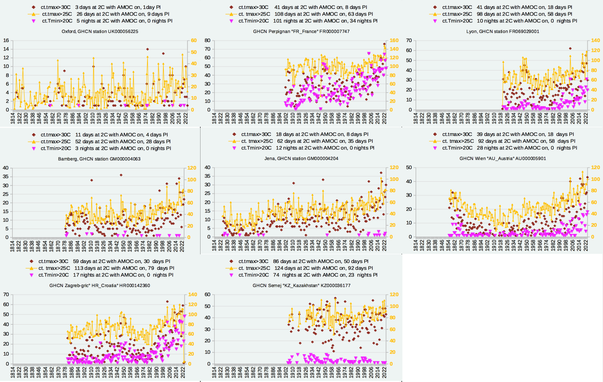
Ich hab jetzt noch mal ein paar mehr Stationen geplottet als nur Bamberg und Oxford, und die modellierten Werte für 2C bei AMOC on in die Legenden geschrieben.
Heiße Tage >=30C, Sommertage >=25C und Tropennacht >=20C.
Stationsauswahl random, Hauptsache ne lange Zeitreihe mit guter Qualität.

Die Stationen sind seit der vergangenen Dekade fast alle beim 2C-Wert, teils 3fach über dem 2C-Wert. Nur die ganz östliche Station in Kazachstan, das Chart unten rechts, hat noch eine Weile Zeit.
Quelle GHCN.
Ab 1814 bis 2024.

Daran sieht man, was für einen Unterschied die grobe Auflösung macht, die van Westens AMOC paper zugrunde liegt. Der verwendet ja extra die CMIP6 um zu zeigen, dass auch in den sturen 😁 Modellen die AMOC kippen kann.
Brunner et al 2025 schreiben auch, dass es schon in 2050 einen enormen Unterschied bei Temperaturextremen macht, ob man 100x100km CMIP6 oder 9x9km Auflösung hat. 🖖🏽

#Klima #ClimateModel #CMIP6 #ExtremeTemperature

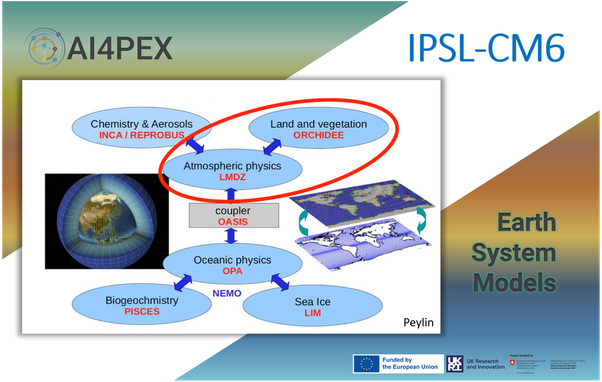
🌱 IPSL-CM: Paris-built climate–biosphere integration links LMDZ atmosphere, ORCHIDEE land, NEMO ocean, and PISCES biogeochemistry.

Our updates: enhance ORCHIDEE land processes & develop LMDZ-ORC coupling for sharper climate–carbon feedbacks.

#ClimateModel #IPSLCM #ORCHIDEE #ESM

🌎 ”A great day for climate science”
🙌 Last Friday, #exa_JUPITER—Europe’s first exascale supercomputer, the largest in Europe—was officially inaugurated. We’re super excited as we are among the first users of this fantastic facility with our #ICON #ClimateModel! In a panel discussion, our director Bjorn Stevens emphasized how #ClimateScience benefits from this fantastic infrastructure: https://vimeo.com/1116692844/f41fcf7b06?share=copy
The full recording can be found here: https://www.youtube.com/watch?v=ijHwxnc98n8
📷 © FZ Jülich @fzj

22-Aug-2025
Sea-level projections from the 1990s were spot on, Tulane study says

https://www.eurekalert.org/news-releases/1095672

#science #environment #ClimateCatastrophe #SeaLevelRise #oceans #ClimateModel

Sea-level projections from the 1990s were spot on, Tulane study says

Tulane researchers found that mid-1990s climate projections of sea-level rise were remarkably accurate when compared with 30 years of satellite data. The 1996 IPCC report predicted about 8 cm of rise, close to the 9 cm observed, though it underestimated ice-sheet contributions. The study highlights both the credibility of climate models and the importance of continued monitoring. Researchers stress the need for region-specific projections, especially for vulnerable coastal areas like south Louisiana, where sea-level rise varies widely.

EurekAlert!
A new Martian climate model suggest a mostly cold, harsh environment https://arstechni.ca/pbTk #planetaryscience #Climatescience #Curiosityrover #climatemodel #carbonates #Science #rover #Mars
A new Martian climate model suggest a mostly cold, harsh environment

A model built using data from the Curiosity rover suggests wet periods were rare.

Ars Technica

https://www.oulu.fi/en/news/most-extreme-solar-storm-hit-earth-12350-bc-scientists-identify

@UniOulu Finland utilised their newly developed chemistry– #climatemodel called SOCOL:14C-Ex,…the model confirmed that the detected solar event was ~18% stronger than the notorious AD 775 event — until now the strongest solar storm ever recorded…

“Compared to the largest event of the modern satellite era — the 2005 particle storm — the ancient 12350 BC event was over 500 times more intense, according to our estimates…”

The most extreme solar storm hit Earth in 12,350 BC, scientists identify

The new finding expands the timeline and intensity of known solar activity and sets a new upper boundary for such solar phenomena.