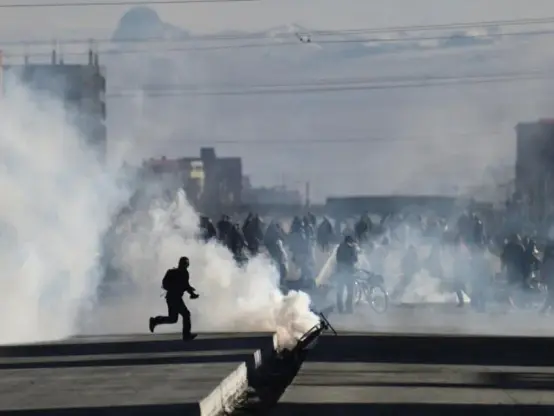
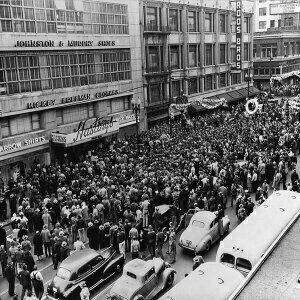
~4000 mostly #Jewish tenants in #NYC attacked a #police force in #TheBronx to evict 17 tenants on #ThisDayInHistory in 1932. Women stationed on rooftops directed the action with megaphones. #ClassStruggle against high #rent works: The landlord was forced to halve the rental cost.
Militant #DirectAction by the #WorkingClass has always been a part of #ClassStruggle. In 1913 on #ThisDayInHistory, waiters on #strike at the #NYC #RitzCarlton took up bricks & bats, surrounded the hotel and smashed its windows. Only one stone-thrower was caught and arrested.

Solidarische Grüße an die streikenden Kolleg*innen in New York! ✊🏽🩺
Euer Streik ist mehr als „Tarifkampf“: Er zeigt den Grundwiderspruch im Krankenhaus.

Pflege soll Leben sichern aber unter kapitalistischen Bedingungen zählt am Ende die Bilanz. Personal wird als Kostenfaktor behandelt, Patient*innen als „Fälle“, und wir als austauschbare Ressource.

Echte Veränderung entsteht nicht durch Appelle an Politik oder Klinikleitungen, sondern durch Selbstorganisation: Streikkomitees, Versammlungen, kollektive Kontrolle über Arbeitsbedingungen.

Unsere Würde ist nicht verhandelbar.
Stay strong. Class unity across borders. 💜

#NursesStrike #NYPresbyterian #MountSinai #Montefiore #Pflege #Krankenhaus #Streik #Solidarität #HealthCareWorkers #ClassStruggle

Working Class History

The annual MLK Jr. Day is a reminder that we've been in this shared fight for a long time now.

"Again, we have deluded ourselves into believing the myth that capitalism grew and prospered out of the Protestant ethic of hard work and sacrifice. The fact is that capitalism was built on the exploitation and suffering of Black slaves and continues to thrive on the exploitation of the poor both Black and white, both here and abroad."

https://www.youtube.com/watch?v=6sT9Hjh0cHM

#MLK #MLKJr #MLKJrDay #solidarity #ClassStruggle #capitalism

#MLK: The Three Evils of Society // #Nonviolence365

YouTube

Corporate America Only Stops When Workers Do: A Caller Explains the Power of a General Strike

A radio caller exposes how corporations exploit workers and why collective action is the only force that can stop systemic abuse.

#americanDreamMyth #CapitalismCritique #classStruggle #cORPORATEAbUSe #corporateGreed #EconomicJustice #generalStrike #IndependentMedia #inflationProfiteering #laborPower #ProgressivePolitics #unionPower #wealthInequality #workersRights https://wp.me/p1OjMZ-oyV

On Venezuela: Towards An Anarchist Anti-Colonialism

The kidnapping of the president of Venezuela, Nicolas Maduro, by the United States this last week has created a divide in anarchist perspectives; particularly those living in the United States. It has made clear that there is a concerning lack of consensus around the implications of this action by the revolutionary left. To get on the same page and ascertain an anarchist perspective on this matter, it is necessary to understand international dynamics, the tradition of anarchist viewpoints, the dynamics of global class struggle and critical role of anarchists residing in the heart of the Empire.

On January 3, 2025, the US conducted a kidnapping operation, firing missiles at military installations and using operatives in helicopters to descend on the presidential palace, kill the security detail of Maduro, and take him and his wife hostage to New York to face fraudulent federal charges.

This comes at a very poignant moment in the US trajectory. As the US economy continues its downward trend, an explicitly far right administration has taken power. At the same time other countries have been rising to global prominence and influence, such as China and Russia. The US response to the situation directly follows historical precedent of the US: increase pressure on people of color and leftists domestically (ICE raids and the Antifa witch hunt), try to dominate globally through proxies, take down governments that follow an ani-colonial path, such as Burkina Faso, install governments in other countries that are subservient to US interests, fund and rally detractors in other countries, and militarily reinforce colonial proxies, such as ‘Israel’. The only difference now is that the far right administration is very explicit about it’s intent for world domination. Deputy Chief of Staff, Stephen Miller, stated on the issue of taking Maduro that essentially might makes right. In a similarly hubristic vein, Donald Trump listed several places the US planned to affect a similar policy, including Cuba, Colombia and Greenland.

The history of US domination and exploitation in Central and South America has left a long and deep scar on the people there. Like now, the motivation for the US was to disrupt the entrenchment of the left in Latin America which would interfere with ability of US companies to extract wealth and resources from the South. The US-based United Fruit company brutalized Colombians for almost one hundred years, funding right wing paramilitaries to keep workers in check. The 1928 Banana Massacre took place in response to worker demands for better conditions, which was disavowed by US officials as, “communist.” It became Chiquita Brands, well known for financing the right wing paramilitary group, the United Self-Defense Forces of Colombia (AUC) to exact killings and torture to keep workers in check. Salvador Allende was the first socialist president of Chile. Before his election the CIA spent $3 million on anti-Allende propaganda and once Allende was elected, the US led a right wing coup on September 11th, 1973 to depose him and install a brutal military dictatorship in his place. The U.S. was heavily involved in El Salvador during its civil war from 1979 to 1992, providing over $1 billion in military and economic aid to the Salvadoran government to combat leftist guerrillas. The list is seemingly endless. Clearly following this extractive trajectory, Donald Trump stated both before and after the kidnapping of Maduro that the oil in Venezuela belongs to the US.

Anarchism has long stood by its principles of internationalism and a borderless perspective, treating state-imposed borders as illegitimate. Buenaventura Durruti didn’t just go into hiding in France, he connected with and worked alongside comrades throughout South America. After the Spanish Civil War, Abraham Guillen made a similar voyage, working with and advising armed struggle groups in South America. The anarchist Shinmin perfecture in Manchuria functioned as a launch pad for actions against imperial Japan in Korea. Now, as then, revolutionary struggle by the oppressed in the Global South should have a seamless connection with revolutionaries in the imperial core. This is an important principle reflecting the statement by Subcomandante Marcos: “Marcos is gay in San Francisco, black in South Africa, an Asian in Europe, a Chicano in San Ysidro, an anarchist in Spain, a Palestinian in Israel, a Mayan Indian in the streets of San Cristóbal…” reflecting how a partisan in the movement must be on the side of the oppressed wherever they are. This international solidarity is an important practice of principle and also a practical consideration that a struggle abroad cannot succeed without a struggle at home and vice versa.

This logic is even more poignant considering the role the US has played geopolitically. Its tyranny extends beyond the borders of Central and South America, cultivating colonial and right wing trajectories around the world. The US has, for example, trained Ukrainian fascist paramilitaries and continuously armed the Zionist regime in its genocide against Palestinians.

There have been arguments made in recent days by those who consider themselves revolutionary leftists and anarchists that we as a movement should not care about the US kidnapping of Maduro because he is authoritarian, as is perhaps the Chavista project altogether. Equating a leader in the global south with leadership in the US on the basis of hierarchic control of a territory is a misinterpretation I once naively shared as an anarchist based in the US. Many years ago as part of an anarchist social center, we shared a post on social media by an ostensibly anarchist collective based in Venezuela, critical of the state. A Brazilian anarchist group of comrades we were connected with, comrades with a proven record of combatting racism and taking an important stance against US imperialism, gently informed us that we were sharing US State Department propaganda. We researched the journal we had shared and found that it, indeed, had questionable origins. The Brazilian anarchists explained that while the social project in Venezuela was not ideal, it was still on the left and that their position, particularly in conjunction with comrades in that country, was to work within the structures that existed which were materially bettering people’s lives and push them further towards the left. This was a new perspective for us because we were living in a country that was so far to the right, we had to work to understand what this meant.

On further reflection and conversation with our comrades in the global south, we made the important distinction that all forms of power over others are not necessarily the same. When an anarchist soldier in the Spanish Civil War captures a fascist and imprisons them, it is to stop a certain political reality. When a fascist does the same to an anarchist, it is that far right political position that becomes more likely. Force is used on either side to propagate or prevent specific social policies from being enacted. With the unbalanced distribution of power that exists between the US and Central and South America, the force necessary to overturn the fascist political reality becomes even greater. This is compounded by the constant low grade warfare launched by the US against, in this case, Venezuela. From aiding right wing coup attempts to an economic sanction to funding the opposition to propagating studies and media pieces about transgressions of Venezuelan leadership, there is a need for Venezuela to tighten its borders and increase security internally to prevent being overrun by the US. The threats by the US actually increase the need for activities that are then denounced by US-based anarchists as authoritarian.

This thought exercise was an invaluable lesson for an anarchist living in the heart of the Empire. There is no doubt that we are tainted by our right wing society, by our global position by birth and our alienated, hyper-capitalist daily lives. In the US, our war against the colonial, capitalist state is inherently just, but due to the complexities of imperialism and history, the same might not be true for every other state at every historical juncture. This doesn’t mean that we give up our ideals or our vision for a truly liberated society and stop fighting for a borderless world, but that we learn how to work with those have been oppressed, specifically in the global south, and that we make alliances and friends along the way in order to build a leftist pole against right-wing domination, neocolonialism and empire. We don’t rise alone, but we rise together, in struggle. And we create the situation for more leftist projects to thrive and move further to the left if we can thwart the power of the globally powerful right, and the colonial intentions of the US.

Anarchist societies don’t arise out of a vacuum. The Anarchists in Spain the 1930’s would not have risen to prominence without a global leftist trajectory. The same is true of Makhno’s Ukraine. If more of the world were to further fall under the diabolical influence of the US, clearly a purveyor of right-wing policies, colonialism, and exploitation for capitalist purposes, we would see a further rise in right wing politics globally. It is no coincidence that so many anti-colonial struggles took a left wing character when they were funded by the Soviet Union. And it is no coincidence that such struggles have currently lost that left wing characteristic. This is not to say that what the global actions of the Soviet Union perfectly created a revolutionary situation, but rather that when there are more left wing countries and projects around the world, there is a greater chance of their proliferation, and a greater chance at creating societies that are even further to the left. Using a smaller example, there likely would not currently be so many anarchists in Greece if their parents had not been communists.

Anarchists with the unique position of living in the US have a responsibility to the rest of the world. Anarchism is a social pursuit, not about creating an isolated bubble where radicals in the heart of the Empire enjoy themselves at the expense of those in the global south. It’s borderless and international principles are about aligning with those who have been historically and globally oppressed and fighting the purveyor of their distress. Accordingly, the Zapatistas have called on US based radicals to struggle against the government. In light of the horrors the US is perpetuating, and the political position it is proliferating, for anyone residing in the US, it should be our primary enemy. The benefit of people of color and the oppressed here and abroad should be a barometer for our actions.

From our position of both privilege and opportunity, when we analyze a situation like the kidnapping of Maduro, our first question should not be, Is the social and economic system in Venezuela a project worthy of my support?, but instead, What does it mean geopolitically for the US to be able to interfere in the politics of a country in the global south? Even if the Chavista project does not represent an ideal society, the alternative of an empowered fascist US deciding policy beyond its borders is vastly more dire. There is no situation where the US should be allowed to operate as a global policeman, garnering it further resources and power and bringing abject misery to the most vulnerable.

Secondly, we must not make the mistake of parroting State Department propaganda that pushes a US agenda. It is important to analyze the sources of information on international subjects, and understand the agenda of the bodies and people the information comes from. When people from Venezuela in the US speak about their dislike of the politics there, are they speaking from a left or right wing perspective? It is essential to be entirely critical of all mainstream US press, especially on geopolitical issues. Both liberal and conservative media outlets share information that furthers the US economic agenda. This was evident, for example, in the months leading up to the war in Iraq when mainstream press consistently and uncritically shared the assertion that Saddam Hussein had weapons of mass destruction. After the war, the same press later shared evidence to the contrary but the damage was already done.

The rift in anarchist perspectives around the kidnapping of Maduro has exposed a crucial, yet fundamental gap, exposing an absence of anarchist anti-colonialism. This is an opportunity to revisit the essential tenets of anarchism and realign with them. As such, it is an opportunity for all anarchists in the US to deeply inspect their own innate prejudices and dispositions that come from that position and figure out how to best shed pernicious Western supremacy that has been embedded their consciousness. Most of all, it is an opportunity to align with the global south, with global leftism and analyze how best to use the benefits of our birth certificates, passports and visas to destroy a powerful and seemingly interminable source of right wing politics around the world. In these critical times we must be clear who our primary enemy is, become united in our fight against it, and thereby create a situation where far more open leftist projects can flourish.

Anonymous Submission https://abolitionmedia.noblogs.org/?p=26844 #anarchism #anticolonialism #antiimperialism #classStruggle #maduro #southAmerica #venezuela

Social Classes and Class Struggle

https://vid.shadowkat.net/w/nqrwk1DGCbjpn66eUd8EY6

Social Classes and Class Struggle

PeerTube

Games for #Degrowth and a Viable Future

Posted on 20 September, 2025 by The #SteadyStateManchester team

by Carolyn Kagan

"Naomi Klein1 asks the question How do you change a world-view, an unquestioned ideology? Much of what we do in Steady State Manchester is to endeavour to change world-views, unquestioned ideologies about economic growth and the exploitation of environmental resources. We seek to enable people to discuss, challenge and develop their ideas and thinking; to help others see that their interests coincide with tackling climate change and securing a viable economic future; to offer hope and possibilities for living better within planetary boundaries; to share practical ways of doing things differently; to provide critiques of current practices but at the same time offer alternatives.

"Games and simulations have been used in training and development arenas for some time and across many different places and groups. They include table top games; video games, educational games, small or large scale role play or simulation games.

"In September 2025 we explored the role that games might play in helping to change world-views. We invited people attending our AGM to:

"Bring along a game, almost any game will do. The idea is that most games could be adapted around the ideas of Degrowth. So there’s the challenge: bring a game and ideas about how it might be adapted or used to inspire a new game that explores or promotes Degrowth.

Ideas for games

The ideas we came up with were mostly small in scale, table top games.

Adaptations of existing games:

- Degrowth Pictionary: Aim: to understand and explore concepts underpinning Degrowth. Following the format of the well known game of #Pictionary, cards are prepared with Degrowth concepts written on them – anything will do for example, anti-capitalism; climate change; collapse; cooperation; commons; fair shares; Limits to Growth; planetary boundaries; tipping points, overshoot; carbon emissions, simplicity. Participants take a card and without speaking draw the concept related to Degrowth, while others guess what it might be. No words are allowed during the drawing, but discussion after each concept is revealed, or after two or three concepts, will help to clarify understanding of the concepts and may identify strategies for change. The challenge is for the sketcher to capture the essence of the concept and for the guessers to articulate what that concept might be.

- Versions of #Monopoly, products of mind games. The aim would be to develop a deep understanding and help move toward collective intelligence and wisdom. Proposed versions of Monopoly included Civil-opoly; Techn-opoly; Polit-opoly; Plent-opoly; Co-opoly – each version emphasises a theme relevant to Degrowth and build on the idea of telling different stories (each shown via clever and captivating graphics in the text).

- Degrowth #SnakesAndLadders: Aim: particularly for younger players, to understand the hazards and actions that can be taken in achieving a viable economy or the green transition. Snakes and ladders boards can be prepared, with short messages on the squares rather than just numbers. Ladders represent actions towards a viable economy and snakes the hazards that detract from a viable economy. The Board could be labelled in terms of general Degrowth (e.g. ladders: waste is recycled; government funds adaptations to homes for insulation and electric heating; a neighbourhood has all it needs for local people; public transport is good; e.g. snakes: you fly several times a year to go on holiday; you buy new shoes and chuck out the old ones which are still good etc.). Alternatively boards could reflect a Degrowth theme: for example inequality; climate change; biodiversity. Discussion takes place throughout so all players explore why the ladders make progress and the snakes do not.

- #Patience: the well known card game, known in the USA as #Solitaire, embodies in and of itself many features of a Degrowth future. The aim of playing Patience is to help players appreciate a move towards a slower, way of life, with intrinsic satisfaction in playing the game itself. Patience is slow, with no particular end point. There is no element of competition and players have to accept they cannot win, but just call an end to the game whenever they like.

- Degrowth draughts: in conventional #draughts (North America, ‘#chequers / #checkers’) the aim is to eliminate all your opponent’s pieces. In Degrowth draughts, the aim could be to jointly reach a pre-defined, right-size complement of pieces. However, each player has to move in turn and if an opponent’s pieces can be taken, they must be, as in the original game, or you will be ‘huffed’. The game would introduce the ideas of degrowth to a steady state and of co-operative action to correct the bloated economy.

Existing games that feature (some) aspects of Degrowth

#CarbonCityZero: a board game to get people talking (and learning) about the choices our towns and cities needed to make in order to take action on climate change. Available to buy.

#Daybreak: Daybreak is a cooperative boardgame about stopping climate change. It presents a hopeful vision of the near future, where you get to build the mind-blowing technologies and resilient societies we need to save the planet. The game requires players to work collaboratively.

#ClassStruggle: The Workers move around a board while trying to survive against the Capitalist player who controls everything. As the Workers unite they take power from the Capitalist player but if they do not succeed in uniting the Capitalist will win. Out of production but it might be possible to find second hand copies."

Read more [includes ideas for computer games and links to some of the games mentioned above]:
https://steadystatemanchester.net/2025/09/20/games-for-degrowth-and-a-viable-future/

#Games #SolarPunkSunday #Degrowth #ViableFuture

Games for Degrowth and a Viable Future

by Carolyn Kagan Games as a tool for Awareness-raising Naomi Klein1 asks the question How do you change a world-view, an unquestioned ideology? Much of what we do in Steady State Manchester is to e…

Steady State Manchester