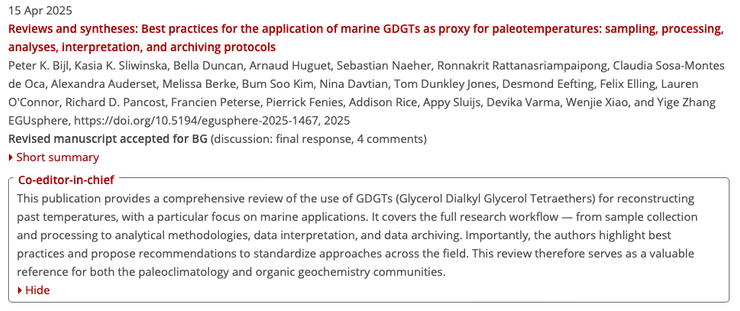

Reviews and syntheses: Best practices for the application of marine GDGTs as proxy for paleotemperatures: sampling, processing, analyses, interpretation, and archiving protocols
Abstract. Marine glycerol dialkyl glycerol tetraethers (GDGTs) are used in various proxies (such as TEX86) to reconstruct past ocean temperatures. Over 20 years of improvements in GDGT sample processing, analytical techniques, data interpretation and our understanding of proxy functioning have led to the collective development of a set of best practices in all these areas. Further, the importance of Open Science in research has increased the emphasis on the systematic documentation of data generation, reporting and archiving processes for optimal reusability of data. In this paper, we provide protocols and best practices for obtaining, interpreting and presenting GDGT data (with a focus on marine GDGTs), from sampling to data archiving. The purpose of this paper is to optimize inter-laboratory comparability of GDGT data, and to ensure published data follows modern open access principles.
Utilizing Probability Estimates from Machine Learning and Pollen to Understand the Depositional Influences on Branched GDGT in Wetlands, Peatlands, and Lakes
Abstract. Branched glycerol dialkyl glycerol tetraethers (brGDGTs) serve as critical molecular biomarkers for the quantitative reconstruction of past environments, ambient temperature and pH across various archives. Despite their success, numerous issues persist that limit their application. The distribution of brGDGTs varies significantly based on provenance, resulting in biases in environmental reconstructions that rely on fractional abundances and derived indices, such as the MBT’5ME. This issue is especially significant in shallow lakes, wetlands, and peatlands within semi-arid and arid regions, where ecosystems are sensitive to diverse environmental and climatic factors. Recent advancements, such as machine learning techniques, have been developed to identify changes in sources; however, these techniques are insufficient for detecting mixed source environments. The probability estimates derived from five machine learning algorithms are employed here to detect provenance changes in brGDGT downcore records and to identify periods of mixed provenance. A new global modern database (n=2301) was compiled to train, validate, test, and apply these algorithms to two sedimentary records. Our findings are corroborated by pollen and non-pollen palynomorphs obtained from the identical records. These microfossil proxies are utilized to discuss changes in provenance, hydrology, and ecology that influence the distribution of brGDGTs. Probability estimates derived from Random Forest with a sigmoid calibration are most effective in detecting changes in brGDGT distribution. Minor changes in the relative contributions of brGDGTs provenance can significantly influence the distribution of brGDGTs, especially regarding the MBT'5ME index. This study introduces a novel brGDGT wetland index aimed at monitoring potential biases arising from wetland development.

Towards quantitative reconstruction of past monsoon precipitation based on tetraether membrane lipids in Chinese loess
Abstract. Variations in the oxygen isotope composition (δ18O) of cave speleothems and numerous proxy records from loess–paleosol sequences have revealed past variations in East Asian monsoon (EAM) intensity. However, challenges persist in reconstructing precipitation changes quantitatively. Here, we use the positive relationship between the degree of cyclization (DC) of branched glycerol dialkyl glycerol tetraethers (brGDGTs) in modern surface soils from the Chinese Loess Plateau (CLP) and mean annual precipitation (MAP) to quantify past monsoon precipitation changes on the CLP. We present a new ∼ 130 000-year-long DC-based MAP record for the Yuanbao section on the western edge of the CLP, which closely tracks the orbital- and millennial-scale variations in available records of both speleothem δ18O and the hydrogen isotope composition of plant waxes (δ2Hwax) from the same section. Combing our new data with existing brGDGT records from other CLP sites reveals a spatial gradient in MAP that is most pronounced during glacials, when the western CLP experiences more arid conditions and receives up to ∼ 250 mm less precipitation than in the southeast, whereas MAP is ∼ 850 mm across the CLP during the Holocene optimum. Furthermore, the DC records show that precipitation amount on the CLP varies at both the precession scale and the obliquity scale, as opposed to the primarily precession-scale variations in speleothem δ18O and δ2Hwax at Yuanbao and the 100 kyr cycle in other loess proxies, such as magnetic susceptibility, which rather indicates the relative intensity of the EAM. At the precession scale, the DC record is in phase with δ2Hwax from the same section and the speleothem δ18O record, which supports the hypothesis that monsoon precipitation is driven by Northern Hemisphere summer insolation.

The importance of mass accuracy in selected ion monitoring analysis of branched and isoprenoid tetraethers
Among the new proxies based on the distribution of glycerol dialkyl glycerol tetraethers (GDGTs), the BIT index (Branched and Isoprenoid Tetraether in…

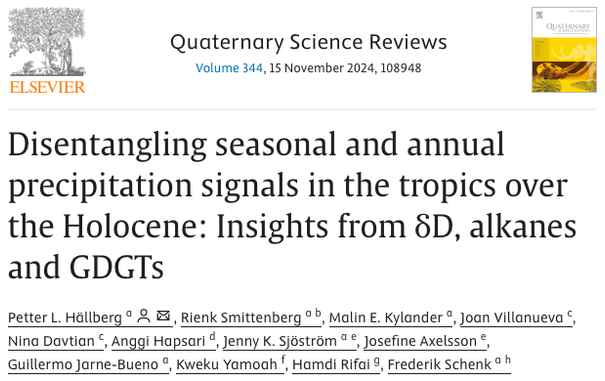
Disentangling seasonal and annual precipitation signals in the tropics over the Holocene: Insights from δD, alkanes and GDGTs
Rainfall seasonality in the tropics has a substantial impact on both ecosystems and human livelihoods. Yet, reconstructions of past rainfall variabili…
 Nina Davtian