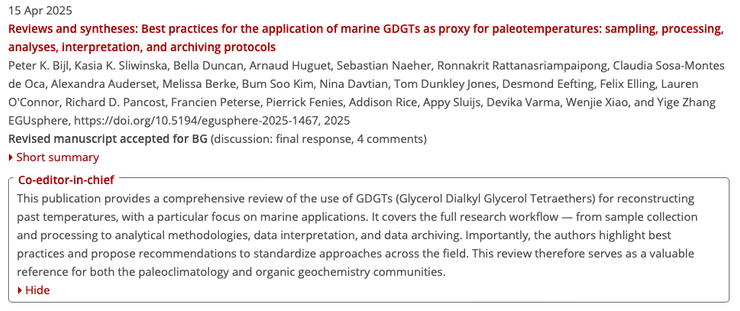
It’s #WomenInScienceDay!
Let me introduce two recent papers led by #WomenInSTEM.
First, this multi-biomarker study—e.g., archaeal and bacterial tetraether lipids—led by Madeleine Santos:
https://doi.org/10.5194/cp-22-187-2026
Second, this #TeamBacteria study—3-hydroxy fatty acids and branched tetraether lipids—led by Sai Ke:
https://www.sciencedirect.com/science/article/pii/S0146638026000136
#Science
#ScienceMastodon
#AcademicMastodon
#IDWGS
#InternationalDayOfWomenAndGirlsInScience

Holocene sea ice and paleoenvironment conditions in the Beaufort Sea (Canadian Arctic) reconstructed with lipid biomarkers
Abstract. The Beaufort Sea region in the Canadian Arctic has undergone substantial sea ice loss in recent decades, primarily driven by anthropogenic climate warming. To place these changes within the context of natural climate variability, Holocene sea ice evolution and environmental conditions (sea surface temperature, salinity, terrestrial input) were reconstructed using lipid biomarkers (HBIs including IP25, OH-GDGT, brGDGT, C16:0 fatty acid, phytosterols) from two marine sediment cores collected from the Beaufort Shelf and slope, spanning the past 9.1 ka and 13.3 cal. kyr BP, respectively. The Early Holocene (11.7–8.2 ka) is characterized by relatively higher sea surface temperature, lower salinity and no spring/summer sea ice until 8.5 ka on the Beaufort Sea slope. Around 8.5 ka, a peak in organic matter content is linked to both increased terrestrial input and primary production and may indicate increased riverine input from the Mackenzie River and terrestrial matter input from coastal erosion. Following this period, terrestrial inputs decreased throughout the Mid-Holocene in both cores. A gradual increase in IP25 and HBI-II concentrations aligns with relatively higher salinity, lower sea surface temperature and rising sea levels, and indicate the establishment of seasonal (spring) sea ice on the outer shelf around 7 ka and on the shelf around 5 ka. These patterns suggest an expansion of the sea ice cover beginning in the Mid-Holocene, influenced by decreasing summer insolation. During the Late Holocene (4.2–1 ka), permanent sea ice conditions are inferred on the slope with a peak during the Little Ice Age. After 1 ka, seasonal sea ice conditions on the slope are observed again, alongside an increase in salinity and terrestrial input, and variable primary productivity. Similar patterns of Holocene sea ice variability have been observed across other Arctic marginal seas, highlighting a consistent response to external climate forcing. Continued warming may drive the Beaufort Sea toward predominantly ice-free conditions, resembling those inferred for the Early Holocene.

Reviews and syntheses: Best practices for the application of marine GDGTs as proxy for paleotemperatures: sampling, processing, analyses, interpretation, and archiving protocols
Abstract. Marine glycerol dialkyl glycerol tetraethers (GDGTs) are used in various proxies (such as TEX86) to reconstruct past ocean temperatures. Over 20 years of improvements in GDGT sample processing, analytical techniques, data interpretation and our understanding of proxy functioning have led to the collective development of a set of best practices in all these areas. Further, the importance of Open Science in research has increased the emphasis on the systematic documentation of data generation, reporting and archiving processes for optimal reusability of data. In this paper, we provide protocols and best practices for obtaining, interpreting and presenting GDGT data (with a focus on marine GDGTs), from sampling to data archiving. The purpose of this paper is to optimize inter-laboratory comparability of GDGT data, and to ensure published data follows modern open access principles.
To all #EGU24-goers (in #person and #virtual), I will have not one, but two first-authored #presentations on Tuesday 16 April 2024 in two different, non-EOS #sessions.
Ergo, one of my two first-authored presentations is a solicited one.
More details in the #thread below 👇🏻 (1/3)
#conference
#presentation
#session
#GDGTs
#iGDGTs
#brGDGTs
#TeamArchaea
#TeamBacteria
#levoglucosan
#science
#ScienceMastodon
@gdgt
 Nina Davtian