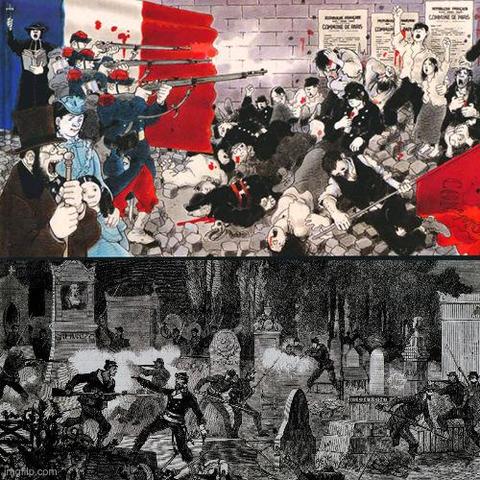
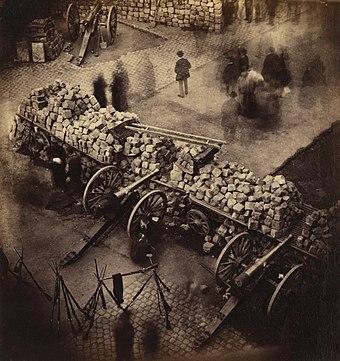
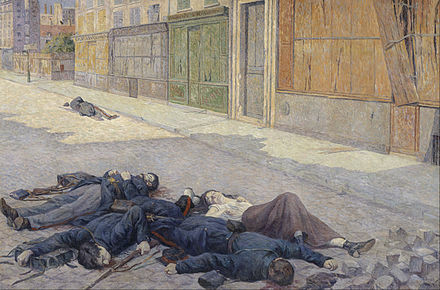
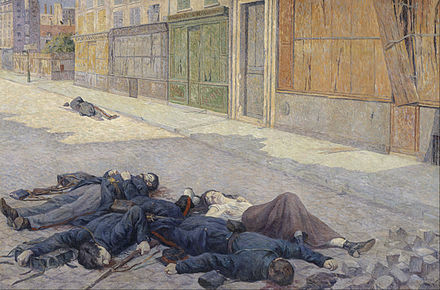
The #SemaineSanglante, #BloodyWeek, began on #ThisDayInHistory in 1871. French troops broke through barricades and attacked the #ParisCommune, engaging its residents in street battles. By the end of the week, about 20,000 #communards had been killed and another 38,000 arrested.

Today in Labor History May 21, 1871: The Bloody Week, a savage orgy of repression and violence, was launched against the Paris Commune. As a result of the French government’s massacres and summary executions, 20,000 to 35,000 civilians died. 38,000 people were arrested. Prior to the repression, workers had taken over the city for 2 months, governing it from a feminist and anarcho-communist perspective, abolishing rent and child labor, and giving workers the right to take over workplaces abandoned by the owners.

During the Commune, workers took over all aspects of economic and political life. They enacted a system that included self-policing, separation of the church and state, abolition of child labor, and employee takeovers of abandoned businesses. Churches and church-run schools were shut down. The Commune lasted from March 18 through May 28, 1871. Karl Marx called it the first example of the dictatorship of the proletariat.

Louise Michel was one of the leaders of the revolution. During the Commune, she was elected head of the Montmartre Women’s Vigilance Committee. She also participated in the armed struggle against the French government. In her memoirs, Michel wrote the following about her state of mind during the commune: “In my mind I feel the soft darkness of a spring night. It is May 1871, and I see the red reflection of flames. It is Paris afire. That fire is a dawn.” She also wrote “oh, I’m a savage all right, I like the smell of gunpowder, grapeshot flying through the air, but above all, I’m devoted to the Revolution.”

Read my complete biography of Louise Michel here: https://michaeldunnauthor.com/2024/04/20/louise-michel/

#workingclass #LaborHistory #bloodyweek #ParisCommune #anarchism #communism #revolution #feminism #louisemichel #marx #massacre #childlabor
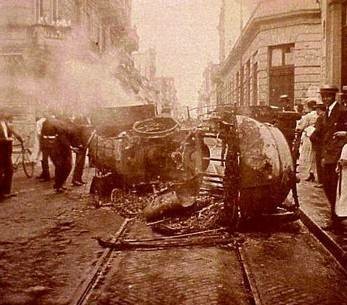
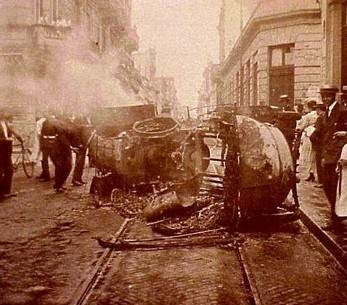
Today in Labor History January 7, 1919: Argentina’s "Bloody Week" (AKA Tragic Week) began in Buenos Aires. Workers were demonstrating for the 8-hour work day. The authorities opened fire, killing four and wounding 30. Clashes with the authorities on the day of the funerals left another 50 dead. In response, they called for a General Strike. Paramilitary groups attacked workers in collaboration with the police. By January 16 the authorities had fully crushed the strike, killing as many as 1,500 and wounding 2,000. Many of the victims were Jewish-Russian, Italian, Spanish and Chilean anarchist immigrants targeted by racists and anti-Bolshevik hysteria. Many were executed without trial after surrendering. The typical workday was 12 hours. However, many workers were forced to toil for up to 16 hours per day.

#workingclass #LaborHistory #argentina #russia #BloodyWeek #massacre #GeneralStrike #police #PoliceBrutality #jewish #anarchism #racism #antisemitism

Today in Labor History May 21, 1871: The Bloody Week, a savage orgy of repression and violence, was launched against the Paris Commune. As a result of the French government’s massacres and summary executions, 20,000 to 35,000 civilians died. 38,000 people were arrested. Prior to the repression, workers had taken over the city for 2 months, governing it from a feminist and anarcho-communist perspective, abolishing rent and child labor, and giving workers the right to take over workplaces abandoned by the owners.

During the Commune, workers took over all aspects of economic and political life. They enacted a system that included self-policing, separation of the church and state, abolition of child labor, and employee takeovers of abandoned businesses. Churches and church-run schools were shut down. The Commune lasted from March 18 through May 28, 1871. Karl Marx called it the first example of the dictatorship of the proletariat.

Louise Michel was one of the leaders of the revolution. During the Commune, she was elected head of the Montmartre Women’s Vigilance Committee. She also participated in the armed struggle against the French government. In her memoirs, Michel wrote the following about her state of mind during the commune: “In my mind I feel the soft darkness of a spring night. It is May 1871, and I see the red reflection of flames. It is Paris afire. That fire is a dawn.” She also wrote “oh, I’m a savage all right, I like the smell of gunpowder, grapeshot flying through the air, but above all, I’m devoted to the Revolution.”

Read my complete biography of Louise Michel here: https://michaeldunnauthor.com/2024/04/20/louise-michel/

#workingclass #LaborHistory #bloodyweek #ParisCommune #anarchism #communism #revolution #feminism #louisemichel #marx #massacre #childlabor

Louise Michel - Michael Dunn

Louise Michel was a leader of the 1871 Paris Commune and a founder of anarcha-feminism

Michael Dunn

Today in Labor History March 1, 1871: The victorious Prussian Army paraded through Paris after the Siege of Paris. Three weeks later, on March 18, radical soldiers from the French National Guard seized control of the city and established the Paris Commune. The workers controlled the city for two months. They abolished child labor and gave workers the right to seize businesses abandoned by the owners. They also dismantled the police and established their own self-policing. The French army quashed the commune beginning on May 21 with the Bloody Week. During that time, they slaughtered up to 20,000 people and arrested over 43,000.

#workingclass #LaborHistory #paris #commune #prussia #anarchism #communism #massacre #slaughter #childlabor #police #bloodyweek

Today in Labor History January 7, 1919: Argentina’s "Bloody Week" (AKA Tragic Week) began in Buenos Aires. Workers were demonstrating for the 8-hour work day. The authorities opened fire, killing four and wounding 30. Clashes with the authorities on the day of the funerals left another 50 dead. In response, they called for a General Strike. Paramilitary groups attacked workers in collaboration with the police. By January 16 the authorities had fully crushed the strike, killing as many as 1,500 and wounding 2,000. Many of the victims were Jewish-Russian, Italian, Spanish and Chilean anarchist immigrants targeted by racists and anti-Bolshevik hysteria. Many were executed without trial after surrendering. The typical workday was 12 hours. However, many workers were forced to toil for up to 16 hours per day.

#workingclass #LaborHistory #argentina #buenosaires #bolshevik #russia #BloodyWeek #massacre #GeneralStrike #police #PoliceBrutality #jewish #anarchism #racism #antisemitism

Today in Labor History May 21, 1871: The Bloody Week, a savage orgy of repression and violence, was launched against the Paris Commune. As a result of the French government’s massacres and summary executions, 20,000 to 35,000 civilians died. 38,000 people were arrested. Prior to the repression, workers had taken over the city for 2 months, governing it from a feminist and anarcho-communist perspective, abolishing rent and child labor, and giving workers the right to take over workplaces abandoned by the owners.

During the Commune, workers took over all aspects of economic and political life. They enacted a system that included self-policing, separation of the church and state, abolition of child labor, and employee takeovers of abandoned businesses. Churches and church-run schools were shut down. The Commune lasted from March 18 through May 28, 1871. Karl Marx called it the first example of the dictatorship of the proletariat.

Louise Michel was one of the leaders of the revolution. During the Commune, she was elected head of the Montmartre Women’s Vigilance Committee. She also participated in the armed struggle against the French government. In her memoirs, Michel wrote the following about her state of mind during the commune: “In my mind I feel the soft darkness of a spring night. It is May 1871, and I see the red reflection of flames. It is Paris afire. That fire is a dawn.” She also wrote “oh, I’m a savage all right, I like the smell of gunpowder, grapeshot flying through the air, but above all, I’m devoted to the Revolution.”

Read my complete biography of Louise Michel here: https://michaeldunnauthor.com/2024/04/20/louise-michel/

#workingclass #LaborHistory #bloodyweek #ParisCommune #anarchism #communism #revolution #feminism #louisemichel #marx #massacre #childlabor

Louise Michel - Michael Dunn

Louise Michel was a leader of the 1871 Paris Commune and a founder of anarcha-feminism

Michael Dunn

Today in Labor History March 1, 1871: The victorious Prussian Army paraded through Paris after the Siege of Paris. Three weeks later, on March 18, radical soldiers from the French National Guard seized control of the city and established the Paris Commune. The workers controlled the city for two months. They abolished child labor and gave workers the right to seize businesses abandoned by the owners. They also dismantled the police and established their own self-policing. The French army quashed the commune beginning on May 21 with the Bloody Week. During that time, they slaughtered up to 20,000 people and arrested over 43,000.

#workingclass #LaborHistory #paris #commune #prussia #anarchism #communism #massacre #slaughter #childlabor #police #bloodyweek

Today in Labor History January 7, 1919: Argentina’s "Bloody Week" (AKA Tragic Week) began in Buenos Aires. Workers were demonstrating for the 8-hour work day. The authorities opened fire, killing four and wounding 30. Clashes with the authorities on the day of the funerals left another 50 dead. In response, they called for a General Strike. Paramilitary groups attacked workers in collaboration with the police. By January 16 the authorities had fully crushed the strike, killing as many as 700 and wounding 2,000. Many of the victims were Jewish-Russian and Italian anarchist immigrants targeted by racists and anti-Bolshevik hysteria.

#WorkingClass #LaborHistory #argentina #buenosaires #bolshevik #russia #BloodyWeek #massacre #GeneralStrike #police #PoliceBrutality #jewish

Non solo bandcamp friday, ma anche #BloodyWeek

I tipi di Bloody Sound, etichetta indipendente marchigiana (casa di Lleroy, Jesus Franco & The Drogas, Gerda, Palmer Generator e tanti altri), hanno rinnovato logo e sito e per festeggiare la novità lanciano una settimana di sconto del 25% su tutto il catalogo, dal 1 al 7 settembre.

https://www.bloodysound.it/news/posts/15917-nuovo-sito-web-bloodysound-it

#BloodySound #DIY #LetsMarche e pure #FediRadio, perché si può ascoltare tutto il catalogo direttamente sul sito (grazie al lettore integrato di bandcamp) 

Nuovo sito web bloodysound.it

Cari amici, artisti, band, fan, simpatizzanti e antipatizzanti,oggi facciamo un grande passo in avanti verso il rinnovamento della nostra etichetta e verso il suo ventennale: è arrivato il NUOVO SITO WEB 💥Offre un'esperienza completamente rinnovata, dedicata agli amanti della musica autentica, sanguigna e agli artisti indipendenti! 🔥Nel nuovo potrete ascoltare interamente ed acquistare tutto il nostro catalogo, a dir poco numeroso ed eclettico: dal rock psichedelico al noise, dall'elettronica sperimentale al folk intimista, una vasta gamma di generi che stimoleranno le vostre orecchie. E ancora, avrete la possibilità di restare connessi con noi attraverso i nostri canali social e la nostra newsletter che attende solo la vostra iscrizione per darvi aggiornamenti esclusivi, contenuti speciali e molto altro. Inoltre, se sei un artista indipendente in cerca di opportunità, il nostro sito è il luogo giusto per te. Scopri come puoi inviare la tua musica per essere considerato per una collaborazione.Inoltre da oggi 1 settembre fino al 7 settembre festeggiamo questa bellissima novità con uno SCONTO DEL 25% SU TUTTO IL CATALOGO: è sufficiente fare i propri acquisti sul sito e, al check-out, lo sconto sarà applicato automaticamente su tutto il carrello 💥 "Bandcamp Friday" sì (tra l'altro è proprio oggi), ma soprattutto "Bloody Week" per inaugurare al meglio il nostro nuovo portale! 💉🩸Con affetto,Nando & Nico

Bloody Sound