 Jeff Munroe
At #AGU25 next week? I’ll present about the international #CZ-NoN project on Wednesday at 3:25 in session H33C-08. #criticalzone #hydrology #ecology #biogeoscience

RE: https://mastodon.world/@nina_davtian/114502798389880294
Let's give a try to the new #QuotePost functionality, so that I can remind the names of the lead authors of my new co-authored #review paper published in the @EuroGeosciences #journal #Biogeosciences, as well as which team and research center I represent in this #synthesis!
https://doi.org/10.5194/bg-22-6465-2025
#Science
#ScienceMastodon
#AcademicMastodon
#Consensus #Scientific #Publication
#isoGDGTs #brGDGTs #TeamArchaea #TeamBacteria
#archaeal #bacterial #tetraether #lipids
#Paleotemperature #Biogeoscience
Gilad Antler is a really cool researcher doing #biogeoscience out of a #science station on the #RedSea, and he's looking for MSc and PhD students to join his #lab. ( #AcademicJobs )
So, he made this neat video to tell you more about it:
https://www.youtube.com/watch?v=8ms-zMpUW3A&ab_channel=GiladAntler
Applications and more information: [email protected]

I´m happy that our investigation about #nitrousoxide #N2O in the Elbe Estuary is out now as a preprint in #biogeoscience
Especially the Hamburg Port produce and emit a huge amount of #N2O to the atmospere.
Spoiler: A CO2 equivalent of a middle town per year!
Tomorrow morning! Grab a coffee, put on your #AGU22 lanyard, and head over to start your Fall Meeting with some #CriticalZone research presented by members of the #BigDataCluster.
"Distinct Regulation of Riverine Inorganic Carbon by Soil CO2 and Climate" is included in 90 minutes of exploring the Frontiers of #WaterQuality.
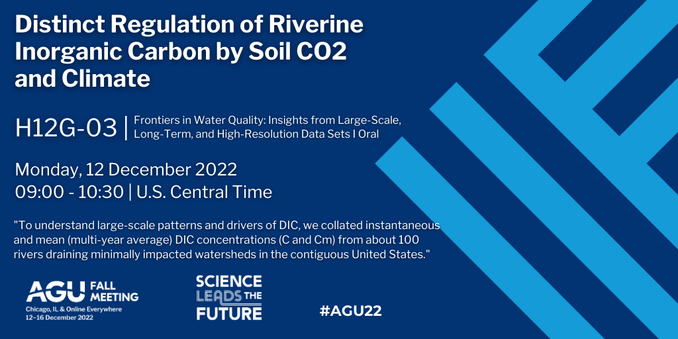
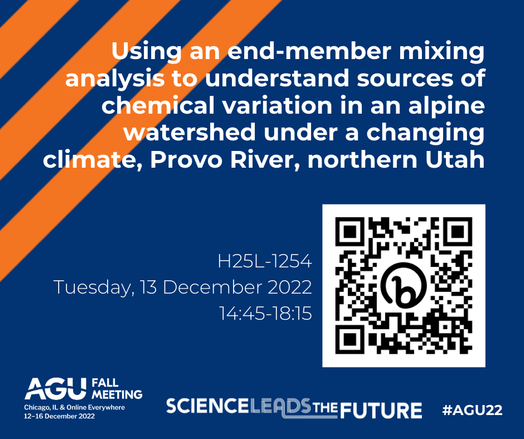
#CriticalZone Collaborative Network #Dustˆ2 Cluster member Greg Carling, based at #BrighamYoung University, collaborated on this research which will be presented in an #AGU22 poster session next week.
"Using an end-member mixing analysis to understand sources of chemical variation in an alpine watershed under a changing climate, Provo River, northern Utah"
#CriticalZone #CriticalZoneScience #chemistry #biogeoscience #AGU2022
Climate Controls on River Chemistry
"Results indicate that in places where river discharge dwindles in a warming climate, solute concentrations will elevate even without human perturbation, threatening water quality and aquatic ecosystems."
Li Li, Bryn Stewart, Wei Zhi, Kayalvizhi Sadayappan, Shreya Ramesh, Devon Kerins, Gary Sterle, Adrian Harpold, Julia Perdrial
📖: https://bit.ly/ClimateControlsonRiverChemistry
Published: 15 May 2022
#OpenSource #CriticalZone #hydrology #biogeoscience #EnvironmentalScience

 Nina Davtian
 Dr. Or M. Bialik
 Tina Sanders
 The Big Data Cluster
 Dustˆ2
 The Big Data Cluster