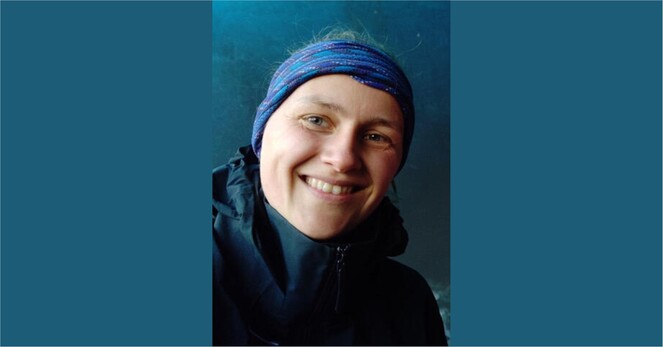
GeoTalk: Meet Ann-Sofie, researcher of Antarctic ice shelves and Cryosphere ECS Representative!
Hi Ann-Sofie. Thank you for joining this GeoTalk! To break the ice, could you tell us a bit about yourself and what got you interested in the Antarctic? Hi Simon, thanks for inviting me! That’s easy! As a child I always used to be ice cold… No, just kidding! I guess I have always been fascinated about nature, geoscience, weather, climate, and ice (creams). I preferred atlases, weather, and geology books as bedtime stories and was sure that I was going to become a meteorologist one day. That was my destiny until I started high school, where the best physics teacher ever told me about glaciology, and I was immediately sold. As a present when I graduated high school, he gave me his old exemplary of “The Physics of Glaciers, W.M.B. Paterson” which he had used during his studies, and that book has followed me ever since and been accompanied by the newest edition. How does basal melting on ice shelves contribute to the bigger picture of changes we’re seeing in the Antarctic? I took the freedom to ask ChatGPT that question to see if it would come up with anything useful and this was the result: “Basal melting on Antarctic ice shelves plays a significant role in the broader context of the changes occurring in the Antarctic region. As the undersides of these ice shelves come into contact with relatively warmer ocean water, they experience melting, causing the ice shelves to thin and lose mass. This phenomenon contributes to the overall ice mass loss from Antarctica, which has consequences for global sea level rise. The basal melting process is linked to several interconnected mechanisms. Warmer ocean water not only melts the ice from below but also affects ice shelf stability by creating cavities and weakening the structural integrity. As ice shelves thin and retreat, they remove a crucial buttressing effect that holds back the flow of land-based glaciers into the ocean. This leads to accelerated glacier discharge and increased ice flow into the sea, further contributing to sea level rise.” What ChatGPT tries to explain here is what we refer to as the Marine Ice Sheet Instability (MISI). Namely the process where ice shelf thinning (for instance due to basal melting) reduces the resistive forces/buttressing effect on the tributary glaciers, which can lead to an inland ice flow acceleration towards and into the ocean, thereby contributing to sea level rise. Ice shelf calving is often referenced in popular media as examples of dramatic changes in the polar regions, such as the break-away of Brunt ice shelf earlier this year. As a scientist who researches ice shelves, what key message do you wish was conveyed about such changes to non-experts? I think that the main message I wish to convey is that a break-away of parts of an ice shelf does not equal sea level rise! When a glacier shifts from being grounded (resting on the bedrock/sea floor) to a floating ice shelf is when the sea level contribution takes place. So, the break-away of ice bergs themselves has no effect on sea level rise, but bigger and more frequent calving events from an ice shelf might be a sign that the ice shelf is becoming unstable. Ice shelf instability can eventually lead to disintegration or collapse and the risk of the Marine Ice Sheet Instability to kick in. You’ve also given your time to investing in the geosciences community, such as raising awareness on gender and LGBTQIA+ topics. Recently, you also stepped up to be one of two Early Career Scientist (ECS) Representatives for EGU’s Cryospheric Sciences Division, alongside sea-ice researcher Lu Zhou. What advice do you have for people wanting to become more involved in the geosciences community, through EGU or otherwise? Yes, that’s correct! While I lived and studied in Copenhagen, Denmark it wasn’t that often that I faced any issues because of being queer. However, the moment that I wanted to apply for a PhD somewhere abroad, that “somewhere” was quickly narrowed down, because of my queerness, to a few countries, and often only capitals or major cities. Therefore, this is a topic very close to my heart and something which I would rather talk about with my colleagues instead of hiding it. Going back to the question you asked, my first tip to people wanting to get involved in the cryospheric community is to subscribe to the cryolist, where everything from conferences, job openings, outreach projects and much more gets shared. In the EGU Cryospheric Sciences Division we also have a blog which is always open to welcome new authors and editors, so don’t hesitate to contact them or me ([email protected]) if you are interested in that (they will also organize a lunch meet-up during EGU24). In the EGU Cryospheric Sciences Division Early Career Scientists (ECS) Team we are also always looking for new people to join. We will be holding an EGUcampfire (an informal online meeting) in the fall, so keep an eye out on the cryolist and our Twitter profile (@EGU_CR) where we will advertise this. And lastly, what are you looking forward to in the future? First of all I am looking forward to two weeks of holiday driving around in a camper with my partner, going wherever the September-weather is nice in Europe. Then, even though it is still far away, I am looking very much forward to EGU24 which will be my first EGU General Assembly as ECS representative and my first EGU General Assembly coinciding with my birthday. Hopefully turning 30 in Vienna will be less scary and much more fun than turning 30 at home on the couch in front of the TV. Besides that, I finally reached the part of my PhD where I feel like I know what I’m doing, my research starts to come out and ideas are evolving like never before. So, I will try to enjoy that roller coaster as long as it lasts, and before I get hit by the panic of having to finalize and submit my thesis and not knowing where to go next after the PhD. (Oeff… I almost already start to panic about where I will go next, so I better stop thinking about it now!)

 EGU
EGU



 Copernicus EU

 PNAS
PNAS