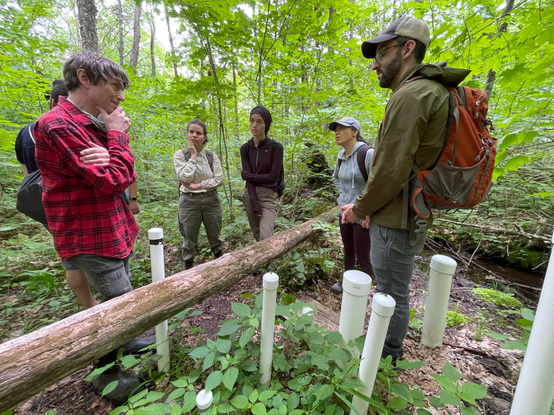
Bryn Stewart is a #BigDataCluster member who's based at #PennState. Stewart is presenting work conducted by the Big Data Cluster at #AGU22.

Stewart reports on data collected from Sleepers River Research Watershed, "we hypothesize that both disturbances (recovery from acidification and climate change) will affect solute concentrations, but recovery from acidification will be more influential for DOC, while the relatively stable DIC trends are maintained by lithological influence."

Tomorrow morning! Grab a coffee, put on your #AGU22 lanyard, and head over to start your Fall Meeting with some #CriticalZone research presented by members of the #BigDataCluster.

"Distinct Regulation of Riverine Inorganic Carbon by Soil CO2 and Climate" is included in 90 minutes of exploring the Frontiers of #WaterQuality.
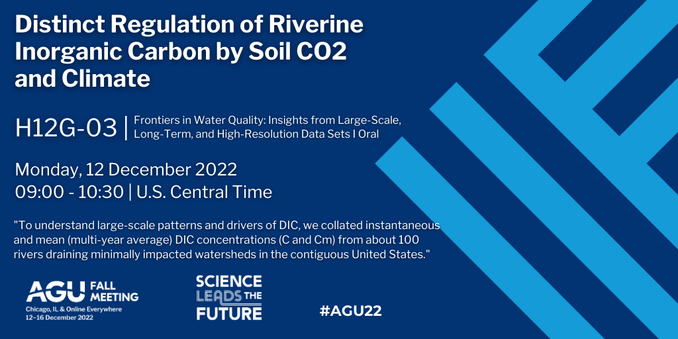
🗓️ 🔗 https://bit.ly/CZNAGU22121202

#AGU2022 #hydrology #biogeoscience

Distinct Regulation of Riverine Inorganic Carbon by Soil CO<sub>2</sub> and Climate

The evasion of CO2 from inland waters, a major carbon source to the atmosphere,...

AGU - Fall Meeting 2022

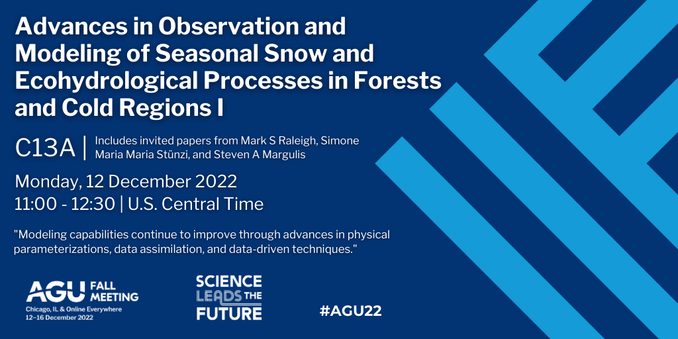
Adrian Harpold, based at the #UniversityOfNevadaReno and member of the #BigDataCluster Southwest team, is the primary convener for this 90 minute #AGU2022 session packed with information about the #ForestCanopy and #SnowScience.

Spend Monday at #AGU22 in the #CriticalZone, add "Advances in Observation and Modeling of Seasonal Snow and Ecohydrological Processes in Forests and Cold Regions I" to your schedule.

🗓️ 🔗 https://bit.ly/CZNAGU22121203

Advances in Observation and Modeling of Seasonal Snow and Ecohydrological Processes in Forests and Cold Regions I Oral

In cold regions and forests, water availability depends on the complex dynamics between seasonal snow and ecohydrological processes, which are also sensitive to a warming climate and land cover disturbances. Many forest processes (e.g., interception, evapotranspiration) are tightly linked to the canopy structure and vary across small spatial scales. Snow and ecohydrological processes further vary across landscape scales due to interactions with atmosphere, topography, and vegetation. These interacting processes entail major observational and modeling challenges for both current and future conditions. Recent remote sensing technology provide detailed understanding of forest snow and canopy structure, vegetation disturbance and regrowth, as well as snow distributions across a range of spatial scales. Modeling capabilities continue to improve through advances in physical parameterizations, data assimilation, and data-driven techniques. This session focuses on novel observations and advances in modeling techniques for understanding snow and ecohydrological processes in snow-covered regions and forests.

AGU - Fall Meeting 2022

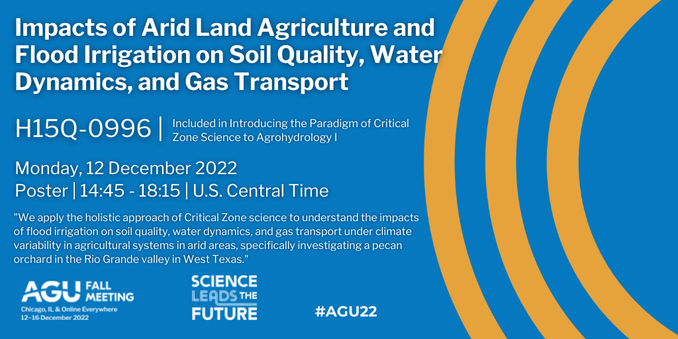
"Impacts of Arid Land Agriculture and Flood Irrigation on Soil Quality, Water Dynamics, and Gas Transport" includes collaborative research from the #BigDataCluster's Li Li, based at #PennState.

📆 🔗 : https://bit.ly/CZNAGU22121208_1

#CriticalZone #biogeochemistry #hydrology #WaterScience #AGU2022 #ScienceMastodon

Impacts of Arid Land Agriculture and Flood Irrigation on Soil Quality, Water Dynamics, and Gas Transport

In this study, we apply the holistic approach of Critical Zone science to under...

AGU - Fall Meeting 2022

"Frontiers in #WaterQuality Science: Origins, Patterns, and Detection of Spatial and Temporal Variation III" is a Monday afternoon #AGU22 poster session. #BigDataCluster member Erin Seybold collaborated with researchers based at Roger Williams University and the Oak Ridge Institute for Science and Education as conveners for the session.

📆 🔗 : https://bit.ly/CZNAGU22121208

#CriticalZone #biogeochemistry #hydrology #WaterScience #AGU2022 #ScienceMastodon

Frontiers in Water-Quality Science: Origins, Patterns, and Detection of Spatial and Temporal Variation III Poster

The chemical, physical and biological condition of waterways – “water quality” – is critical for ecological and human health. This session explores cutting-edge methods, novel synthesis products, and new models about water quality. We encourage submissions that use new tools and data sets to reveal spatio-temporal patterns in water quality across scales ranging from single catchment studies to cross-site syntheses. Wide-spread deployment of in-situ sensors has revolutionized our understanding of watershed dynamics over diel, storm, and seasonal timescales, highlighting the disproportionate impact of discrete events on annual export. Emerging capabilities for remote sensing of water quality, the explosion in synthesis opportunities, and improvements in water quality models enable new understanding of where, when, and why water quality varies, and new theories to explain these patterns. We solicit contributions that explore these water quality patterns in watersheds across the land use continuum, and particularly in systems experiencing the impacts of environmental change.

AGU - Fall Meeting 2022

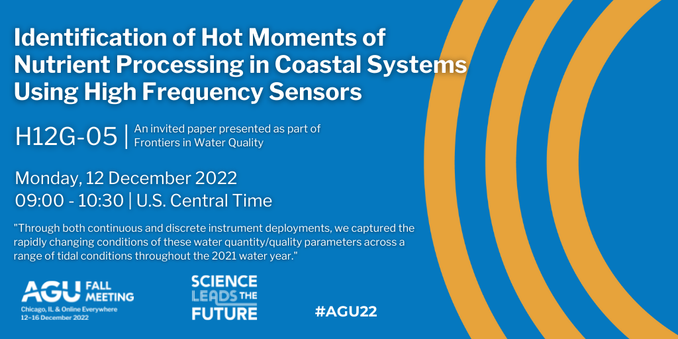
#BigDataCluster #hydrologists are collaborators in several sections of Frontiers of #WaterQuality including this invited paper in the Monday morning oral session.

"Identification of Hot Moments of Nutrient Processing in Coastal Systems Using High Frequency Sensors"

📆 🔗 : https://bit.ly/CZNAGU22121202_1

#CriticalZone #biogeochemistry #hydrology #WaterScience #AGU2022 #ScienceMastodon

Identification of Hot Moments of Nutrient Processing in Coastal Systems Using High Frequency Sensors

Salt marshes are critical hot spots of nutrient processing and retention and pl...

AGU - Fall Meeting 2022
Sleepers River Research Watershed and the Value of Long-term Datasets: Scientific insights and opportunities to support the next generation of scientists | U.S. Geological Survey

This article is part of the Fall 2022 issue of the Earth Science Matters Newsletter. 

Cluster Chat with #CriticalZone Network #BigDataCluster’s Dr. Byung Lee based at the University of #Vermont.

Work described in this conversation will be presented during #AGU22

#MachineLearning #DataCleaning #AI

https://youtu.be/i4T0nC5uUL0

Cluster Chat 05: Dr. Byung Lee | University of Vermont

YouTube

#midjourney generated art prompted by quotes from #BigDataCluster #AGU22 abstracts. These images prompted with "land-river connectivity via subsurface flow paths" from December 12th's Frontiers in #WaterQuality.

Add this #CriticalZone #hydrology session to your schedule https://bit.ly/CZNAGU22121202

#BigDataAtAGU22: https://bit.ly/CZNAGU22BigDataSpreadsheet

Distinct Regulation of Riverine Inorganic Carbon by Soil CO<sub>2</sub> and Climate

The evasion of CO2 from inland waters, a major carbon source to the atmosphere,...

AGU - Fall Meeting 2022