 BethB
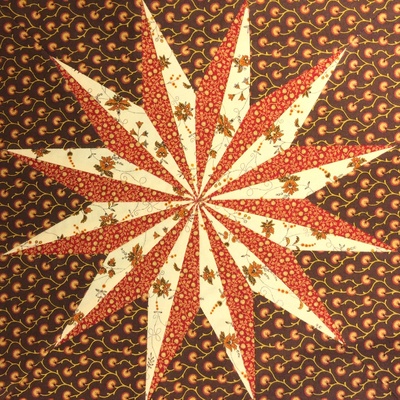
BethBI found an excuse to use Penrose tiling! Eight weeks of EPP, and now I've got 5 days left to quilt this for the "Sun Day Wool" art installation.
#Quilting #Quilts #EPP #AperiodicTiling #Aperiodic #Solar #SunDayOfAction
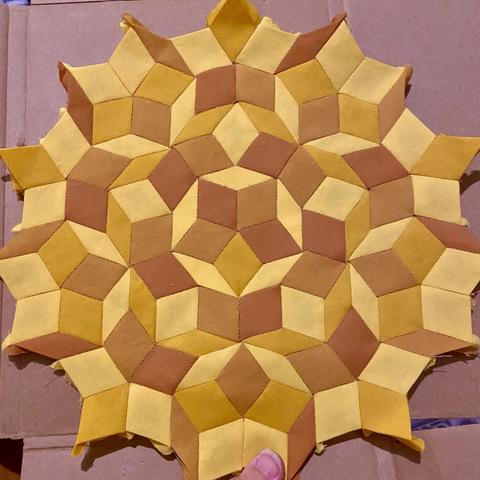
I found an excuse to use Penrose tiling! Eight weeks of EPP, and now I've got 5 days left to quilt this for the "Sun Day Wool" art installation.
#Quilting #Quilts #EPP #AperiodicTiling #Aperiodic #Solar #SunDayOfAction
Happy Monday everyone!
Here's something to brighten up the start of your week: a paper about solving mathemusical problems with ILP and SAT, from our latest issue:
Computing aperiodic tiling rhythmic canons via SAT models
https://link.springer.com/article/10.1007/s10601-024-09375-6
To make this Monday extra sweet: the authors use MapleSAT!
#Mathematics
#Music
#ConstraintProgramming
#AI
#Rhythm
#AcademicMastodon
#BooleanSatisfiability
#AperiodicTiling
#MapleSAT
#ILP
#CombinatorialAlgorithms
#ArtificialIntelligence

In Mathematical Music theory, the Aperiodic Tiling Complements Problem consists in finding all the possible aperiodic complements of a given rhythm A. The complexity of this problem depends on the size of the period n of the canon and on the cardinality of the given rhythm A. The current state-of-the-art algorithms can solve instances with n smaller than $$\varvec{180}$$ 180 . In this paper, we propose an ILP formulation and a SAT Encoding to solve this mathemusical problem, and we use the Maplesat solver to enumerate all the aperiodic complements. We then enhance the SAT model in two different ways. First, we enforce the SAT model with a set of clauses that retrieves the solutions up to translation. Second, we propose a decomposition of the solution space that allows to parallelize the resolution of the problem. We validate our different models using several different periods and rhythms and we compute for the first time the complete list of aperiodic tiling complements of standard Vuza rhythms for canons with period $$\varvec{n} = \varvec{\left\{ 180, 420, 900 \right\} }$$ n = 180 , 420 , 900 .
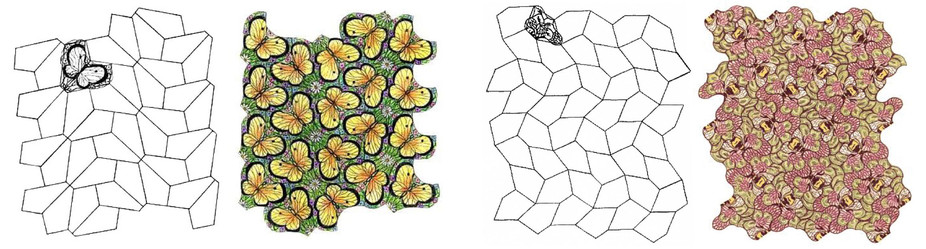
Marjorie Rice https://www.quantamagazine.org/marjorie-rices-secret-pentagons-20170711/
Joan Taylor
http://taylortiling.com/
Quanta Magazine’s mathematics coverage in 2023 included landmark results in Ramsey theory and a remarkably simple aperiodic tile capped a year of mathematical delight and discovery.
2023’s Biggest Breakthroughs in Math
#2023 #Algebra #AperiodicMonotile #AperiodicTiling #Combinatorics #Geometry #GraphTheory #Math #Mathematics #QuantaMagazine #RamseyNumbers #tiling #YouTube

The spectre (and friends): aperiodic monotiles *without reflection*
This is very cool! 😎
https://vm.tiktok.com/ZGJxCtuWM/
#mathematics #RecreationalMathematics #tiling #tesselation #AperiodicTiling
Here's a more detailed article on the recently discovered non-repeating "einstein" shape — covers a lot more about the #design of #AperiodicTiling, why #The Hat works, and how it was tested
#Design meets #math: A geometric shape that doesn't repeat itself when tiled may finally have been discovered — and its referred to as an 'einstein" shape, but not for the reasons you might guess

A quartet of mathematicians from Yorkshire University, the University of Cambridge, the University of Waterloo and the University of Arkansas has discovered a 2D geometric shape that does not repeat itself when tiled. David Smith, Joseph Samuel Myers, Craig Kaplan and Chaim Goodman-Strauss have written a paper describing how they discovered the unique shape and possible uses for it. Their full paper is available on the arXiv preprint server.
 Constraints Journal
 Peter Riley
 EclipseLion
 Deborah Pickett
 Anna Nicholson
 s31415
 Craig Saila
 Prof. Sally Keely