1/2 Exciting news: we just published a new paper: "Preimage attacks on round-reduced MD5, SHA-1, and SHA-256 using parameterized SAT solver", by Oleg Zaikin

If you are interested in security, cryptology, or Constraint Programming, definitely give this paper a read!

https://link.springer.com/article/10.1007/s10601-025-09383-0

#ConstraintProgramming #Security #Cryptology #Cryptography #CryptographicHashFunctions #ConflictDrivenClauseLearning #BooleanSatisfiability #MD5 #SHA1 #SHA256

Happy Monday everyone!

Here's something to brighten up the start of your week: a paper about solving mathemusical problems with ILP and SAT, from our latest issue:

Computing aperiodic tiling rhythmic canons via SAT models
https://link.springer.com/article/10.1007/s10601-024-09375-6

To make this Monday extra sweet: the authors use MapleSAT!

#Mathematics
#Music
#ConstraintProgramming
#AI
#Rhythm
#AcademicMastodon
#BooleanSatisfiability
#AperiodicTiling
#MapleSAT
#ILP
#CombinatorialAlgorithms
#ArtificialIntelligence

Computing aperiodic tiling rhythmic canons via SAT models - Constraints

In Mathematical Music theory, the Aperiodic Tiling Complements Problem consists in finding all the possible aperiodic complements of a given rhythm A. The complexity of this problem depends on the size of the period n of the canon and on the cardinality of the given rhythm A. The current state-of-the-art algorithms can solve instances with n smaller than $$\varvec{180}$$ 180 . In this paper, we propose an ILP formulation and a SAT Encoding to solve this mathemusical problem, and we use the Maplesat solver to enumerate all the aperiodic complements. We then enhance the SAT model in two different ways. First, we enforce the SAT model with a set of clauses that retrieves the solutions up to translation. Second, we propose a decomposition of the solution space that allows to parallelize the resolution of the problem. We validate our different models using several different periods and rhythms and we compute for the first time the complete list of aperiodic tiling complements of standard Vuza rhythms for canons with period $$\varvec{n} = \varvec{\left\{ 180, 420, 900 \right\} }$$ n = 180 , 420 , 900 .

SpringerLink

Survey of Theme One Program • 6
https://inquiryintoinquiry.com/2024/02/26/survey-of-theme-one-program-6/

This is a Survey of resources for the Theme One Program I worked on all through the 1980s. The aim was to develop fundamental algorithms and data structures for integrating empirical learning with logical reasoning. I had earlier developed separate programs for basic components of those tasks, namely, two‑level formal language learning and propositional constraint satisfaction, the latter using an extension of C.S. Peirce's logical graphs as a syntax for propositional logic. Thus arose the question of how well it might be possible to get “empiricist” and “rationalist” modes of operation to cooperate. The long-term vision is the design and implementation of an Automated Research Tool able to double as a platform for Inquiry Driven Education.

Please follow the above link for the full set of resources.
A collection of articles on the core ideas is linked below.

Wiki Hub —

Theme One Program • Overview
https://oeis.org/wiki/Theme_One_Program_%E2%80%A2_Overview

Documentation —

Theme One Program • Pascal Source Code
https://www.academia.edu/5210987/Theme_One_Program_Pascal_Source_Code

Theme One Program • User Guide
https://www.academia.edu/5211369/Theme_One_Program_User_Guide

Theme One Program • Exposition
https://oeis.org/wiki/Theme_One_Program_%E2%80%A2_Exposition

Applications —

Applications of a Propositional Calculator • Constraint Satisfaction Problems
https://www.academia.edu/4727842/Applications_of_a_Propositional_Calculator_Constraint_Satisfaction_Problems

Exploratory Qualitative Analysis of Sequential Observation Data
https://oeis.org/wiki/User:Jon_Awbrey/Exploratory_Qualitative_Analysis_of_Sequential_Observation_Data

References —

An Architecture for Inquiry • Building Computer Platforms for Discovery
https://www.academia.edu/1270327/An_Architecture_for_Inquiry_Building_Computer_Platforms_for_Discovery

Exploring Research Data Interactively • Theme One : A Program of Inquiry
https://www.academia.edu/1272839/Exploring_Research_Data_Interactively._Theme_One_A_Program_of_Inquiry

#Peirce #Logic #LogicalGraphs #ThemeOneProgram
#BooleanSatisfiability #DeclarativeProgramming

Survey of Theme One Program • 6

This is a Survey of blog and wiki posts relating to the Theme One Program I worked on all through the 1980s.  The aim was to develop fundamental algorithms and data structures for integrating …

Inquiry Into Inquiry

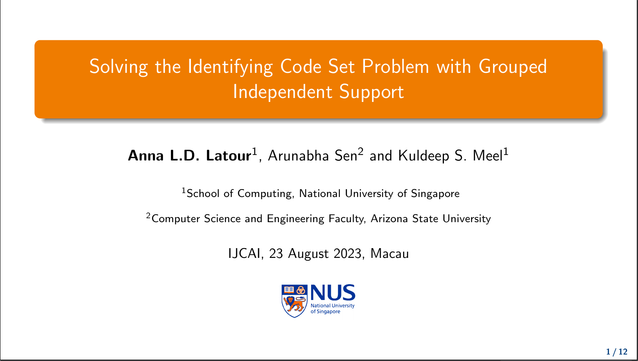
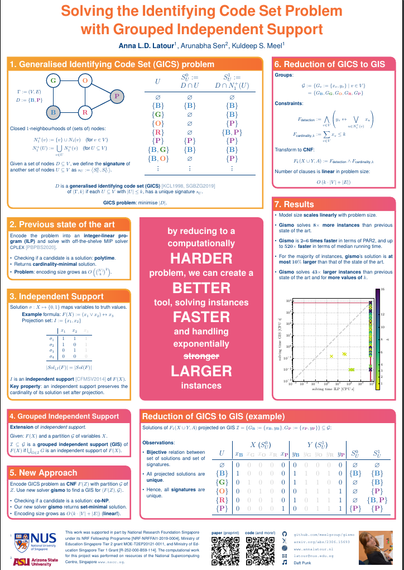
Last week, I presented the work I did with prof. Kuldeep Meel and prof. Arunabha Sen at IJCAI 2023.

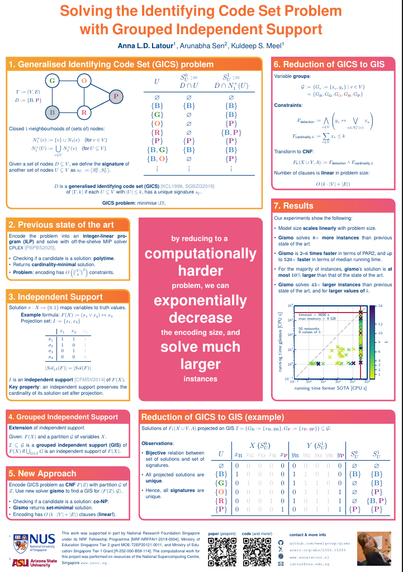
We showed the benefits of reducing a problem to a computationally harder problem (yes, you read that right!), by demonstrating how it allows us to solve much larger problem instances.

It was so much fun to finally share this work with so many fantastic researchers at IJCAI! Thank you to all organisers for making this conference possible. I'm also super grateful to the reviewers who gave us great feedback!

Please find our paper, slides, poster, a short video, and our open source tool, gismo, here: www.annalatour.nl/publication/2023-08-01-Solving-the-Identifying-Code-Set-Problem-with-Grouped-Independent-Support

#IJCAI2023 #IJCAI #AcademicMastodon #FOSS #PostdocLife #ConstraintProgramming #BooleanSatisfiability #Complexity #AcademicChatter #OpenSource #OpenSourceSoftware

Excited to be presenting "Solving the Identifying Code Set Problem with Grouped Independent Support" at 11:45 in Almaty 6007 (CSO Constraint Programming session) today at IJCAI!

If you cannot make it to my presentation, no worries! You can check out the slides or my poster, or come talk to me during the poster session at the end of the day 🤓

paper: https://www.ijcai.org/proceedings/2023/0219.pdf

slides: https://raw.githubusercontent.com/latower/latower.github.io/master/files/slides/LatEtAl23-handout.pdf

poster: https://raw.githubusercontent.com/latower/latower.github.io/master/files/posters/LatEtAl23.pdf

#IJCAI2023 #IJCAI #PostdocLife #BooleanSatisfiability #ConstraintProgramming #CombinatorialOptimisation #ConstraintOptimisation #AcademicMastodon #AcademicChatter

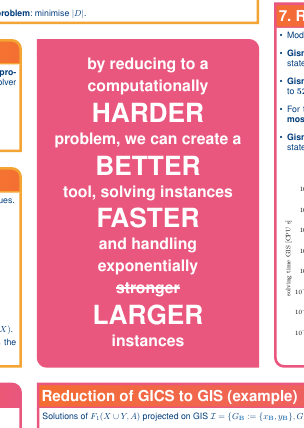
Hi fellow academics! I was wondering if y'all can give me some feedback on the poster I am working on for IJCAI (https://ijcai-23.org/)? I'm playing a bit with the design and how to make it attractive.

I'm attaching two screenshots. My questions are about the big eye-catcher in the middle. If you have a minute, can you please let me know what you think?

1. Do you get the reference?
2. Does the effort to make the reference distract you?
3. Do you think that the text in the big pink box has NSFW vibes?
4. Does the text in the big pink box help to pique your interest in the poster?

Thanks!

#AcademicMastodon #conference #IJCAI #IJCAI2023 #BooleanSatisfiability #AI #ArtificialIntelligence #NetworkScience #LaTeX #poster #AcademicChatter #ConstraintOptimisation #ConstraintProgramming #GraphicDesignIsMyPassion #PostdocLife

IJCAI 2023 – Macao

Inquiry Into Inquiry • On Initiative 1
https://inquiryintoinquiry.com/2022/07/10/inquiry-into-inquiry-on-initiative-1/

Re: R.J. Lipton and K.W. Regan • Sorting and Proving
https://rjlipton.wpcomstaging.com/2022/06/13/sorting-and-proving/

❝GPT‑3 works by playing a game of “guess the next word” in a phrase.
This is akin to “guess the next move” in chess and other games, and
we will have more to say about it.❞

My Observation —
https://rjlipton.wpcomstaging.com/2022/06/13/sorting-and-proving/#comment-119056

As a person who struggles on a daily basis to rise to the level of sentience
I've learned it has more to do with beginning than ending this sentence.

Resources —

Survey of Inquiry Driven Systems
https://inquiryintoinquiry.com/2023/04/23/survey-of-inquiry-driven-systems-5/

Survey of Theme One Program
https://inquiryintoinquiry.com/2023/03/30/survey-of-theme-one-program-5/

#Peirce #Logic #Inquiry #InquiryDrivenSystems #InquiryIntoInquiry
#BooleanSatisfiability #ComputationalComplexity #GödelsLostLetter
#AbductionDeductionInduction #IntelligentSystems #GPT #LLM #SAT

Inquiry Into Inquiry • On Initiative 1

Inquiry Into Inquiry

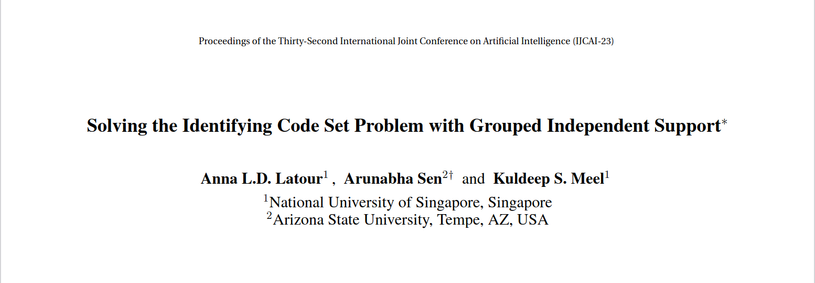
Very happy that our paper "Solving the Identifying Code Set Problem with Grouped Independent Support" was accepted to IJCAI 2023!

I did this work together with Prof. Kuldeep Meel and from NUS and Prof. Arunabha Sen from ASU. It was a great pleasure to work with them, and I learned a lot from both of them during this project. We have some ideas for further research, so I hope this story is to be continued...

Shout-out and many thanks to @msoos for his last-minute help to fix a bug in the code!

This is my first accepted conference paper that I worked on without my PhD advisor Dr. Siegfried Nijssen Dr. Behrouz Babaki. It felt a little bit weird doing this without them, but I guess that's part of the job.

Many thanks to everyone who contributed to this work in conversation, encouragement, feedback, or just simply making our office a nice place to work at 🙂

If you're planning to attend IJCAI in Macau, and want to meet up, let me know!

#IJCAI #IJCAI2023 #AcademicMastodon #AcademicChatter #PostdocLife #ArtificialIntelligence #AI #CombinatorialOptimisation #BooleanSatisfiability

Survey of Theme One Program
https://inquiryintoinquiry.com/2023/03/30/survey-of-theme-one-program-5/

This is a Survey of resources for the Theme One Program I worked on all through the 1980s. The aim was to develop fundamental algorithms and data structures for integrating empirical learning with logical reasoning. I had earlier developed separate programs for basic components of those tasks, namely, 2-level formal language learning and propositional constraint satisfaction, the latter using an extension of C.S. Peirce's logical graphs as a syntax for propositional logic. Thus arose the question of how well it might be possible to get “empiricist” and “rationalist” modes of operation to cooperate. The long-term vision is the design and implementation of an Automated Research Tool able to double as a platform for Inquiry Driven Education.

Please follow the above link for the full set of resources. An initial sample is linked below.

Wiki Hub —

Theme One Program • Overview
https://oeis.org/wiki/Theme_One_Program_%E2%80%A2_Overview

Documentation —

Theme One Program • Pascal Source Code
https://www.academia.edu/5210987/Theme_One_Program_Pascal_Source_Code

Theme One Program • User Guide
https://www.academia.edu/5211369/Theme_One_Program_User_Guide

Theme One Program • Exposition
https://oeis.org/wiki/Theme_One_Program_%E2%80%A2_Exposition

Applications —

Applications of a Propositional Calculator • Constraint Satisfaction Problems
https://www.academia.edu/4727842/Applications_of_a_Propositional_Calculator_Constraint_Satisfaction_Problems

Exploratory Qualitative Analysis of Sequential Observation Data
https://oeis.org/wiki/User:Jon_Awbrey/Exploratory_Qualitative_Analysis_of_Sequential_Observation_Data

References —

An Architecture for Inquiry • Building Computer Platforms for Discovery
https://www.academia.edu/1270327/An_Architecture_for_Inquiry_Building_Computer_Platforms_for_Discovery

Exploring Research Data Interactively • Theme One : A Program of Inquiry
https://www.academia.edu/1272839/Exploring_Research_Data_Interactively._Theme_One_A_Program_of_Inquiry

#Peirce #Logic #LogicalGraphs #ThemeOneProgram #IdeaProcessor
#BooleanSatisfiability #CactusLanguage #DeclarativeProgramming

Survey of Theme One Program • 5

Inquiry Into Inquiry