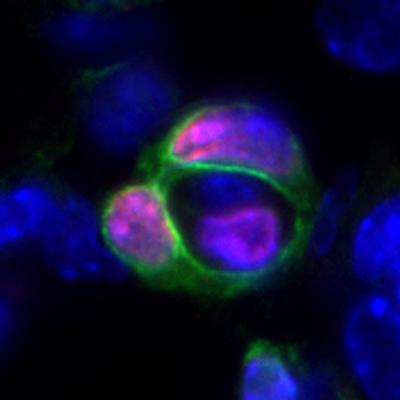
💪 Could one molecular “typo” break the balance between strength and flexibility in our muscles?

🔗 Dynamical features of smooth muscle actin pathological mutants: The arginine-257(258)-Cysteine cases. Computational and Structural Biotechnology Journal, DOI: https://doi.org/10.1016/j.csbj.2025.02.010

📚 CSBJ: https://www.csbj.org/

#ComputationalBiology #MolecularDynamics #ProteinScience #Actin #RareDiseases #PrecisionMedicine #Biophysics #CryoEM #Bioinformatics #DrugDiscovery #VisceralMyopathy #AorticAneurysm


I am a cardiologist and I want you to know what really causes sudden deaths such as aortic aneurysms and dissections

Editor’s Note: In this fortnightly column, top doctors share how they deal with their own health challenges, offering…
#NewsBeep #News #Headlines #aorticaneurysm #aorticdissection #cardiovascularsurgery #geneticrisk #Heartattack #heart-disease #India #Latvia #LV #screening #silentthreat #Suddendeath
https://www.newsbeep.com/203211/

Cardiology Followup Results

Today, I saw a new cardiologist.

An Aging Trans Woman

CRISPR-activated Oct4 as #GeneTherapy for #Progeria (LmnaC698G) & natural aged🐭
#HutchinsonGilfordProgeriaSyndrome

Polyethylenimine-cationic gold nanoparticle iv.

Do we need an aortotropic vector for #AorticAneurysm?

Dr. Jongpil Kim lab @AgingCell 2023
https://onlinelibrary.wiley.com/doi/10.1111/acel.13825

Through Oct4 expression is only transiently activated for 2 weeks in 50% aortic SMCs (by day 5 delivery) in progeria mice, but with an amazing long-lasting benefits on SMC vitality, arterial stiffness, progerin, multi-organ ( kidney, spleen, muscle, lung, and skin) senescence transcriptional profile, lifespan w/o apparent dysplasia

#Cohesinopathy

BRD4 (acetyl lysine reader)-NIPBL (cohesin loading ) complex is critical to #NeuralCrest differentiation into #SmoothMuscleCell

BRD4 depletion->⏬#GenomeFolding+loop extrusion

BRD4 in #AorticAneurysm?

Dr. Rajan Jain lab Nature Genet 2021
https://www.nature.com/articles/s41588-021-00934-8

BRD4 orchestrates genome folding to promote neural crest differentiation - Nature Genetics

Depletion of BRD4 reduces the chromatin occupancy of NIPBL, resulting in aberrant genome folding. Loss of BRD4 impedes neural crest differentiation, which can be rescued by depletion of WAPL.

Nature

Thoracic #AorticDissection (type A+B) in Nova Scotia, Canada🇨🇦2005-2015

382 scheduled thoracic #AorticAneurysm repair
294♂️vs 88♀️

345 dissection events
212♂️vs 133♀️
4.4 vs 2.4 per 10,000 person-years🧐

Dr. Claudia Cote lab #CJCOpen 2022
https://www.cjcopen.ca/article/S2589-790X(22)00176-7/fulltext

Decoupling #TGFβ1 with phospho-SMAD2 (S457) & phospho-SMAD3 (S423/425) in ascending #AorticAneurysm with #BicuspidAorticValve or #UnicuspidAorticValve

How about TGFβ2/3?

As a comparison, in #TricuspidAorticValve aorta, diameter and elastin break correlate well with increased TGFβ1 level or p-SMAD2/3 levels

Dr. Brittany Balint & Hans-Joachim Schäfers lab, Sci Rep 2022
https://www.nature.com/articles/s41598-022-19335-w

SMAD3 contributes to ascending aortic dilatation independent of transforming growth factor-beta in bicuspid and unicuspid aortic valve disease - Scientific Reports

We sought to determine whether there are differences in transforming growth factor-beta (TGFß) signaling in aneurysms associated with bicuspid (BAV) and unicuspid (UAV) aortic valves versus normal aortic valves. Ascending aortic aneurysms are frequently associated with BAV and UAV. The mechanisms are not yet clearly defined, but similarities to transforming growth factor-beta TGFß vasculopathies (i.e. Marfan, Loeys-Dietz syndromes) are reported. Non-dilated (ND) and aneurysmal (D) ascending aortic tissue was collected intra-operatively from individuals with a TAV (N = 10ND, 10D), BAV (N = 7ND, 8D) or UAV (N = 7ND, 8D). TGFß signaling and aortic remodeling were assessed through immuno-assays and histological analyses. TGFß1 was increased in BAV/UAV-ND aortas versus TAV (P = 0.02 and 0.04, respectively). Interestingly, TGFß1 increased with dilatation in TAV (P = 0.03) and decreased in BAV/UAV (P = 0.001). In TAV, SMAD2 and SMAD3 phosphorylation (pSMAD2, pSMAD3) increased with dilatation (all P = 0.04) and with TGFß1 concentration (P = 0.04 and 0.03). No relationship between TGFß1 and pSMAD2 or pSMAD3 was observed for BAV/UAV (all P > 0.05). pSMAD3 increased with dilatation in BAV/UAV aortas (P = 0.01), whereas no relationship with pSMAD2 was observed (P = 0.56). Elastin breaks increased with dilatation in all groups (all P < 0.05). In TAV, elastin degradation correlated with TGFß1, pSMAD2 and pSMAD3 (all P < 0.05), whereas in BAV and UAV aortas, elastin degradation correlated only with pSMAD3 (P = 0.0007). TGFß signaling through SMAD2/SMAD3 contributes to aortic remodeling in TAV, whereas TGFß-independent activation of SMAD3 may underlie aneurysm formation in BAV/UAV aortas. Therefore, SMAD3 should be further investigated as a therapeutic target against ascending aortic dilatation in general, and particularly in BAV/UAV patients.

Nature

Phospholipase Cε #Aortopathy

Plce1 KO🐭 are susceptible to ANGII-induced ascending #AorticAneurysm+Dissection

Role of adventitial myofibroblast cytokines?😎

Dr. Alan Smrcka, Santhi Ganesh, Markus Bitzer labs AJP Heart Circ 2022
https://journals.physiology.org/doi/abs/10.1152/ajpheart.00262.2022

Phospholipase Cε Insufficiency Causes Ascending Aortic Aneurysm and Dissection | American Journal of Physiology-Heart and Circulatory Physiology

Phospholipase Cε (PLCε) is a phospholipase C isoform with a wide range of physiologic functions. It has been implicated in aortic valve disorders but its role in frequently associated aortic disease remains unclear. To determine the role of PLCε in thoracic aortic aneurysm and dissection (TAAD) we used PLCε deficient mice which develop aortic valve insufficiency and also exhibit aortic dilation of the ascending thoracic aorta and arch without histopathological evidence of injury. Fourteen days of infusion of Plce1+/+ and Plce1-/- mice with angiotensin II (Ang II), which induces aortic dilation and dissection, lead to sudden death secondary to ascending aortic dissection in 43% of Plce1-/- versus 5% of Plce1+/+ mice (p<0.05). Medial degeneration and TAAD were detected in 80% of Plce1-/- compared to 10% of Plce1+/+ mice (p<0.05) after four days of Ang II. Treatment with Ang II markedly increased PLCε expression within the ascending aortic adventitia. RNA sequencing of ascending aorta tissue prior to aortic rupture demonstrated marked increased expression of pro-inflammatory and fibrotic signaling pathways, as well as upstream regulators interleukin-1β, interleukin-6, and tumor necrosis factor-α in Plce1-/- mice. In silico analysis of whole-exome sequences of 258 patients with Type A dissection identified 5 patients with non-synonymous PLCE1 variants. Our data suggest PLCε as a novel regulator in the development of TAAD and aortic insufficiency.

American Journal of Physiology-Heart and Circulatory Physiology
Large study of thoracic aortic aneurysm backs guidelines

A large, new Kaiser Permanente study provides high-quality evidence that most of the 33,000 patients diagnosed each year in the U.S. with a thoracic aortic aneurysm—a bulge in the part of the main artery that runs through the chest—are not likely to experience an aortic dissection and may not need open-heart surgery.

Medical Xpress